
You may have felt it: you’ve spent years studying grammar rules, memorising vocabulary lists, and reading English books. But the moment you speak English in a real conversation, your brain freezes. You translate every sentence word-for-word in your head, trip over your pronunciation, and sound far less intelligent than you actually are.
Learning English vocabulary and grammar does not automatically make speaking easy. Speaking requires you to process language and coordinate pronunciation, rhythm, stress, and timing in real time.
If you want to speak fluent, natural English from the comfort of your home—without a native speaker or paying for expensive tutors—you need a technique that trains you directly.
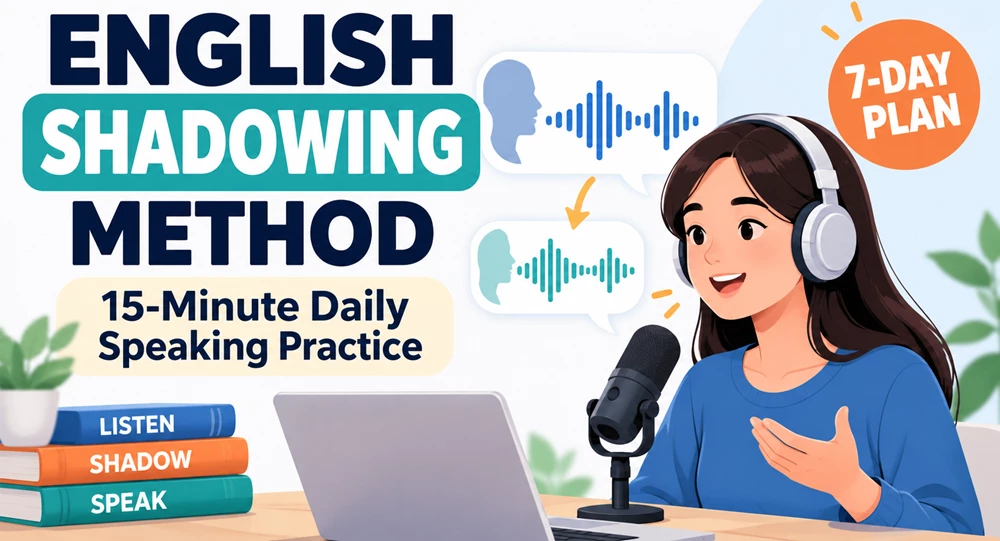
Enter the Shadowing Method. Here is a 15-minute daily routine to master the method with native speed, rhythm, and confidence.
What Is the Shadowing Method? (And Why It Works)
At its core, shadowing is a technique where you listen to a native speaker and repeat what they say in real time with a tiny delay (usually a fraction of a second)—just like an echo or a shadow.
In the shadowing method, you speak simultaneously alongside the speaker rather than listening to a full sentence, stopping the recording, and repeating it.
Why Is It So Effective?
It is effective because it:
Builds Speech Muscle Memory: Speaking a foreign language requires your tongue, lips, and throat to move in its way. Shadowing acts as a daily workout for these vocal muscles.
Improves Intonation & Rhythm: English is a stress-timed language. Shadowing trains you to naturally pick up connected speech, pitch changes, and natural pauses without having to study dry phonetic rules.
Reduces Mental Translation: Because you are speaking almost instantly, your brain doesn’t have time to translate from your native language. You learn to process and produce English directly.
Distinction: Shadowing vs. Repeating
In repeating, you:
Listen → pause → speak.
But in shadowing, you:
Listen → speak along with the speaker with a very short delay.
The 15-Minute Daily Shadowing Routine (Step-by-Step)
You don’t need hours of free time to see results from shadowing. You just need 15 focused minutes every day. Here is how to structure your daily session:
+-----------------------------------------------------------------------+
| 15-MINUTE SHADOWING ROUTINE                                           |
+-----------------------------------------------------------------------+
| 00:00 - 02:00 (2 mins)  | Step 1: Select a 30-60s Native Audio/Video Clip   |
| 02:00 - 05:00 (3 mins)  | Step 2: Listen Once with Transcript           |
| 05:00 - 10:00 (5 mins)  | Step 3: Shadow WITH Text (Build Mechanics)    |
| 10:00 - 15:00 (5 mins)  | Step 4: Blind Shadowing WITHOUT Text          |
+-----------------------------------------------------------------------+
Do I repeat the 30-second clip once or ten times?
For a 30–60 second clip:
- listen 1–2 times
- shadow with transcript 2–4 times
- shadow without transcript 2–4 times
- record one final attempt
Below, the steps are in more detail.
Step 1: Choose the Right Audio Material (2 Minutes)
Select a short audio or video clip—30 to 60 seconds maximum. Look for a clear clip from a native speaker with transcripts or subtitles.
Great Sources: TED Talks, short podcast clips (like BBC 6 Minute English), interviews, or audiobooks. You can easily search for such a clip on YouTube or Google.
Based on your English level, choose a clip that is:
- Beginner: slow learner dialogue with a transcript
- Elementary/intermediate: clear everyday conversation
- Upper-intermediate: natural interviews, podcasts or educational videos
- Advanced: natural-speed interviews, speeches or discussions
Note: If you can’t find short audio/video clips, you can start with a clip of any length. Use the Play → Shadow → Replay technique for a part of the clip.
Step 2: Listen and Understand (3 Minutes)
In this step, listen to your chosen clip once while reading the transcript. Make sure you understand the general context, key vocabulary, and emotional tone of the speaker.
Step 3: Shadow With Text (5 Minutes)
Play the audio and read along out loud, mirroring the speaker’s voice as closely as possible.
Focus on matching their speed, volume, stress points, and pauses.
Don’t worry if you miss a word or stumble at first; just keep going!
During this shadowing step, pay attention to the speaker:
- Word stress — which syllables sound stronger?
- Sentence stress — which words receive emphasis?
- Connected speech — how do words blend together?
- Reduced sounds — which sounds become weaker?
- Rhythm — how are stressed and unstressed parts distributed?
- Intonation — does the speaker’s pitch rise, fall, or change?
Step 4: Blind Shadowing—No Text (5 Minutes)
Put the transcript away in this step. Now, use only your ears to hear the words. Play the clip again and shadow the speaker.
Pro-Tip: Use your phone to record your final run-through. Listen back to your recording and compare it with the original audio to spot areas for improvement.
A Worked Example: How to Shadow an English Sentence
Let’s practice the steps of the shadowing method. For now, imagine you are listening to an audio or video clip. Let’s take this simple sentence as a speaker says:
“I wanted to ask you about the meeting.”
Step 1: Listen for Meaning
First, just listen to the sentence to understand what the speaker is saying.
“I wanted to ask you about the meeting.”
Do not worry about copying the pronunciation yet. Focus on understanding the message.
Step 2: Notice the Stress
Listen again and identify the words that receive the most emphasis.
I wanted to ASK you about the MEETing.
The speaker may give less emphasis to words such as I, to, you, and the, while important words carry more stress.
Step 3: Notice Connected Speech
Now listen to how the words flow together rather than treating every word as a separate unit.
You may hear something closer to:
“I wanted to ask you about the meeting.”
In natural speech, some words may sound weaker or connect neighbouring words. Your goal is not to force yourself to pronounce every word exactly this way. Instead, notice how the speaker connects the words.
Step 4: Shadow With the Transcript
Play the sentence again and begin speaking along with the speaker with only a very short delay.
Try to copy:
the speaker’s pace
word and sentence stress
pauses
intonation
connected speech
If you miss a word, keep going rather than stopping the clip.
Step 5: Shadow Without the Transcript
Put the transcript away (or don’t look at it) and play the sentence again.
Now try to reproduce the speaker’s rhythm and pronunciation using only what you hear.
Don’t aim for a perfect imitation. Concentrate on staying with the speaker and reproducing the overall pattern of the sentence.
Step 6: Record Yourself
Finally, record your own shadowing attempt and listen to it alongside the original.
And check:
Am I stressing the same important words?
Am I keeping the same rhythm?
Am I pausing in similar places?
Am I speaking smoothly instead of stopping after every word?
This simple comparison can help you identify specific aspects of your spoken English that you can work on during your next practice session.
Remember: The purpose of shadowing is not simply to repeat English sentences. It is to train yourself to listen closely and reproduce the speaker’s pronunciation, rhythm, stress, and intonation in real time.
Shadowing self-check
After your recording, ask:
- Did I stay with the speaker?
- Did I pronounce the stressed words clearly?
- Did I copy the speaker’s pauses?
- Did I imitate the intonation?
- Did I keep speaking after missing a word?
- Could I follow the clip without reading the transcript?
If yes, your shadowing practice is on the right track.
What can shadowing not do?
Research supports shadowing as a pronunciation/speaking practice technique for developing fluency, but it can’t be a complete English-learning system.
Shadowing does not replace areas like:
- vocabulary development
- grammar practice
- spontaneous conversation
- writing
- comprehension practice
- feedback from a teacher or proficient speaker
But from my experience, shadowing helped me follow the way native speakers speak and gain English speaking confidence. If you need vocabulary development, you should study it extra.
Common Mistakes to Avoid
To get the maximum benefits out of your 15 minutes during shadowing, avoid these common mistakes:
Using Material That Is Too Long or Fast: Working with a 20-minute video will overwhelm you. Stick to short, 30–60 second snippets for your training.
Focusing Only on Individual Words: Don’t focus solely on clear word pronunciation. Pay attention to how words link together (e.g., how “What do you want to do?” often sounds like “Whadya wanna do?”).
Mumbling Under Your Breath: Speak out loud with your full voice.
Skipping the Self-Recording: It might feel uncomfortable to hear your own voice at first, but recording yourself is an easy way to track your progress and fix pronunciation errors.
“Whadya wanna do?” above is just an example of how connected speech may sound in casual conversation; you don’t need to imitate. But what you should do is understand the pattern.
7-Day English Shadowing Practice Plan
| Day | Main Focus | What to Practice |
|---|---|---|
| Day 1 | Getting Started | Following the speaker and becoming comfortable speaking while listening. |
| Day 2 | Word Stress | Notice and reproduce stressed syllables and important words. |
| Day 3 | Sentence Rhythm | Practice the natural flow of stressed and unstressed words. |
| Day 4 | Connected Speech | Notice how words connect and sounds change in natural speech. |
| Day 5 | Intonation | Copy the speaker's rising and falling pitch and expressive tone. |
| Day 6 | Natural Speed | Develop fluency and timing by shadowing at natural speaking speed. |
| Day 7 | Review & Self-Assessment | Record yourself, compare your speech with the original, and identify areas to improve. |
Frequently Asked Questions
How long does it take to see results from shadowing?
Progress varies by learner, starting level, practice consistency, and the type of material used. With regular practice, you may notice improvements in pronunciation, rhythm, listening-to-speaking coordination, or confidence, but there is no fixed number of days that applies to everyone.
Is shadowing better than talking to a native speaker?
They train different skill sets! Shadowing builds accuracy, accent control, vocabulary absorption, and muscle memory. Live conversation with a native speaker trains spontaneous thinking and real-time interaction. Combining both gives you the best results.
Should complete beginners use the shadowing method?
Beginners can use shadowing, but they should start with slow, simple dialogues (such as audio from language learning courses). Intermediate to advanced learners will benefit most from natural, native-speed audio/video.
Start Your 15-Minute Habit Today!
Fluency isn’t a secret for talented people—anyone can build the skill through a deliberate daily habit. With 15 minutes of shadowing in your daily routine, you can move from knowing English to actually speaking it easily.
What short video or podcast clip are you going to use for your shadowing session? Share the link to a good clip you use or ideas in the comments below!
Research and Sources
This article draws on research on shadowing and second-language pronunciation:
Whitworth, B., & Rose, H. (2025). A Systematic Review of Research on the Use of Shadowing for Second Language Pronunciation Teaching. The review examined 44 studies and found evidence that shadowing can support comprehensibility, intelligibility, accentedness, fluency, and aspects of prosody such as rhythm and intonation. Read the systematic review
Hamada, Y. Shadowing: Who, How, and What? It examined shadowing as a technique for developing listening and pronunciation-related skills in second-language learners.
Kehoe-Seamons, M., Tanner, M., Hartshorn, K. J., & Martinsen, R. (2026). The Effect of Text Shadowing on English Language Learners’ Pronunciation Development: A Quasi-Experimental Study. This 10-week study reported improvements in fluency and comprehensibility over time, while finding no statistically significant difference between the treatment and control groups across the measured outcomes. Read the study
Articles and guides that help improve spoken English:
- Question Tag Rules English Learners Often Get Wrong
- How to Stop Translating from Hindi to English
- Recommended Spoken English Courses
For beginners from a Hindi background, read the free eBook Real-World Spoken English: 50+ Daily Situations to Speak English Confidently.
