
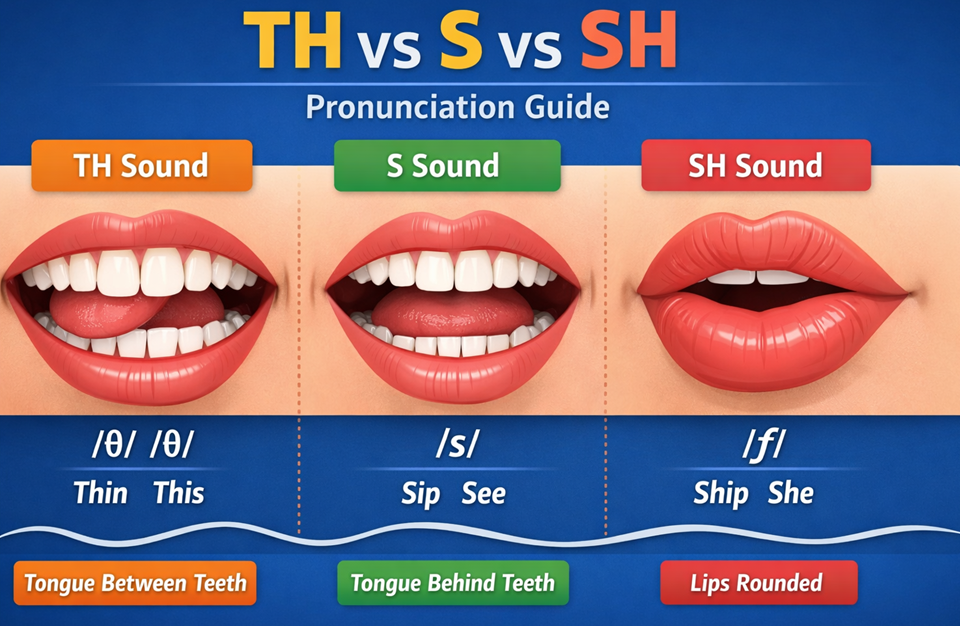
TL;DR:
Many Indian learners struggle with the “Th” (/θ/, /ð/) and “S/Sh” (/s/, /ʃ/) sounds because these sounds do not exist in most Indian languages.
As a result, words like “think” may sound like “tink” and “sip” may sound like “ship.”
The key to improvement is learning the correct tongue placement—for example, gently placing the tongue between the teeth for the “th” sound.
With simple daily practice drills (5–10 minutes) such as mirror practice and minimal-pair exercises, learners can noticeably improve their pronunciation within a few weeks.
English pronunciation can be a minefield, especially when your native language has a completely different phonetic structure. For many Indian learners, two of the most frustrating sounds to master are the “Th” (as in Think or This) and the “S” vs. “Sh” distinction (as in Sip vs. Ship).
We, at 99Learners, believe that clear pronunciation is not about “losing your accent,” but about clarity and confidence. In this guide, we’ll break down why these sounds are difficult for the Indian tongue and give you the physical exercises to fix them.
1. The “Th” Problem: Dental vs. Interdental
In many Indian languages (like Hindi, Bengali, or Tamil), we have “dental” sounds where the tongue touches the back of the upper teeth. However, the English “Th” is interdental.
The Mistake
Most Indian learners replace the English “Th” with a “D” or “T” sound.
- Thinking becomes Tinking.
- This becomes Dis.
The Fix: The “Tongue Sandwich”
To make a proper English “Th,” your tongue must actually come between your teeth.
- Place the tip of your tongue between your front teeth.
- Blow air out gently. You should feel the air vibrating between your tongue and your upper teeth.
Practice: Say the word “Thin” slowly, making sure you can see your tongue in the mirror.
2. The “S” vs. “Sh” Confusion
Depending on which part of India you are from, you might find yourself swapping the “S” and “Sh” sounds. In some regions, Station becomes S-tation, while in others, Seven becomes Sheven.
The Difference in Mechanics
The “S” Sound (Alveolar): Your tongue should be near the roof of your mouth, but not touching it. The air should hiss through a small gap. Think of the sound a snake makes: Ssssss.
The “Sh” Sound (Post-alveolar): Your tongue moves slightly further back, and your lips should “pucker” or round out slightly. Think of the sound you make when asking someone to be quiet: Shhhhh.
| Word A (S) | Word B (Sh) |
| Sip | Ship |
| Seat | Sheet |
| Sell | Shell |
| Sort | Short |
3. The “V” and “W” Mix-up
While not in the title, this is the third pillar of Indian pronunciation challenges.
V (as in Van): Your top teeth must touch your bottom lip. (Friction sound).
W (as in Watch): Your teeth should not touch anything. Your lips should form a small circle. (Gliding sound).
4. Daily Mouth Exercises for Clarity
The muscles in your mouth need training, just like any other muscle. Practice these for 2 minutes every morning:
The Th-Slide: Slide your tongue in and out of your teeth while blowing air. Th-th-th-th.
The Snake to Librarian: Switch between “S” and “Sh” rapidly. Ssss-Shhh-Ssss-Shhh.
Tongue Twisters:
- “She sells seashells by the seashore.”
- “The thin thief thought thirty thoughts.”
5. Why Does This Matter for 2026?
In the age of global remote work and AI-driven voice recognition, clear pronunciation ensures that:
Voice-to-Text AI (like Gemini or Siri) understands you perfectly.
International Clients on Zoom or Teams can follow your ideas without effort.
IELTS/TOEFL Examiners give you the high “Speaking” band you deserve.
Can You Master the "Th" and "S" Sounds?
Which word requires you to place your tongue between your teeth (the "Tongue Sandwich")?
Answer: Think. Explanation: The “th” in “Think” is an interdental sound. If your tongue stays behind your teeth, it will sound like “Tink.”
True or False: The 'W' sound in "Watch" requires your teeth to touch your lip.
Answer: False. Explanation: If your teeth touch your lip, you are making a “V” sound (Van). For “W,” your lips should be rounded like a small circle without touching your teeth.
If you say "Sea" and it sounds like "She," what is the mechanical error?
Answer: Your tongue is too far back. Explanation: For the “S” sound, your tongue should be forward, near the ridge behind your upper teeth. If you pull it back and pucker your lips, it becomes “Sh.”
Which of these is a "Voiced" sound (where your throat vibrates)?
Answer: This. Explanation: Put your hand on your throat. When you say “This,” you should feel a vibration. When you say “Think,” you should only feel air.
Which word is the correct "Minimal Pair" for "Sip"?
Answer: Ship. Explanation: A minimal pair is a word that sounds the same except for one sound. Switching “S” for “Sh” changes “Sip” (drinking) to “Ship” (a large boat).
When making the "Sh" sound (like a librarian), what should your lips do?
Answer: Pucker or round out slightly. Explanation: Rounding the lips creates the correct space for the “Sh” sound to resonate.
Why do many Indian learners say "Dis" instead of "This"?
Answer: Mother Tongue Influence (MTI). Explanation: Most Indian languages have a dental “D” but no interdental “Th,” so the brain automatically substitutes the “D” sound.
In the word "Breath" (Noun), is the "Th" voiced or voiceless?
Answer: Voiceless. Explanation: It is just air. However, in the verb “Breathe,” the “Th” becomes voiced (vibrating).
Which sound is compared to a "Snake's Hiss"?
Answer: The “S” sound. Explanation: The “S” sound is a continuous stream of air passing through a narrow gap between your tongue and the roof of your mouth.
Which of these sounds requires you to blow air out while your tongue is between your teeth?
Answer: The “Th” sound. Explanation: Unlike “T” or “D,” which are “stop” sounds (blocking air), the “Th” is a “fricative,” meaning the air must keep flowing.