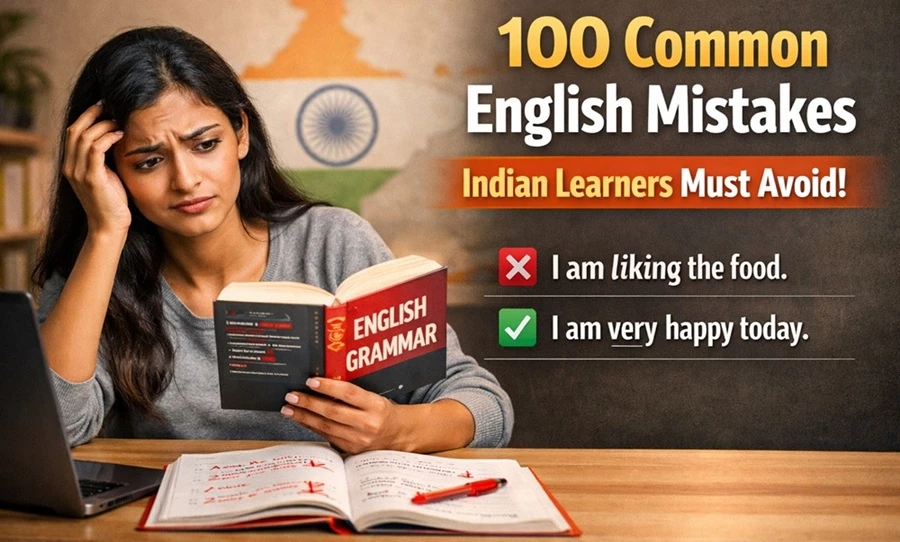
For many Indian learners, English is a second or even third language. Because we often think in our mother tongue and then translate those thoughts into English, we develop unique habits known as “Indianisms.” While these are perfectly understood within India, they can lead to lower scores in competitive exams and confusion in global business settings. On this page, I discuss 100 common English mistakes made by Indians to help correct them.
At 99Learners, we have analyzed thousands of student essays (also in our classroom) to compile this master list. If you can fix these 100 errors, your fluency will instantly move to an advanced level.
100 Common English Mistakes Made By Indians
1. The “Continuous Tense” Trap
In many Indian languages, we use the continuous form (“-ing”) to describe states of being or possession. In English, these are “stative verbs” and should remain in the simple present. Here are 5 examples:
| ❌ The Mistake (Incorrect) | ✅ The Correction (Correct) | Why it Happens |
|---|---|---|
| I am having two brothers. | I have two brothers. | Literal translation of “Mere do bhai hain.” |
| Are you liking the food? | Do you like the food? | Using “-ing” for a permanent feeling. |
| I am knowing the answer. | I know the answer. | “Know” is a state, not an action. |
| She is wanting a coffee. | She wants a coffee. | Desires are stative verbs. |
| I am understanding you. | I understand you. | Understanding is a mental state. |
⇒ Take this Tense Quiz.
2. Redundancy: Saying the Same Thing Twice
Indian English often adds extra words that aren’t needed. Removing these makes your writing “crisp”—a quality examiners love.
Revert back: “Revert” already means to go back. Say: “Please revert by Monday.”
Return back: Use: “When will you return?”
Cope up: “Cope” is followed by “with.” Use: “I can’t cope with the pressure.”
Discuss about: “Discuss” already implies “about.” Say: “Let’s discuss the project.”
Blunder mistake: A blunder is a big mistake. Use: “It was a blunder.”
3. Preposition Pitfalls
Prepositions are the “glue” of English, but they are often misplaced by Indian speakers.
| Category | ❌ Incorrect | ✅ Correct |
|---|---|---|
| Time | What is the time in your watch? | What is the time on your watch? |
| Travel | I came to office by walk. | I came to office on foot. |
| Marriage | He is married with a doctor. | He is married to a doctor. |
| Orders | I ordered for a pizza. | I ordered a pizza. |
| Listening | Please listen me. | Please listen to me. |
⇒ Take this Preposition Test.
4. Subject-Verb Agreement (The IELTS Killer)
As discussed in our previous guide, the subject must match the verb. Here are the most common “hidden” errors you should care about:
Incorrect: One of my friend is coming. -> Correct: One of my friends is coming. (You have many friends, but only one is coming).
Incorrect: The news are shocking. -> Correct: The news is shocking. (“News” is uncountable and singular).
Incorrect: Everyone have finished. -> Correct: Everyone has finished.
Incorrect: Does she has a car? -> Correct: Does she have a car? (After “does,” always use the base verb “have”).
Incorrect: Politics are a dirty game. -> Correct: Politics is a dirty game.
5. Vocabulary: Indianisms vs. Global English
These terms are common in India but might confuse a native speaker in London or New York.
| Indianism | 🌍 Global English Alternative |
|---|---|
| “Passed out” of college | Graduated from college (To “pass out” means to faint!) |
| Give me your “Good name“ | May I have your name? |
| I’ll “prepone” the meeting | I’ll bring the meeting forward |
| “Out of station“ | Out of town / Away |
| “Do the needful“ | Take the necessary action |
6. Question Formation
A very common error is using statement word order for a question.
Incorrect: You are coming tomorrow? -> Correct: Are you coming tomorrow?
Incorrect: Why you are late? -> Correct: Why are you late?
Incorrect: Where I can find a taxi? -> Correct: Where can I find a taxi?
Incorrect: What he is doing? -> Correct: What is he doing?
Incorrect: He is your brother, no? -> Correct: He is your brother, isn’t he? (Using “no” or “na” as a tag is a major Indianism).
7. The “Only” Obsession
Indian speakers often use “only” for emphasis at the end of a sentence (a direct translation from the Hindi hi).
Incorrect: I live here only. -> Correct: I live right here.
Incorrect: I will do it today only. -> Correct: I will do it today.
Incorrect: That only I was saying! -> Correct: That is exactly what I was saying.
8. Article Errors (A, An, The)
Articles are often omitted or overused in Indian English because our native languages handle nouns differently.
| # | ❌ Incorrect | ✅ Correct | Why it’s a mistake |
|---|---|---|---|
| 34 | I am going to the Mumbai. | I am going to Mumbai. | Never use “the” before names of cities or people. |
| 35 | It is an unique opportunity. | It is a unique opportunity. | Though it starts with ‘U’, the sound is ‘Yoo’ (consonant sound), so use “a”. |
| 36 | He is a honest man. | He is an honest man. | ‘H’ is silent; the word begins with a vowel sound. |
| 37 | We need to buy a furniture. | We need to buy furniture. | Furniture is uncountable; you cannot use “a” before it. |
| 38 | She is best girl in class. | She is the best girl in class. | Always use “the” with superlative adjectives (best, tallest, highest). |
⇒ Take this Article Test.
9. Pronunciation & Spelling Confusion
These errors often occur because words are spelled one way but pronounced another (silent letters) or because they are “homophones” (sound the same but have different meanings).
Receipt (Ruh-SEET): Many pronounce the ‘P’. It is silent.
Wednesday (WENZ-day): Do not pronounce the ‘d’.
Debt (DET): The ‘b’ is silent.
Almond (AAH-mund): The ‘l’ is usually silent.
Their vs. There: Their is for people (their car); There is for place (Go there).
Principal vs. Principle: Your school has a Principal; a rule is a Principle.
Stationary vs. Stationery: Stationary means not moving; Stationery refers to pens and paper.
10. The “V” and “W” Swap
A classic Indian English error where the lips are not positioned correctly for the specific sound.
| # | The Sound | Mouth Position | Example Correction |
|---|---|---|---|
| 46 | V (Vine, Van) | Upper teeth touch the lower lip | Don’t say “Wine” when you mean “Vine.” |
| 47 | W (Wine, West) | Lips are rounded (like a kiss) | Don’t say “Vest” when you mean “West.” |
11. Redundant Tense & Helping Verbs
Incorrect: I did not saw him. -> Correct: I did not see him. (Always use the base verb after “did”).
Incorrect: We have reached yesterday. -> Correct: We reached yesterday. (Don’t use “have” with a specific past time).
Incorrect: He has been working here since 10 years. -> Correct: He has been working here for 10 years. (Use “for” for duration).
12. Preposition & Phrasal Verb Errors
Many Indian learners add extra prepositions where they aren’t needed or use the wrong “glue” to connect ideas.
| # | ❌ The Mistake (Incorrect) | ✅ The Correction (Correct) | Why it’s a mistake |
|---|---|---|---|
| 51 | Discussion about politics | Discussion on politics | “Discuss” is a verb, “Discussion” is a noun. Use ‘on’ with the noun. |
| 52 | I am too happy today. | I am very happy today. | “Too” implies negative excess (e.g., too hot). |
| 53 | Myself I am Ravi. | I am Ravi / My name is Ravi. | “Myself” is a reflexive pronoun, not a subject. |
| 54 | Although it rained but we went. | Although it rained, we went. | Do not use two conjunctions (although/but) together. |
| 55 | This is more better. | This is better. | “Better” is already comparative; do not add “more.” |
| 56 | According from me | According to me / In my opinion | Use “according to.” “In my opinion” is better for personal views. |
| 57 | Whom is calling? | Who is calling? | “Who” is the subject; “Whom” is the object. |
| 58 | It’s colour is blue. | Its colour is blue. | “It’s” means “it is.” “Its” shows possession. |
| 59 | Less people came today. | Fewer people came today. | Use “fewer” for countable nouns (people, apples). |
| 60 | Beside math, I like art. | Besides math, I like art. | “Beside” means next to; “Besides” means in addition to. |
⇒ Take this Phrasal Verb Quiz.
13. Common Indianisms & Social Slips
These are phrases that sound natural in Hindi or other regional languages but translate awkwardly into global English.
“He is having a headache”: Correct: He has a headache. (Physical states are not continuous).
“I will call you when I will arrive”: Correct: I will call you when I arrive. (Don’t use “will” twice in conditional sentences).
“Please repeat again”: Correct: Please repeat. (“Repeat” already means to do it again).
“He is my cousin brother”: Correct: He is my cousin. (In English, the gender is understood from the context or name).
“I look forward to meet you”: Correct: I look forward to meeting you. (The phrase always takes the “-ing” form).
“The staff is angry”: Correct: The staff are angry. (Use plural for collective nouns when members act individually).
“Suppose if it rains…”: Correct: Suppose it rains… (Choose one: “Suppose” or “If”).
“I know him from two years”: Correct: I have known him for two years.
“She drove fastly”: Correct: She drove fast. (“Fast” is both an adjective and an adverb).
“You’re going, no?”: Correct: You’re going, aren’t you? (Avoid using “no” or “na” as a question tag).
14. Advanced Word Choice & Context
“I have a doubt”: Correct: I have a question. (In global English, a “doubt” means you don’t believe someone).
“Open/Close the light”: Correct: Turn on/off the light. (You open doors, not electricity).
“Giving an exam”: Correct: Taking/Sitting for an exam. (The teacher gives the exam; the student takes it).
“Marriage anniversary”: Correct: Wedding anniversary. (Marriage is the state; the “wedding” is the event).
“I am a veg”: Correct: I am a vegetarian. (“Veg” is an adjective, not a noun for a person).
“Pick up the call”: Correct: Answer the phone.
“What is your good name?”: Correct: What is your name? (Literal translation of “Shubh naam”).
“I’m out of station”: Correct: I’m out of town / I’m away.
“Do the needful”: Correct: Please take the necessary action. (Considered dated/cliché in modern business).
“Kindly revert back”: Correct: Please reply / Please get back to me.
15. The Final 20: Quick Fixes for Fluency
“One of my friend”: Correct: One of my friends.
“I seen that”: Correct: I saw that / I have seen that.
“He don’t like it”: Correct: He doesn’t like it.
“Every students”: Correct: Every student. (“Every” is always followed by singular).
“Informations”: Correct: Information. (Uncountable).
“Loves to play the guitar”: Correct: Loves playing the guitar.
“She is married with…”: Correct: She is married to…
“Explain me the rule”: Correct: Explain the rule to me.
“I didn’t knew”: Correct: I didn’t know.
“Since 10 o’clock” (Correct for a point in time). “For 10 hours” (Correct for duration).
“I prefer tea than coffee”: Correct: I prefer tea to coffee.
“Years back”: Correct: Years ago.
“Cent percent”: Correct: One hundred percent / Absolutely.
“Eat my brain”: Correct: Annoy me / Pester me.
“Cut the call”: Correct: Hang up / Disconnect.
“Keep it on the table”: Correct: Put it on the table.
“Dress sense” (Correct). Avoid “Dressing sense.”
“I’m living here since 2010”: Correct: I have been living here since 2010.
“I had a dream” (Correct). Avoid “I saw a dream.”
“Last before year”: Correct: The year before last.
Even experts may make mistakes. These 100 common English mistakes will help you identify and correct your own errors. Practice makes perfect. Take our English quizzes and tests to identify your weak areas. Ask your teacher for help or study more with a book or course to improve your English.