
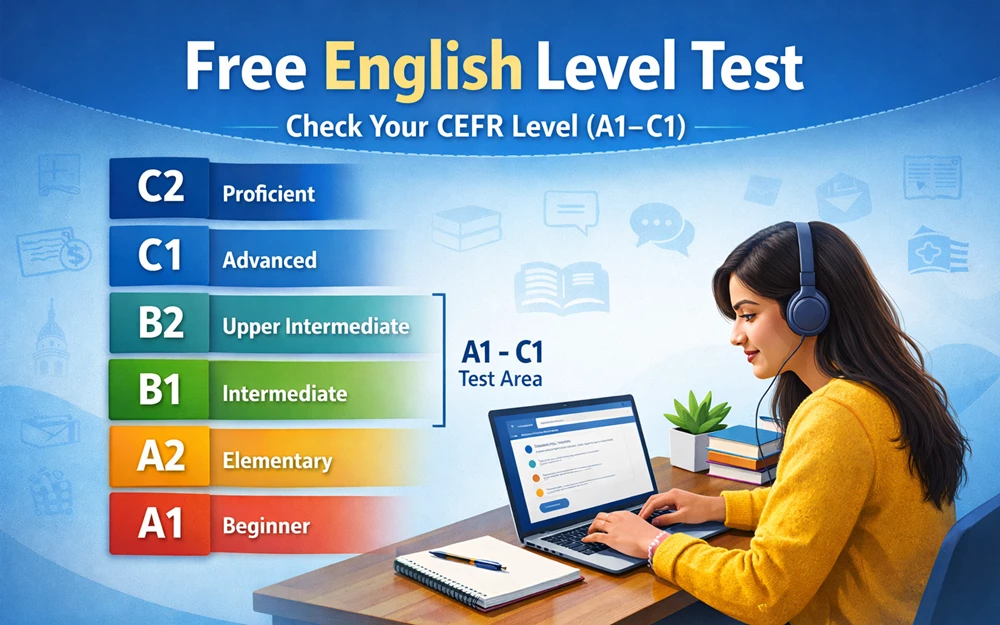
How Does This English Level Test Work?
This free English level test contains 40 multiple-choice questions designed to help you assess your knowledge of English grammar, vocabulary, sentence structure, and usage. It is intended for learners who want to identify gaps in their English knowledge before choosing suitable study materials.
Read each question carefully and select the answer you believe is correct. Complete the test independently, without a dictionary, translator, or outside assistance, to obtain a more useful picture of your current abilities.
After submitting your answers, review your score and the explanations provided. Use the results to identify topics that need more practice.
Please note: This is an informal English diagnostic test. It does not measure every language skill, such as speaking, listening, pronunciation, or extended writing, and it does not provide an official CEFR certificate.
Understanding the CEFR English Levels
The Common European Framework of Reference for Languages (CEFR) describes language proficiency using six main levels, from A1 (beginner) to C2 (proficient). These levels help learners understand what they can generally do with a language in real-life situations.
Level | Level description |
|---|---|
A1 – Beginner | Can understand and use familiar everyday expressions and simple phrases. |
A2 – Elementary | Can communicate in simple, routine situations involving familiar topics. |
B1 – Intermediate | Can understand the main points of clear language and deal with many familiar situations. |
B2 – Upper-intermediate | Can understand more complex texts and communicate with a degree of fluency. |
C1 – Advanced | Can use English flexibly and effectively for social, academic, and professional purposes. |
C2 – Proficient | Can understand virtually everything heard or read and express meaning precisely and fluently. |
These are broad descriptions, not pass marks for this particular quiz. A score from a short multiple-choice test cannot establish a learner’s full CEFR proficiency across all language skills.
The test takes about 15–20 minutes to complete and provides an instant CEFR level estimate at the end. Try to answer all questions within 20 minutes. You can use a timer.
Why take this test?
Before preparing for IELTS, TOEFL, or other English exams, it’s important to know where you currently stand. But it cannot predict an IELTS band score or TOEFL score. This will help you:
- Choose the right exam strategy
- Set realistic score goals
- Identify areas that need improvement
- Avoid wasting time on the wrong preparation level
Take the CEFR level checker test now and discover your English level in minutes.
English Level Test: 40 Questions
Assess your knowledge of English grammar, vocabulary, sentence structure and usage with this free multiple-choice test.
Before you begin
- Choose one answer for each question.
- Try to answer without a dictionary or translator.
- Submit all 40 answers to see your score and explanations.
- Review incorrect answers to identify topics for further study.
This is an informal educational quiz, not an official CEFR assessment. It does not test speaking, listening or extended writing.
Your English Practice Results
Use this result to plan your next steps. Your score reflects performance on these questions only.
Important: This score is not a validated CEFR placement result. It should not be interpreted as an official A1, A2, B1, B2, C1 or C2 level, or used to predict an IELTS or TOEFL score.
Topic performance
These scores show how you performed on the questions assigned to each topic. A topic with only a few questions may not represent your overall ability.
Review your answers
Read each explanation, especially where your answer differed from the correct answer.
Your answers are processed in this page. This widget does not send quiz responses to a server or save them in a database.
How to Use Your Test Results
Your result is a starting point for planning your learning, not a final judgment of your English ability.
If your result is A1 or A2: Practise basic sentence structure, common vocabulary, articles, prepositions, and everyday expressions.
If your result is B1: Work on verb tenses, conditionals, phrasal verbs, reading comprehension, and longer sentences.
If your result is B2: Focus on advanced grammar, collocations, nuanced vocabulary, and complex reading passages.
If your result is C1: Practise precise word choice, complex sentence patterns, idiomatic usage, and academic or professional English.
These are suggested study priorities, not a diagnosis of your individual weaknesses. Use your incorrect answers to decide which topics to study first.
If you are preparing for IELTS or TOEFL, read our articles, Click Here
Or, scroll down and see the books and courses shown: