If you find yourself constantly debating whether to say “I have seen that movie” or “I saw that movie,” you are not alone. This is arguably the most confusing distinction in English grammar for non-native speakers. After reading this article, you’ll understand the distinction between the present perfect vs past simple. You’ll also be able to use them correctly.
We see that students at 99Learners master the formulas easily, yet struggle with the application. The secret to choosing the right tense isn’t in the verb itself; it’s in the time you are referring to.
Remember the basic structure:
- Present Perfect: Subject + have/has + past particle form (of the verb)
- Past Simple (Past Indefinite): Subject + past form (of the verb)
Present Perfect vs Past Simple
1. The Fundamental Difference: Finished vs. Unfinished Time
The easiest way to decide between the Past Simple and the Present Perfect is to look at the “time container.” Let’s see in detail with examples:
The Past Simple (The Finished Container)
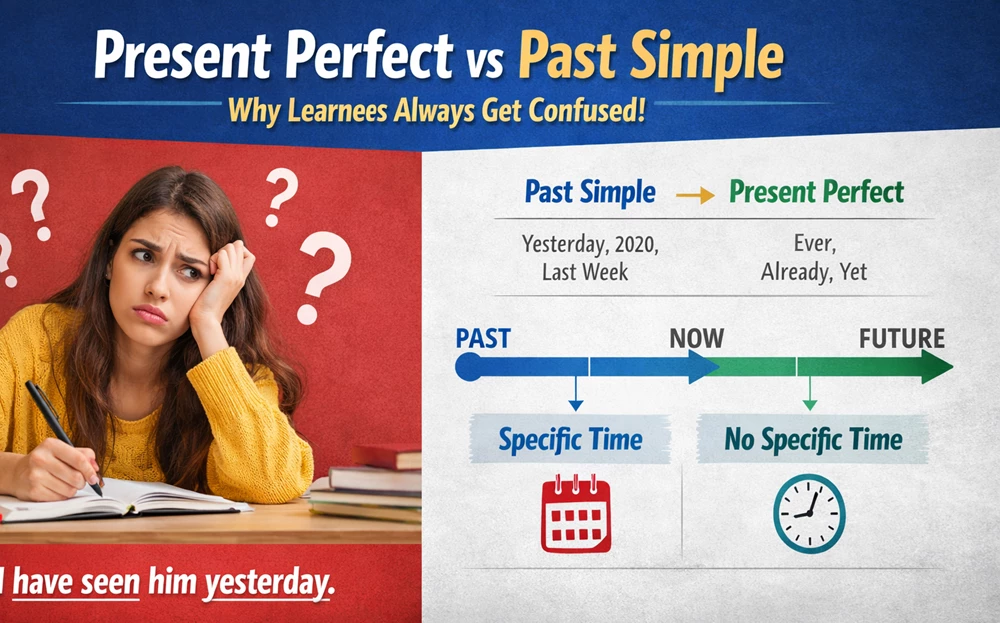
Use the Past Simple when the action happened at a specific, finished time in the past. That time “box” is closed.
Keywords: Yesterday, last week, in 2010, three hours ago, when I was a child (these are used with the past simple)
Example: “I visited Mumbai in 2022.” (2022 is over, disconnected from the present)
The Present Perfect (The Unfinished Container)
Use the Present Perfect when the action happened at an unspecified time, or the time period is still continuing up to now. The “box” is still open.
Keywords: Today, this week, so far, already, yet, recently, ever, never (these are used with the present perfect)
Example: “I have visited Mumbai three times.” (It means I might go again; my life is still continuing).
2. Comparing Present Perfect and Past Simple: Side-by-Side
| Past Simple (Finished) | Present Perfect (Unfinished) |
| (Focuses on WHEN it happened.) | (Focuses on THE RESULT or experience.) |
| “I lost my keys yesterday.” (They might be found now). | “I have lost my keys!” (They are still missing right now). |
| “She lived in London for five years.” (She doesn’t live there now). | “She has lived in London for five years.” (She still lives there). |
| “Did you see that movie last night?“ | “Have you ever seen that movie?“ |
3. Why Indian Learners Struggle: The “Life Experience” Trap
In many Indian languages, the distinction between “I did” and “I have done” is subtle or non-existent. This leads to the most common error in business communication:
The Mistake: “I have finished the report yesterday.”
The Correction: “I finished the report yesterday.”
The Rule: If you mention a specific past time (yesterday, Monday, 2:00 PM), the Present Perfect cannot be used. You must use the Past Simple.
4. The “Connection to Now”
The Present Perfect acts as a bridge between the past and the present.
Experience: “I have been to France.” (It’s part of my life experience now).
Change over time: “The prices have increased recently.” (They are higher now than they were before).
Accomplishment: “Man has walked on the moon.“ (A human achievement that still matters today).
Continuing Action: “I have studied at 99Learners for two months.” (I am still studying here).
5. Practical Checklist: Which one should I use?
Ask yourself these two questions before you speak or write:
Is there a specific time mentioned?
Yes (Yesterday, 1995, last week) → Past Simple.
No → Present Perfect.
Is the action finished, or is there a result in the present?
Totally finished/disconnected → Past Simple.
Affects the present/still happening → Present Perfect.
In short: If you refer to a time in the past (or give a past time expression), use the past simple. If the past action or state has present relevance or continues up to now (or is at an unspecified time), use the present perfect.
Quick Practice Quiz
Choose the correct tense for each sentence:
I (see / have seen) that man before.
We (bought / have bought) a new car last Friday.
(Did you finish / Have you finished) your homework yet?
Shakespeare (wrote / has written) many famous plays.
I (lost / have lost) my phone! Can you help me find it?
(Answers: 1. have seen, 2. bought, 3. Have you finished, 4. wrote, 5. have lost)
 Watch a video about English tenses and their types: