In, On, or At: Prepositions of Time and Place Explained with Easy Examples
 Watch a YouTube video:




If you’ve ever wondered why we say “in March” but “on March 15th,” or why we are “at the station” but “on the bus,” you aren’t alone. Prepositions are notoriously tricky because they often don’t follow a direct translation from regional languages.
Prepositions in, on, and at are among the most confusing parts of English grammar. Many learners struggle to know when to use in, on, or at for time and place.
In this guide, you’ll learn the simple rules, examples, and common mistakes so you can use these prepositions correctly in everyday English.
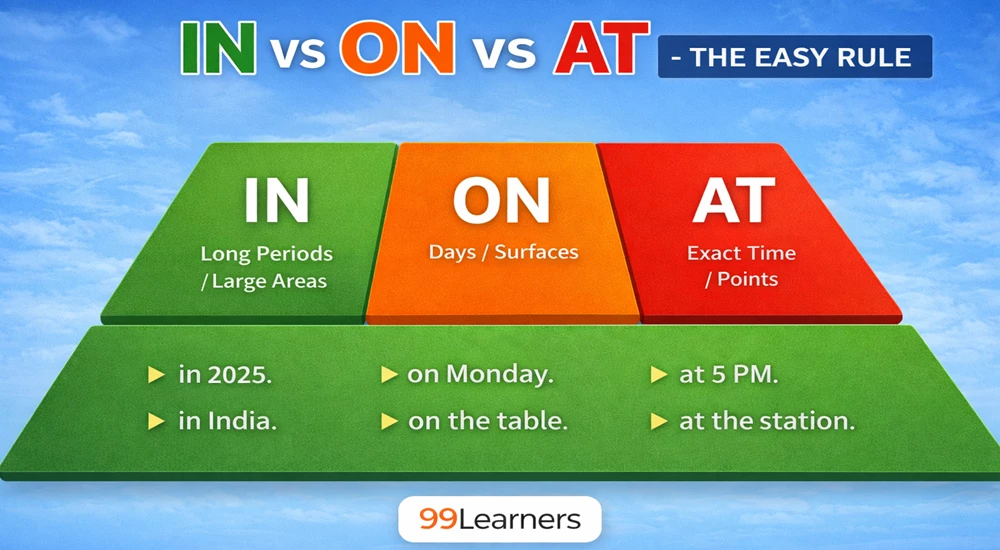
The secret to mastering them is the “Pyramid Principle.” Think of it as moving from the General (Big) to the Specific (Small).
| Preposition | Use For | Example |
|---|---|---|
| IN | Long periods / large areas | in 2026, in India |
| ON | Days / surfaces | on Monday, on the table |
| AT | Exact time / specific point | at 5 PM, at the station |
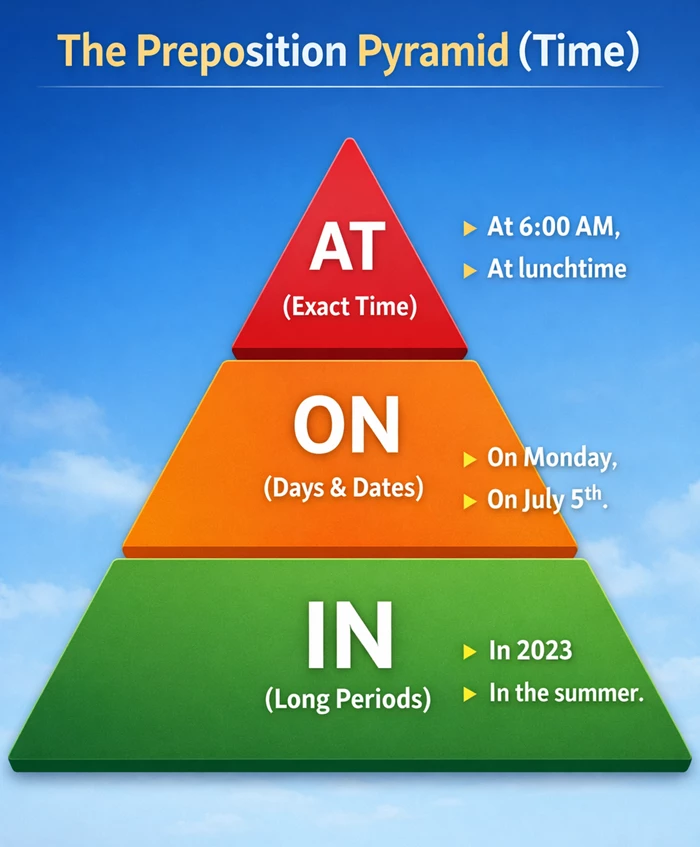
When talking about time, your choice of preposition depends on how broad or specific the time frame is.
Use “In” for long periods of time.
Centuries/Decades: In the 20th century, in the 90s.
Years/Months: In 2026, in August.
Seasons: In the summer, in the winter.
Time of day: In the morning, in the evening (but at night!).
Use “On” for specific days and dates.
Days of the week: On Monday, on Friday.
Specific dates: On the 12th of March, on my birthday.
Holidays with “Day”: On Diwali Day, on Christmas Day.
Use “At” for precise moments and clock times.
Clock time: At 10:30 AM, at sunset.
Specific moments: At the moment, at lunchtime.
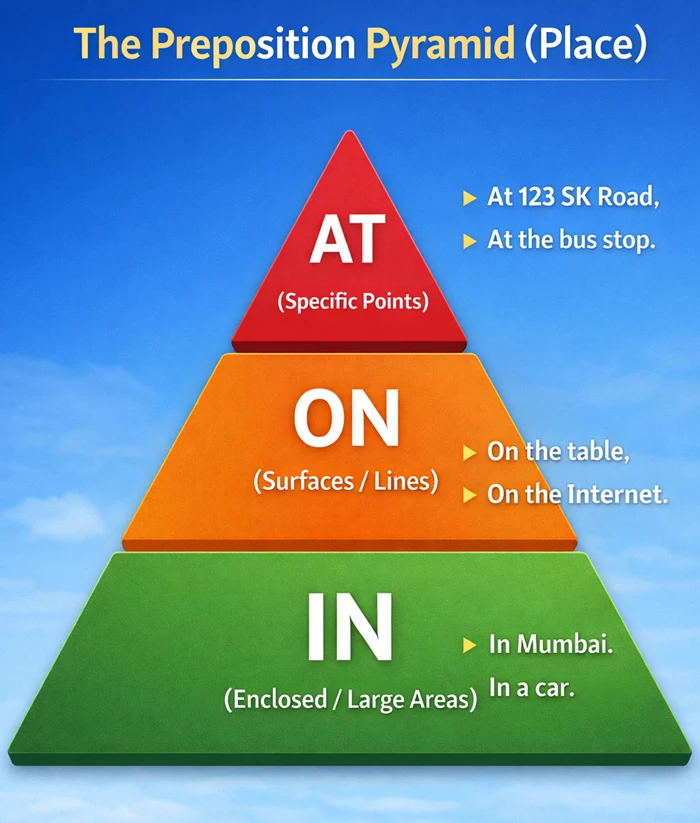
The same logic applies when you are talking about where something is located.
Use “In” for locations with physical or virtual boundaries.
Cities/Countries: In Mumbai, in India.
Enclosed spaces: In a car, in a room, in a box.
Water: In the ocean, in the river.
Use “On” when something is touching a surface or following a line.
Surfaces: On the table, on the wall, on the floor.
Floor of a building: On the 2nd floor.
Media/Communication: On the internet, on the phone, on TV.
Use “At” for a specific point or a social destination.
Specific addresses: At 123 SK Road.
Points in a journey: At the bus stop, at the entrance.
Social locations: At school, at the office, at the cinema.
In India, we often mix these up due to direct translation. Here are the most common fixes for your resume and emails:
| Incorrect | Correct | Why |
|---|---|---|
| I am in the bus. | I am on the bus. | For public transport, you can walk on (bus, train, plane), use on. |
| Meet me in 5:00 PM. | Meet me at 5:00 PM. | Specific clock time always takes at. |
| I am on the room. | I am in the room. | Rooms are enclosed spaces. |
| It is in the 3rd floor. | It is on the 3rd floor. | Floors are considered surfaces. |
| Discuss about the issue. | Discuss the issue. | Discuss already includes the meaning of “about”. |
| Return back the book. | Return the book. | “Return” already means go back. |
| I did a mistake. | I made a mistake. | The correct collocation is make a mistake. |
Read more about English mistakes by Indians
English is famous for its exceptions. While we say “in the morning” and “in the afternoon,” we almost always say “at night.”
Example: “I study grammar in the afternoon and sleep at night.”
Can you fill in the blanks correctly?
The meeting is _______ Tuesday.
I live _______ Manipur.
I’ll see you _______ 9 o’clock.
The book is lying _______ the desk.
He was born _______ 1995.
(Answers: 1. On, 2. In, 3. At, 4. On, 5. In)
We use cookies to improve your experience on our site. By using our site, you consent to cookies.
Manage your cookie preferences below:
Essential cookies enable basic functions and are necessary for the proper function of the website.
These cookies are needed for adding comments on this website.
Statistics cookies collect information anonymously. This information helps us understand how visitors use our website.
Google Analytics is a powerful tool that tracks and analyzes website traffic for informed marketing decisions.
Service URL: policies.google.com (opens in a new window)