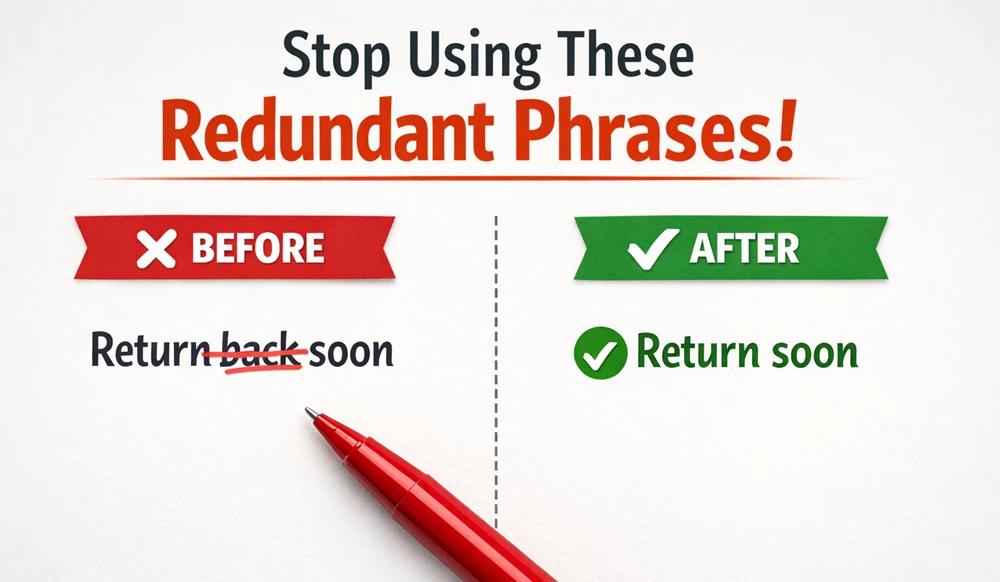
In English, “Redundancy” means using two or more words together that mean the same thing. It is like saying “a round circle”—a circle is already round, so the extra word is unnecessary!
Many Indian learners fall into the “Redundancy Trap” because of direct translation from their mother tongue. For example, in Hindi, we might say “phir se repeat kijiye,” but in English, the word “repeat” already means “to do again.” Adding “again” is unnecessary.
If you want to sound more fluent, natural, and confident, removing these extra words is very important.
Let’s look at 10 common redundant phrases in English you should stop using today.
Table of Contents
1. “Discuss about”
The Mistake: “We need to discuss about the new project.”
The Correction: “We need to discuss the new project.”
Why: “Discuss” already means “to talk about.” You don’t need the word “about.”
2. “Return back”
The Mistake: “When will you return back from Delhi?”
The Correction: “When will you return from Delhi?”
Why: “Return” means to come back. Adding “back” doubles the meaning.
3. “Repeat again”
The Mistake: “Could you please repeat that again?”
The Correction: “Could you please repeat that?”
Why: “Repeat” means to say or do something again.
4. “Revert back”
The Mistake: “I will revert back to your email by tomorrow.”
The Correction: “I will revert to your email by tomorrow.” or “I will reply to your email tomorrow.”
Why: This is a very common “Indianism” in offices. “Revert” means to go back to a previous state or to reply.
5. “Actual facts”
The Mistake: “Give me the actual facts of the case.”
The Correction: “Give me the facts of the case.”
Why: A fact is, by definition, something that is actual. If it isn’t actual, it isn’t a fact!
6. “New innovation”
The Mistake: “The company introduced a new innovation.”
The Correction: “The company introduced an innovation.”
Why: An innovation is a new idea or method. It cannot be “old.”
7. “Small in size”
The Mistake: “The room was small in size.”
The Correction: “The room was small.”
Why: “Small” already describes the size.
8. “Period of time”
The Mistake: “I will be away for a short period of time.”
The Correction: “I will be away for a short period” or “short time.”
Why: A “period” is already a length of time.
9. “Advance planning”
The Mistake: “We need to do some advance planning for the exam.”
The Correction: “We need to do some planning for the exam.”
Why: You cannot plan for the past. Planning always happens in advance.
10. “Added bonus”
The Mistake: “The free PDF is an added bonus.”
The Correction: “The free PDF is a bonus.”
Why: A bonus is always something extra (added).
⚡ Quick Fix Table: Concise Writing
| Don’t Say… | Say This Instead… |
| Close proximity | Near / Close |
| End result | Result |
| Postpone until later | Postpone |
| Fellow classmates | Classmates |
| Unexpected surprise | Surprise |
Why This Matters for Exams
If you are preparing for the IELTS or SSC exams, avoiding redundancy is key to a high score in “Lexical Resource” (vocabulary).
Using clear, precise, and natural English shows that you:
- Understand word meanings properly
- Can communicate effectively
- Have a higher level of English proficiency
How to Stop Using Redundant Phrases
Avoiding redundancy is easier than you think. Just follow these simple tips:
1. Learn the exact meaning of words
Many mistakes happen because we don’t fully understand a word.
For example, if you know “return” already means “come back,” you won’t say “return back.”
2. Avoid translating directly from your mother tongue
Direct translation often creates extra words.
Instead of translating, try to think in English phrases.
3. Keep your sentences simple
Good English is clear, not complicated.
Shorter sentences are usually more natural and correct.
4. Check if any word is unnecessary
After writing a sentence, ask yourself:
👉 “If I remove this word, does the meaning change?”
If not, remove it.
5. Read and listen to natural English
Watching videos, reading blogs, or listening to native speakers helps you learn how real English is used.
Practice Time (Quick Quiz)
Choose the correct sentence:
A. Please repeat again.
B. Please repeat.
A. We discussed about the issue.
B. We discussed the issue.
A. I will revert back to you soon.
B. I will reply to you soon.