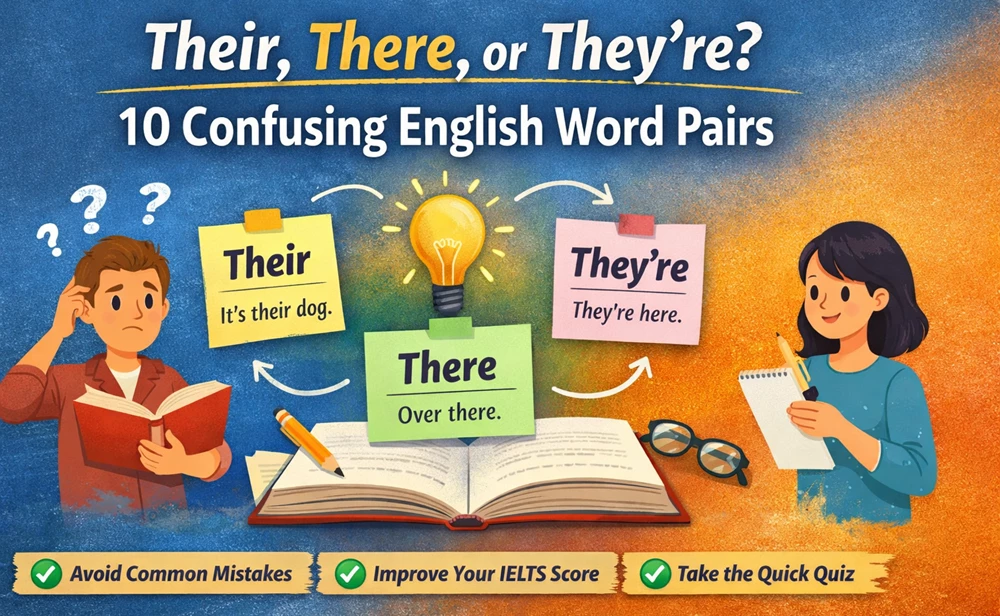
Why Learning These Word Pairs Matters
 Avoid embarrassing mistakes in emails and exams Improve your IELTS Writing band score Write more clearly and professionally Build strong grammar fundamentals


English can be a frustrating language because many words sound the same but have completely different meanings and spellings. These are called homophones, and they are one of the most common causes of writing mistakes. Even with 15+ years of teaching experience, I still see advanced students mix these up in emails, exams, and professional writing.
By the end of this article, you’ll be able to confidently choose the right word every time.
Mastering these 10 confusing English word pairs will instantly improve your writing clarity, professionalism, and IELTS score.
Avoid embarrassing mistakes in emails and exams Improve your IELTS Writing band score Write more clearly and professionally Build strong grammar fundamentals
This is the most common mistake in the English language.
Their: Shows possession (belongs to them). Example: “It is their book.”
There: Refers to a place or something existing. Example: “Put the book over there.”
They’re: A contraction of “They are.” Example: “They’re coming to the party.”
💡 Tip: Expand “they’re” → “they are.” If it fits, it’s correct.
Its: Shows possession. Example: “The dog wagged its tail.”
It’s: A contraction of “It is” or “It has.” Example: “It’s raining outside.”
Tip: If you can replace the word with “It is,” use the apostrophe (‘).
💡 Tip: Replace with “it is.” If it works, use it’s.
Your: Shows possession. Example: “Is this your phone?”
You’re: A contraction of “You are.” Example: “You’re doing a great job.”
Loose (adjective): Not tight. Example: “This shirt is too loose.”
Lose (verb): To suffer a loss or not win. Example: “Don’t lose your keys.”
💡 Tip: “Lose” = loss (same root idea)
Affect (Verb): To influence something. Example: “The weather will affect our plans.”
Effect (Noun): The result of a change. Example: “The medicine had a positive effect.”
Complement: Something that completes or goes well with something else. Example: “That tie complements your suit.”
Compliment: A polite expression of praise. Example: “He gave her a nice compliment.”
Accept: To receive or agree to. Example: “Please accept my apology.”
Except: Not including; but. Example: “Everyone went except Rahul.”
💡 Tip: Except = exclusion
Principal: The head of an institution or the most important person. Example: “Mr. Singh is the school principal.”
Principle: A fundamental truth or rule. Example: “It’s against my principles to lie.”
💡 Tip: Principal = “pal” (a person)
Stationary: Not moving. Example: “The car hit a stationary truck.”
Stationery: Writing materials like paper and envelopes. Example: “I bought new stationery for the office.”
💡 Tip: Stationery has “e” for envelope
Advice (Noun): A suggestion about what to do. Example: “Thank you for the advice.”
Advise (Verb): The act of giving a suggestion. Example: “I advise you to stay home.”
💡 Tip: Advice = thing, Advise = action
| Word Pair | Meaning | Example |
|---|---|---|
| Their | Possession | Their car is new |
| There | Place | Sit there |
| They’re | They are | They’re happy |
| Its | Possession | Its color is red |
| It’s | It is | It’s raining |
Can you pick the right word?
✅ Answers
Confusing English word pairs are a common problem—but with practice, they become easy to master.
👉 Bookmark this guide and revisit it regularly.
👉 Practice daily to avoid mistakes in exams and real-life writing.

We use cookies to improve your experience on our site. By using our site, you consent to cookies.
Manage your cookie preferences below:
Essential cookies enable basic functions and are necessary for the proper function of the website.
These cookies are needed for adding comments on this website.
Statistics cookies collect information anonymously. This information helps us understand how visitors use our website.
Google Analytics is a powerful tool that tracks and analyzes website traffic for informed marketing decisions.
Service URL: policies.google.com (opens in a new window)