
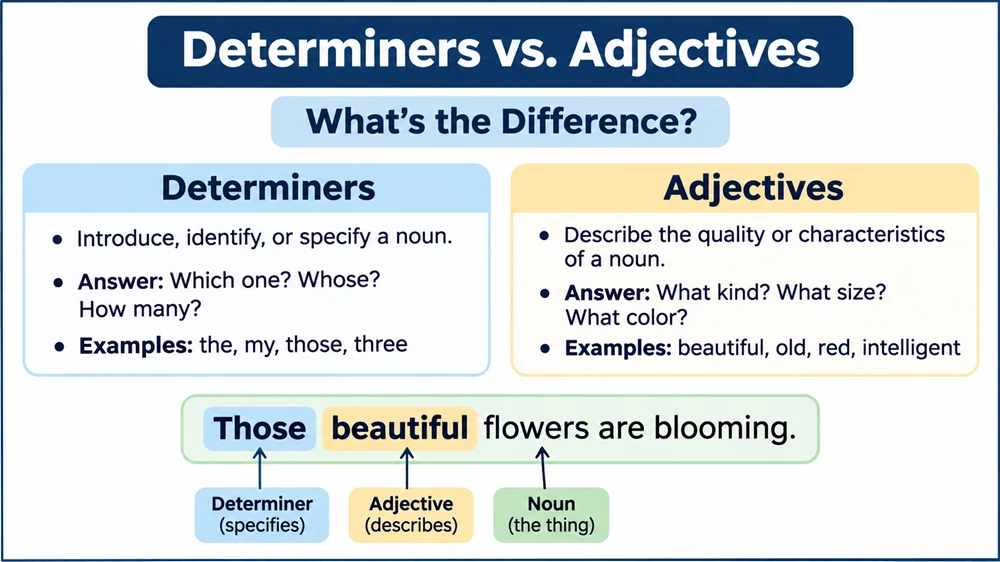
Many English learners find it tricky to tell how determiners and adjectives are different. We use both types of words before nouns to give us more details about them, but they function differently in a sentence.
Determiners introduce, identify, or specify nouns, whereas adjectives describe the qualities or characteristics of nouns.
For example:
- Those beautiful flowers are blooming.
- My younger brother loves football.
- Three intelligent students won the competition.
In these sentences, the bold words are determiners, while the other descriptive words (beautiful, younger, and intelligent) are adjectives.
Here is a clear, simple breakdown of the differences, the types of determiners, how to identify each, and the correct order to use when we use them together in a noun group.
1. The Core Difference Between Determiners and Adjectives
The easiest way to understand the difference is to look at what job the word is doing.
- Determiners introduce, point out, or specify a noun (person or thing). They answer questions like “Which one?”, “Whose?”, or “How many?”
- Adjectives describe or modify a noun by giving qualities, characteristics, or states. They answer questions like “What kind?”, “What size?”, or “What colour?”
Let’s see the table to compare their differences.
| Feature | Determiners | Adjectives |
|---|---|---|
| Primary Job | Point out, identify, or specify a noun | Describe the quality, size, or characteristics of a noun |
| Core Questions | Which one? Whose? How many? How much? | What kind? What colour? What size? |
| Examples | this, that, my, the, three, some | tall, blue, honest, delicious, old |
| Position | Generally come before adjectives in a noun phrase | Generally appear between a determiner and a noun |
| Degrees of Comparison | Most determiners do not have degrees of comparison | Many adjectives have comparative and superlative forms |
Examples:
- Determiner: That house belongs to my uncle.
- Adjective: That beautiful house belongs to my uncle.
Here, “that” identifies a particular house, whereas “beautiful” describes its quality.
Important: Use the table above for clues, but it is not a universal identification test. Some quantity words, such as many and few, have comparative forms (more, fewer) while functioning as determiners.
2. Types of Determiners
Understanding the types of determiners helps you distinguish them from adjectives.
Here are the major types of determiners used in English, with examples:
| Type of Determiner | Examples | Example Sentence |
|---|---|---|
| Articles | a, an, the | I bought a book. |
| Demonstratives | this, that, these, those | These flowers are beautiful. |
| Possessives | my, your, his, her, its, our, their | My brother is a doctor. |
| Quantifiers | some, any, much, many, little, few, several | Many students participated. |
| Numbers | one, two, three, first, second | Three boys are playing. |
| Distributives | each, every, either, neither | Every student passed. |
| Interrogatives | which, what, whose | Which book do you want? |
Note: Some traditional grammar books use the terms “possessive adjectives” for possessive determiners and “demonstrative adjectives” for demonstrative determiners. Modern grammar generally classifies them as determiners when they appear before nouns.
3. Comparing Determiners and Adjectives Side-by-Side
Let’s look at how determiners and adjectives function differently in sentences.
Example 1: Demonstratives vs. Describing Words
- Determiner: “I want this book.” (Which book? This one—it points out a specific item.)
- Adjective: “I want an interesting book.” (What kind of book? An interesting one—it describes a quality.)
Example 2: Quantity vs. Quality
- Determiner: “She has three cats.” (How many cats? Three—it specifies the number.)
- Adjective: “She has fluffy cats.” (What kind of cats? Fluffy—it describes their appearance.)
Example 3: Possessives vs. Characteristics
- Determiner: “That is my car.” (Whose car? My car—it indicates ownership.)
- Adjective: “That is a fast car.” (What kind of car? A fast car—it describes its speed.)
More Examples of Their Usage
Look at these sentences to understand how determiners and adjectives are used together:
| Sentence | Determiner | Adjective | Noun |
|---|---|---|---|
| Those beautiful birds are singing. | Those | Beautiful | Birds |
| My younger sister is intelligent. | My | Younger, intelligent | Sister |
| Several interesting books are available. | Several | Interesting | Books |
| Every hardworking student deserves encouragement. | Every | Hardworking | Student |
| The old wooden chair needs repair. | The | Old, wooden | Chair |
| Her new smartphone is expensive. | Her | New, expensive | Smartphone |
If you need further reading, check out the following links:
- British Council – Specific and General Determiners: Explore specific and general determiners with practical examples.
Cambridge Grammar – Adjectives: Forms: Learn about adjective forms and comparative and superlative adjectives.
4. The Word Order Rule: Determiner First, Adjective Second
When you use both a determiner and an adjective together in the same noun phrase, the determiner generally comes before the adjective.
Structure: Determiner + Adjective + Noun
Examples:
- The (determiner) smart (adjective) student (noun).
- My (determiner) old (adjective) house (noun).
- Those (determiner) red (adjective) apples (noun).
- Some (determiner) delicious (adjective) food (noun).
Incorrect: “Smart the student” or “Old my house.”
Correct: “The smart student” and “My old house.”
What If There Are Two or More Adjectives?
In English, we can use multiple adjectives to describe a noun. When we use several adjectives together, they generally follow a conventional order as follows:
Opinion → Size → Age → Shape → Colour → Origin → Material → Purpose → Noun
For example:
- A beautiful large old brown Indian leather bag.
If you don’t follow the order of adjectives, your sentence may sound unnatural.
For example:
Natural: She bought a beautiful old wooden chair.
Unnatural: She bought a wooden old beautiful chair.
5. Words That Can Have Different Grammatical Functions (Context Matters!)
Some words can function as different parts of speech depending on how they are used in a sentence. Their grammatical function depends on their position and role in the sentence.
Words Like This, That, These, Those
These words can function as determiners or pronouns. See the examples:
As a Determiner: “This car is mine.”
Here, “this” comes before the noun “car” and identifies a specific car.
As a Pronoun: “This is my car.”
Here, “this” stands alone and refers to a particular thing. It does not come before a noun.
Words Like Many, Some, Few
These words can also perform different grammatical functions.
As a Determiner: “Many people came to the event.”
Here, “many” specifies the number of people.
As a Pronoun: “Many were invited, but few attended.”
Here, “many” and “few” stand independently without an expressed noun.
Important: You should examine how a word is used in a sentence rather than identify its grammatical category by looking at the word alone.
When Can We Use Nouns Without Determiners?
We can use nouns without determiners in certain situations. This is sometimes called the zero determiner or zero article construction.
Consider these examples without any determiners:
- Children need love.
- Water is essential for life.
- Books provide valuable knowledge.
These nouns do not require determiners because they are used in a general sense. So, determiners are not compulsory before every noun. Their use depends on the type of noun and the meaning we want to convey.
Common Mistakes: Determiners vs. Adjectives
English learners sometimes confuse determiners and adjectives because both can appear before nouns. Remember, determiners are placed before adjectives in the noun phrase:
Incorrect: Beautiful a flower
Correct: A beautiful flower
Incorrect: Red those apples
Correct: Those red apples
Incorrect: Old my house
Correct: My old house
Incorrect: A red big ball
Correct: A big red ball
Incorrect: An Indian attractive young actor
Correct: An attractive young Indian actor
Remember: In ordinary noun phrases, determiners generally are used before attributive adjectives. If there is more than one adjective, follow the conventional order.
Quick Tests: Is It a Determiner or an Adjective?
Whenever you are unsure, you can apply the following tests. However, remember that these are useful clues, not foolproof grammatical rules.
1. The Removal Test
Try deleting the word from the sentence and observe what happens.
Example 1:
- Original: She bought a car.
- Without the determiner: She bought car. (Incorrect)
The second sentence is grammatically incorrect in standard English because the singular countable noun “car” generally requires a determiner.
Example 2:
- Original: She bought a red car.
- Without the adjective: She bought a car. (Correct)
The second sentence is still grammatically correct because the adjective “red” is not essential to the basic grammatical structure.
Example 3:
- Original: I like my books.
- Without the determiner: I like books.
Both sentences are grammatically correct, although their meanings are slightly different.
2. The Comparison Test
Many adjectives have comparative and superlative forms.
For example:
- Happy → Happier → Happiest
- Tall → Taller → Tallest
- Beautiful → More beautiful → Most beautiful
Determiners generally do not have these forms.
For example:
- The → The-er (Incorrect)
- My → My-est (Incorrect)
- This → This-er (Incorrect)
However, some quantifying words can have comparative and superlative forms.
For example:
- Many → More → Most
- Few → Fewer → Fewest
- Much → More → Most
These words can function as determiners when they specify nouns.
3. The Function Test
Ask yourself:
- Does the word identify, specify, or quantify the noun? It is probably functioning as a determiner.
- Does the word describe a quality, characteristic, size, colour, or condition of the noun? It is probably functioning as an adjective.
For example:
“Those beautiful flowers attract butterflies.”
- Those: Identifies which flowers (determiner).
- Beautiful: Describes the flowers (adjective).
- Flowers: The noun.
Practice Exercise: Identify the Determiners and Adjectives
Instructions: Identify the determiners and adjectives in each sentence. Try this exercise before looking at the answers to test your knowledge.
- Those beautiful flowers are blooming.
- My younger brother loves football.
- Several intelligent students participated in the competition.
- Every hardworking employee deserves recognition.
- The old wooden chair needs repair.
- Three hungry children entered the room.
- Her new smartphone is expensive.
- These little puppies are adorable.
- Many talented musicians performed tonight.
- An interesting story appeared in the magazine.
Answer Key
| No. | Determiner(s) | Adjective(s) |
|---|---|---|
| 1 | Those | Beautiful |
| 2 | My | Younger |
| 3 | Several | Intelligent |
| 4 | Every | Hardworking |
| 5 | The | Old, wooden |
| 6 | Three | Hungry |
| 7 | Her | New, expensive |
| 8 | These | Little, adorable |
| 9 | Many | Talented |
| 10 | An | Interesting |
Note: In sentences 7 and 8, some adjectives also appear after linking verbs or as part of the predicate.
In this lesson, you have learned that determiners and adjectives both help us provide more information about nouns, but they perform different grammatical functions. With regular practice and by looking at their functions in sentences, distinguishing determiners from adjectives becomes much easier.
My suggestions to master determiners and adjectives for improving your English:
- Study the types of determiners and adjectives
- Study the differences in their function and usage in sentences
- Try using them in your everyday sentences.
Also, check your knowledge with these quizzes and worksheets:
For grammar essentials, read our book → 20 Chapters to Learn English Faster
