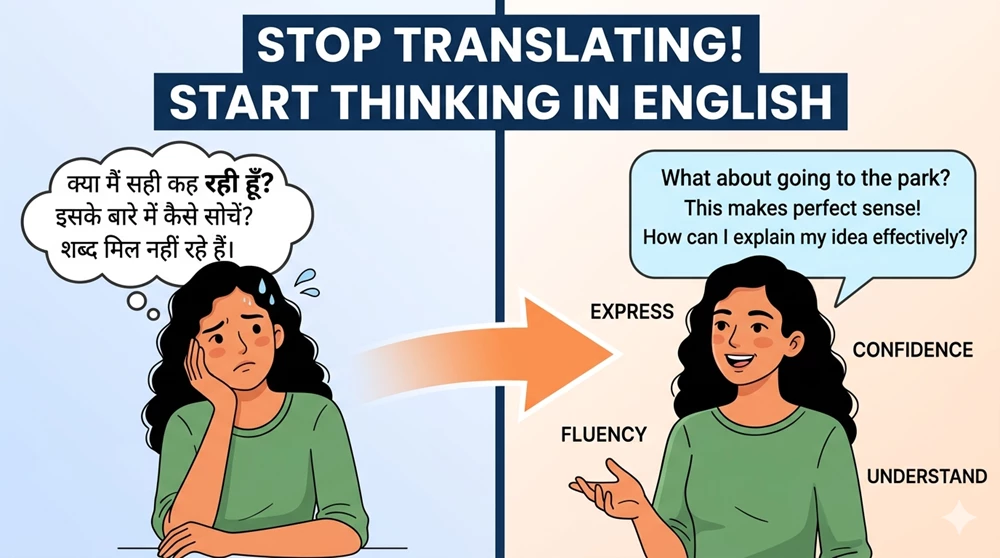
Do you translate every sentence in your head before speaking English? That’s why you feel slow and tired. You are likely a victim of the “Internal Translator.” The good news? You can train your brain to think directly in English with simple daily exercises.
In India, many of us grow up thinking in Hindi, Bengali, Marathi, Manipuri, or other regional languages, then translating those thoughts into English word-for-word. This process is slow, tiring, and often leads to errors. To become truly fluent, you must learn how to think in English and stop translating.
#1. The “Labelling” Technique to Think in English
Don’t start with complex sentences. Start with the objects around you.
The Exercise: As you move through your house, name every object you see in English.
Example: Don’t just see a pankha; think “fan” (Your brain should instantly say “fan,” not “pankha → fan”). Like that, don’t just see kitab; think “book.”
Goal: To create a direct mental link between the physical object and the English word without needing the middleman of your native language.
#2. Narrate Your Day in English (The “Internal Monologue”)
Become the narrator of your own life. Speak to yourself (in your head or quietly) about what you are doing.
The Exercise: “I am waking up now. I need to make some tea. Where is the sugar? Ah, here it is. Now, I will check my emails.”
Why it works: This forces you to use functional, everyday English and connects language to your physical actions.
#3. The “Substitution” Game
If you don’t know a specific word in English, don’t switch back to your mother tongue. Use other English words to describe it.
The Exercise: If you forget the word for “refrigerator,” describe it: “The cold box where we keep the milk.”
Goal: This builds “circumlocution” skills, which are essential for high scores in the IELTS Speaking test.
#4. Think in “Chunks,” Not Words
Native speakers don’t build sentences word-by-word; they use pre-made “chunks.”
The Exercise: Stop learning individual words. Instead, learn common phrases as a single unit.
Examples: Instead of learning “How,” “Are,” and “You,” learn “How’s it going?“ or “To be honest…“
Goal: When your brain stores chunks, you can pull them out instantly without translating.
#5. Change Your Digital Environment
Your brain adapts to the language it sees most often.
The Exercise: Change the language settings on your smartphone and social media accounts to English.
The Result: You will start seeing “Settings,” “Notifications,” and “Messages” in English hundreds of times a day. Eventually, your brain will accept these as its default language.
Choose Your Level: Start Thinking in English Step-by-Step
Not everyone learns at the same pace. That’s why you should practice based on your current level. Start simple and move up gradually.
Beginner Level: Build Basic English Thinking
If you are just starting, focus on simple words and daily actions.
Exercises to follow:
- The “Labelling” Technique
- Simple Internal Monologue (basic sentences)
How to practice:
- Look at objects and name them in English
- Use very short sentences
- “This is a chair.”
- “I am eating.”
Goal: Train your brain to connect objects and actions directly with English words.
Intermediate Level: Think in Sentences
If you can form basic sentences, start expanding your thoughts.
Exercises to follow:
- Narrate Your Day
- The “Substitution” Game
How to practice:
- Describe what you are doing
- “I am cooking rice.”
- “I am checking my phone.”
- If you forget a word, explain it in English
- “The thing we use to cut vegetables”
Goal: Reduce dependence on your native language and speak more naturally.
Advanced Level: Think Like a Native Speaker
Now focus on fluency and natural expressions.
Exercises to follow:
- Think in “Chunks”
- Change Your Digital Environment
How to practice:
- Use phrases instead of single words
- “To be honest…”
- “It depends on…”
- React instantly in English without translating
Goal: Think fast, speak smoothly, and sound natural.
Pro Tip: Master each stage before moving to the next. Just 10 minutes of daily practice can improve your English thinking speed.
The 99Learners Challenge: 5-Minute Daily Practice
Try the following exercise daily. Do not let a single word of your mother tongue enter your thoughts during those 5 minutes. It will be difficult at first, but with practice, it becomes a habit!
Look around and name 10 objects in English


Speak 5 sentences about what you are doing
If you forget a word, describe it in English
Now that you’ve started thinking in English, check out our guide on how to stop using ‘Only’ and ‘Na’ in your sentences.
Want to improve your English faster using a guided method? Study more using the books and courses recommended on this site.