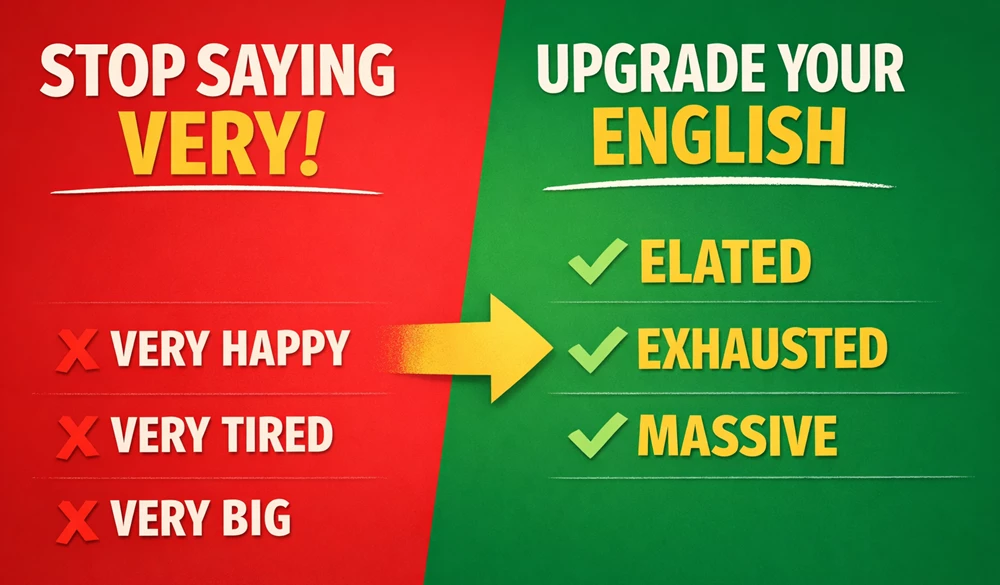
In the world of English learning, “Very” is often called a “lazy” word. While it isn’t grammatically wrong to say you are “very happy” or “very tired,” using it too often makes your English sound repetitive and basic.
At 99Learners, we help our learners move from Basic English to Advanced Fluency. If you want to improve your English vocabulary and sound more advanced, one trick is to stop using the word “very.” Instead, learn how native speakers often use stronger, more precise adjectives. In this guide, you’ll learn 25 powerful alternatives to “very” that will instantly upgrade your English.
Table of Contents
1. Why You Should Stop Using “Very” in English Writing
When you use “very,” you are using two words to do the job of one. In professional emails, IELTS essays, and public speaking, brevity is power.
Basic: The meeting was very long.
Advanced: The meeting was interminable. (This sounds much more impactful!)
2. 25 Better Words to Replace “Very” (Advanced Vocabulary List)
Here is your “Cheat Sheet” for 2026. Try to use at least one of these in your next conversation.
| Basic Phrase | Advanced Alternatives | Category |
|---|---|---|
| Very Happy | Elated / Thrilled | Emotions |
| Very Sad | Sorrowful / Devastated | Emotions |
| Very Angry | Furious / Incensed | Emotions |
| Very Afraid | Terrified | Emotions |
| Very Tired | Exhausted / Drained | Emotions |
| Very Big | Massive / Colossal | Size & Appearance |
| Very Small | Minuscule / Tiny | Size & Appearance |
| Very Beautiful | Stunning / Exquisite | Size & Appearance |
| Very Ugly | Hideous | Size & Appearance |
| Very Clean | Spotless / Immaculate | Size & Appearance |
| Very Smart | Brilliant / Ingenious | Skill & Intelligence |
| Very Stupid | Idiotic | Skill & Intelligence |
| Very Talented | Gifted | Skill & Intelligence |
| Very Creative | Innovative | Skill & Intelligence |
| Very Fast | Rapid / Swift | Speed & Difficulty |
| Very Slow | Sluggish | Speed & Difficulty |
| Very Difficult | Arduous / Challenging | Speed & Difficulty |
| Very Easy | Effortless | Speed & Difficulty |
| Very Good | Superb / Outstanding | General |
| Very Bad | Awful / Atrocious | General |
| Very Hot | Sweltering / Scorching | General |
| Very Cold | Freezing / Frigid | General |
| Very Loud | Deafening | General |
| Very Quiet | Silent | General |
| Very Important | Crucial / Vital | General |
3. How to Practice (The “Context” Method)
Don’t just memorize the list. Use them in sentences that relate to your daily life:
Basic: “The weather in Manipur is very hot in June.”
Advanced: “The weather in Manipur is sweltering in June.”
Basic: “Getting a professional certificate is very important for my job application.”
Advanced: “Getting a professional certificate is crucial for my job application.”
4. When is “Very” Actually Useful?
You don’t have to delete “very” from your vocabulary entirely. It is still useful in casual, spoken English. However, if you are writing a formal letter, an academic essay, or a business proposal, your goal should be to eliminate “very” at least 80% of the time.
Common Mistakes When Replacing “Very”
While replacing “very” with stronger adjectives can improve your English, many learners make mistakes when doing this. Avoid these common errors:
1. Using “Very” with Strong Adjectives
Some adjectives are already strong, so adding “very” is incorrect or unnatural.
❌ Very exhausted – ✔ Exhausted
❌ Very freezing – ✔ Freezing
❌ Very perfect- ✔ Perfect
Tip: Words like exhausted, freezing, perfect, and impossible are already extreme.
2. Overusing Advanced Words
Using too many advanced words in one sentence can sound unnatural.
❌ The movie was atrocious and the acting was abysmal and the story was dreadful.
✔ The movie was terrible, and the acting was poor.
Tip: Keep your language natural, not forced.
3. Using Formal Words in Casual Situations
Some replacements are too formal for everyday conversations.
❌ I am feeling devastated because my phone battery died.
✔ I am very upset because my phone battery died.
Tip: Match your vocabulary with the situation.
4. Choosing the Wrong Word for Context
Not all replacements mean exactly the same thing.
❌ The room was silent (when you mean “a little quiet”)
✔ The room was quiet.
Tip: Learn the exact meaning before using a new word.
5. Ignoring Tone and Emotion
Some words are much stronger than “very” and may change the meaning.
❌ I was furious when he came late (too strong)
✔ I was very annoyed when he came late.
Tip: Use strong words only when the emotion is truly strong.
6. Memorizing Without Practice
Just memorizing lists will not improve your English.
Instead:
- Practice using new words in sentences
- Speak using them in daily conversations
- Write short paragraphs using them
Final Tip
Don’t try to remove “very” completely. Focus on replacing it when you want to sound more precise and professional.
Quick Quiz: Replace “Very” with Better Words
Choose the best advanced word to replace the phrase with “very”:
1. She was very tired after the long journey.
A) Sluggish
B) Exhausted
C) Silent
2. The weather is very cold in winter.
A) Freezing
B) Loud
C) Massive
3. He was very angry when he heard the news.
A) Brilliant
B) Furious
C) Tiny
4. This problem is very difficult to solve.
A) Effortless
B) Arduous
C) Swift
5. The room was very clean and well-organized.
A) Spotless
B) Atrocious
C) Sluggish
Answers
- B) Exhausted
- A) Freezing
- B) Furious
- B) Arduous
- A) Spotless
Start using these words in your daily conversations and writing. The more you practice, the more natural your English will sound. Read a vocabulary book or join a course to learn advanced words.
Challenge: Try to replace “very” in 5 sentences today!