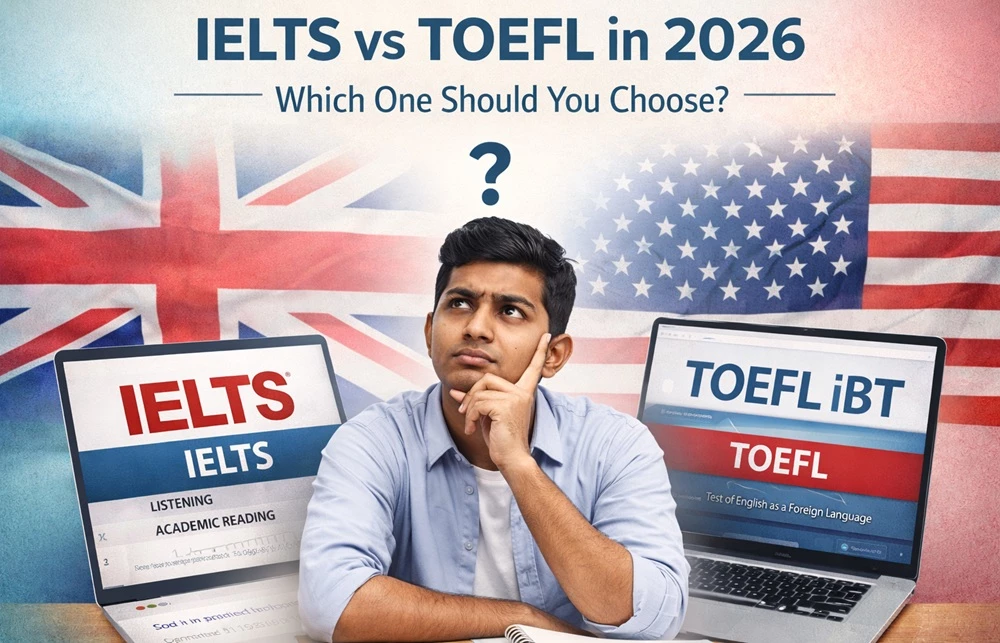
Choosing between the International English Language Testing System (IELTS) and the Test of English as a Foreign Language (TOEFL) has always been a crossroads for Indian students who want to study abroad. However, in 2026, the decision has become more complicated. With TOEFL launching a major adaptive format in January 2026 and IELTS expanding its “One Skill Retake” globally, the “easiest” test is no longer a simple answer—it depends entirely on your digital comfort and target destination.
At 99Learners, we’ve broken down everything you need to know to make the right decision for your future.
IELTS Vs. TOEFL in 2026: Study Abroad Guide for Indians
1. The 2026 Landscape: What has changed?
The most significant update this year is the New TOEFL iBT (launched January 21, 2026).
Adaptive Testing: Unlike the static tests of the past, TOEFL’s Reading and Listening sections now adapt to your performance. If you answer correctly, the next questions become harder (and carry more weight).
Shorter Duration: TOEFL has been slashed to just 90 minutes, making it the fastest major English proficiency test.
IELTS Response: IELTS remains at roughly 2 hours and 45 minutes but has solidified its “One Skill Retake” (OSR) across India, allowing students to fix a single low score without sitting for the entire exam again.
2. Comparison Table: At a Glance (2026 Data)
| Feature | IELTS Academic (2026) | TOEFL iBT (New 2026 Format) |
| Duration | 2 Hours 45 Minutes | 90 Minutes (Approx.) |
| Format | Paper-based or Computer | 100% Computer-based |
| Speaking | Face-to-face with an Examiner | Recorded via Microphone (AI + Human) |
| Scoring | 0 – 9 Band Scale | 1 – 6 Band (New) & 0 – 120 Scale |
| Fees in India | ₹18,000 – ₹18,500 | ₹19,000 – ₹21,000 (Based on USD) |
| Result Time | 3 – 5 Days (Computer) | 72 Hours (Fast-track) |
3. The Speaking Section: Human vs. Machine
This remains the “Dealbreaker” for most Indian students.
The IELTS Experience
In IELTS, you sit in a private room with a human examiner. It feels like a job interview. You can see their body language, ask them to repeat a question, and use natural hand gestures.
- Pro: Best for students who are good at “social” English and natural conversation.
- Con: Can be nerve-wracking if you are shy or intimidated by direct eye contact.
The TOEFL Experience
In 2026, TOEFL uses a Virtual Interview task. You speak into a microphone, and your voice is analyzed by a mix of high-precision AI and human raters.
- Pro: Zero “examiner bias.” The AI doesn’t care if you look nervous; it only cares about your pronunciation and flow.
- Con: You are often in a room with other students speaking at the same time, which can be distracting.
4. The AI Factor: Adaptive Scoring in 2026
If you take the TOEFL in 2026, you are interacting with one of the most advanced AI assessment tools in the world.
- Stage 1: You receive a mix of medium-difficulty questions.
- Stage 2: Based on your accuracy, the AI determines if you should receive “High-Level” or “Standard-Level” questions.
Why this matters for your score: You cannot simply “guess” your way through the first half of the test. To get a top-tier score (Band 5.5 or 6.0 on the new scale), you must perform flawlessly in the initial stage to “unlock” the harder, higher-scoring questions.
5. Regional Preferences: Where are you going?
While both tests are accepted by 11,000+ institutions, regional preference still exists in 2026.
United States: The TOEFL remains the “Gold Standard.” While 100% of US universities accept IELTS, STEM (Science, Technology, Engineering, Math) programs often prefer the academic depth of the TOEFL.
United Kingdom: IELTS is non-negotiable for many visa categories. If you are applying for a UK Student Visa, ensure you take the IELTS for UKVI version.
Canada & Australia: Both are equally accepted, but IELTS has a slight edge for those looking at Permanent Residency (PR) pathways later, as the immigration systems are built on the 0-9 Band system.
6. The 2026 Fee Breakdown (India)
For Indian families, the cost is a significant factor.
IELTS: Fixed at ₹18,000. This makes it easier to budget.
TOEFL: Priced in US Dollars (approx. $235). Because of the fluctuating Rupee, you may pay anywhere between ₹19,500 and ₹21,000, depending on the exchange rate and bank convenience fees on the day of booking.
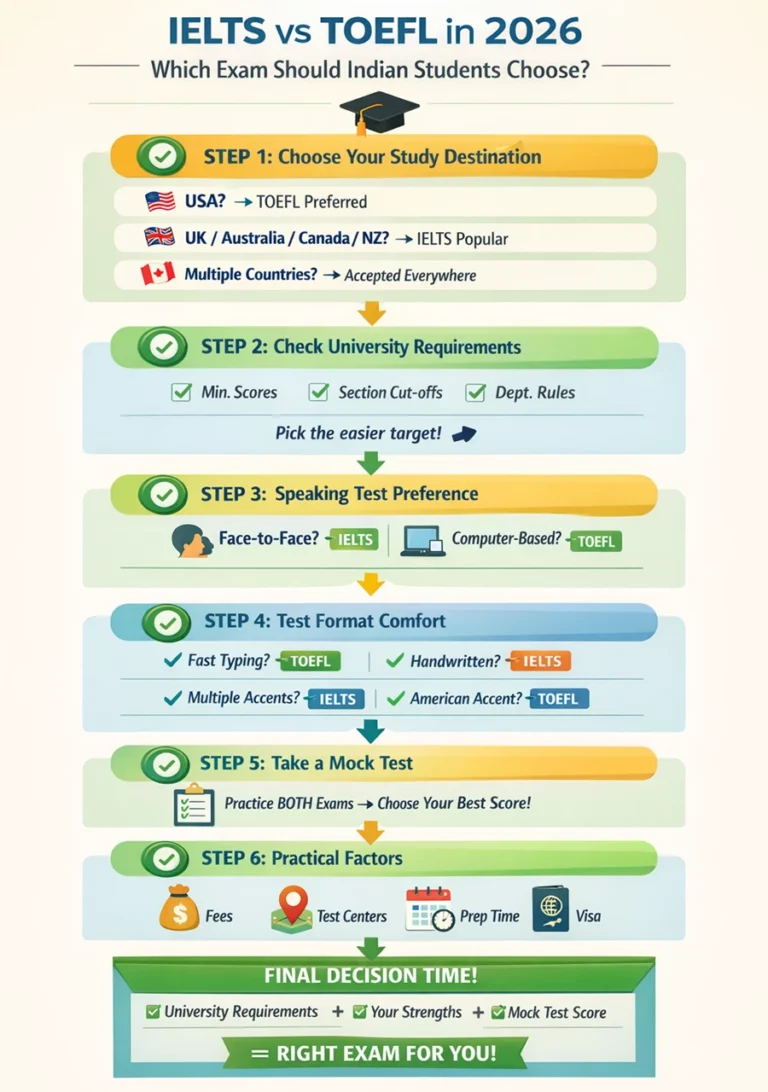
7. Which Exam is “Easier” for You? (The Decision Tree)
To help you decide, ask yourself these three questions:
Q1: Are you a fast typer or a neat writer?
TOEFL: Requires high-speed typing for the integrated writing tasks. If you hunt for keys on a keyboard, you will struggle.
IELTS: Offers a Paper-based option. If you have beautiful, clear handwriting, this is a massive advantage.
Q2: Do you prefer American or British accents?
TOEFL: Primarily uses North American accents (USA/Canada). If you grew up watching Hollywood movies, this will feel natural.
IELTS: Features a “Global” mix—British, Australian, New Zealand, and American.
Q3: How do you handle “Multi-tasking”?
TOEFL Writing: Often requires you to read a text, listen to a lecture, and then write a summary. It tests three skills at once.
IELTS Writing: More straightforward. You look at a graph or a prompt and write. No listening is required in the writing section.
8. Final Verdict for 2026
Choose IELTS if: You want a face-to-face speaking experience, are targeting the UK/Canada, and prefer a test that doesn’t “change” its difficulty while you are taking it.
Choose TOEFL if: You are targeting the USA, are very comfortable with technology, have a short attention span (90-minute test!), and need your results back in a hurry (72 hours).
Top University Examples
Harvard prefers TOEFL 100+ (but check program rules)
Many Harvard schools and professional programs expect very high English scores: while some graduate units list lower official minimums, the Harvard Business School and several graduate programs discourage applicants with TOEFL scores below ~109 (and competitive applicants typically present 100+). Use TOEFL iBT if you want to signal you’re in the top percentile for U.S. Ivy League admissions.
Oxford prefers IELTS ~7.5 for most courses
The University of Oxford sets high “higher-level” thresholds for many undergraduate and graduate courses — commonly IELTS Academic 7.5 overall (with strong section minima) or TOEFL iBT totals in the ~110 range for its more competitive programs. If you’re applying to humanities or PPE-style degrees, aim for the higher IELTS band to stay competitive.
Takeaway for Indian students: Don’t treat “Harvard prefers TOEFL” and “Oxford prefers IELTS” as literal bans. Instead, treat them as shorthand for how each university signals its preferred/competitive test profile — many top U.S. programs lean toward high TOEFL totals (100+), while top UK programs often list high IELTS bands (7.0–7.5). Always check the exact department page — English requirements vary by faculty and degree level.
Frequently Asked Questions (FAQs)
1. What is the main difference between IELTS and TOEFL?
The biggest difference lies in format, scoring, and test style.
- IELTS includes a face-to-face speaking test with an examiner. It uses a band score system (0–9).
- The TOEFL iBT is fully computer-based, including the speaking section. It uses a score scale of 0–120.
IELTS often feels more conversational and practical, while TOEFL is more academic and integrated (you read, listen, and respond together).
2. Which exam is easier: IELTS or TOEFL?
There is no universally “easier” exam — it depends on your strengths.
- If you’re comfortable speaking to a person → IELTS may feel easier.
- If you type fast and prefer computer-based tests → TOEFL may suit you better.
- If you struggle with accents → TOEFL mostly uses American accents, while IELTS includes British, Australian, and others.
Indian students strong in structured academic writing often find the TOEFL manageable. Those confident in real-life conversation often prefer IELTS.
3. How do IELTS and TOEFL scores compare?
Here’s a simplified comparison:
| IELTS Band | TOEFL iBT Score |
|---|---|
| 6.0 | 60–78 |
| 6.5 | 79–93 |
| 7.0 | 94–101 |
| 7.5 | 102–109 |
| 8.0 | 110–114 |
| 8.5–9.0 | 115–120 |
Always check university-specific requirements.
4. Which exam is more accepted globally?
Both exams are widely accepted:
- TOEFL is preferred by many U.S. universities.
- IELTS is highly popular in the UK, Australia, Canada, and New Zealand.
- Both are accepted by 11,000+ institutions worldwide.
5. Which certification is better?
Neither is “better.” The best certification is the one:
- Accepted by your target university
- Matches your strengths
- Aligns with your study destination
6. What factors should Indian students consider?
Consider these factors:
- Target country (USA → TOEFL common; UK → IELTS common)
- Test format preference (computer vs human interaction)
- Cost and availability in your city
- Your English strengths (speaking vs academic writing)
- Visa requirements (some countries may prefer IELTS for immigration)
7. How should I decide between IELTS and TOEFL?
Follow this simple 5-step method:
- Shortlist your universities.
- Check their English language requirement pages.
- Take a free practice test for both exams.
- Compare your mock scores.
- Choose the exam where you perform better naturally.
8. What are expert tips to ace IELTS or TOEFL in 2026?
- Start preparation at least 2–3 months in advance.
- Practice full-length mock tests weekly.
- Improve typing speed (for TOEFL).
- Practice speaking with a timer daily.
- Focus on vocabulary for academic topics.
- Review official sample answers.
- Avoid memorized essays — examiners can detect them.
💡 Preparation Tip for Aspirants
Regardless of the test you choose, don’t just “study English”—study the test format. A student with average English but great test strategy will always outscore a fluent speaker who goes in unprepared.
Ready to start? Take our Free English Diagnostic Test to see where your current level sits on the CEFR scale!