
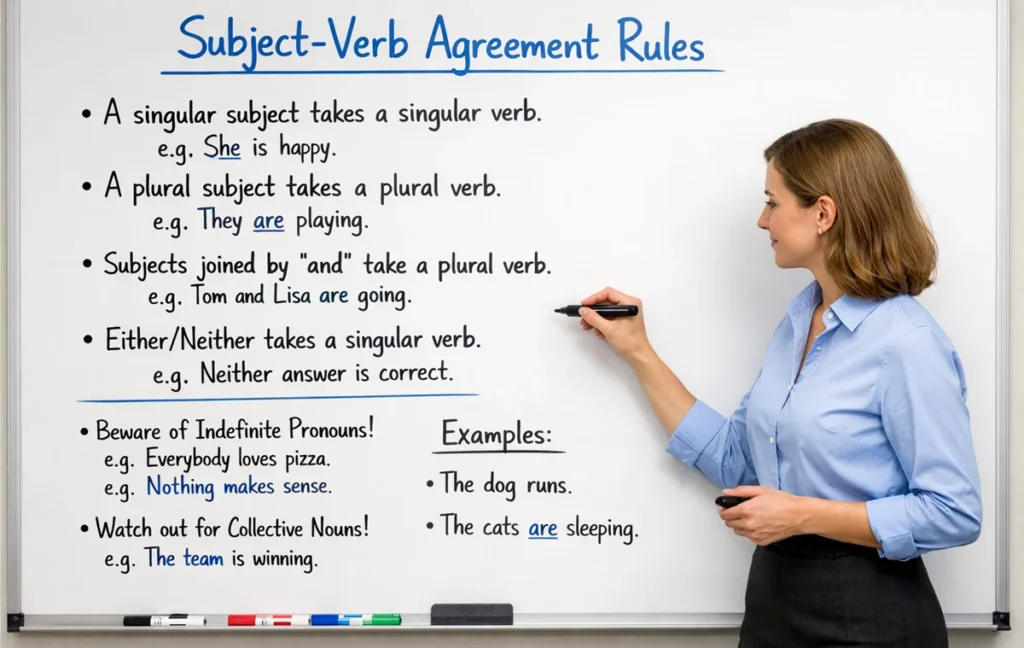
In the journey of mastering the English language, few things are as fundamental—yet as deceptively complex—as Subject-Verb Agreement (SVA). On the surface, the rule is simple: a singular subject takes a singular verb, and a plural subject takes a plural verb.
However, as any advanced learner at 99Learners knows, English is a language built on nuances and exceptions. Whether you are preparing for an English proficiency exam or refining your professional communication for 2026’s global workplace, understanding these ten advanced rules will set you apart from the average speaker.
Table of Contents
10 Advanced Subject-Verb Agreement Rules
The Core Foundation
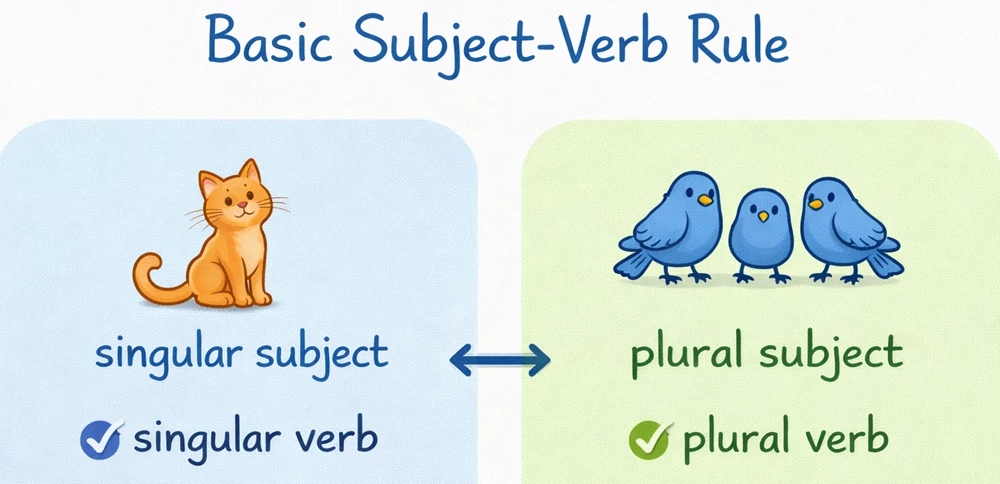
Before diving into the complexities, let’s revisit the anchor:
The student learns. (Singular verb; we add -s or -es to the verb based on its spelling.)
The students learn. (Plural)
While this seems straightforward, errors often creep in when the subject is separated from the verb by long phrases or when the “number” of the subject is ambiguous.
1. The “Intervening Phrases” Trap
One of the most common mistakes occurs when words like including, as well as, together with, or along with follow the subject. These phrases are not part of the grammatical subject.
Incorrect: The CEO, along with his assistants, are attending the seminar.
Correct: The CEO, along with his assistants, is attending the seminar.
Expert Tip: Mentally “cross out” the phrase between commas to find your true subject.
2. Collective Nouns: The Regional Nuance
Words like team, committee, staff, and family can be singular or plural depending on the context and the dialect of English (British vs. American).
American English: The team is winning. (The group is a single unit).
British English: The team are fighting among themselves. (The individuals are acting separately).
2026 Professional Standard: In global business English, the singular is usually preferred unless you are specifically highlighting individual disagreement within the group.
3. Indefinite Pronouns: The “Singular” Rule
Many learners assume that words like everyone, somebody, each, and neither are plural because they refer to multiple people. Grammatically, however, they are singular.
Correct: Each of the candidates has a unique vision.
Correct: Everyone in the digital marketing department is required to use the new AI tools.
Pro Tip: Although they seem to be referring to more than one person or thing, use a plural verb when they are the subject.
4. The “Either/Or” and “Neither/Nor” Proximity Rule
When subjects are joined by or or nor, the verb must agree with the part of the subject closest to the verb.
Example A: Neither the manager nor the employees want to work on Sunday.
Example B: Neither the employees nor the manager wants to work on Sunday.
5. Fractions and Percentages
In these cases, the verb depends on the noun that follows the “of” phrase.
Singular: Fifty percent of the pie has disappeared.
Plural: Fifty percent of the students have passed the exam.
You see: when the noun after ‘of’ is singular, the verb is singular; when the noun is plural, the verb is plural.
6. Distances, Periods of Time, and Sums of Money
When these units are considered as a single collective amount, they take a singular verb.
Correct: Five thousand dollars is too much to pay for that course.
Correct: Ten kilometers is a long way to walk in the heat.
7. The Case of “The Number” vs. “A Number”
This is a classic “trap” in advanced English exams.
The number of… is always singular (focuses on the specific total).
A number of… is always plural (functions like “many”).
Examples:
The number of learners on our site is increasing.
A number of students are struggling with this rule.
8. Plural-Form Nouns with Singular Meanings
Some nouns look plural because they end in “-s” but are actually singular in meaning. This includes disciplines like Mathematics, Physics, Economics, and News.
Correct: The news is traveling fast through social media.
Correct: Physics remains the most challenging subject for many.
Remember: Some words like ‘police’ look singular. Such plural-only words take plural verbs.
9. Inverted Sentences (Starting with “There” or “Here”)
In sentences beginning with there or here, the true subject follows the verb.
Incorrect: There is many reasons to study English.
Correct: There are many reasons to study English. (Subject: reasons)
Note: The true subject is after the verb in such sentences.
10. Compound Subjects with “And”
Generally, two subjects joined by “and” take a plural verb. However, if the two nouns refer to the same person or a single entity, the verb is singular.
Two people: The teacher and the principal are in the hallway.
One person: My teacher and mentor is coming to the party. (If the teacher is also the mentor).
One entity: Rice and beans is my favorite meal.
Quick Note:
Subject–verb agreement means that the verb must match the subject in number:
• Singular subject → singular verb
• Plural subject → plural verb
Some words may look singular but are actually plural, while others may look plural but are actually singular. Always check the meaning of the word to decide whether it is singular or plural.
When a sentence has multiple subjects, determine whether they together express a singular idea or a plural idea.
The key rule: the subject and verb must always agree in number.
One important exception is the pronoun “you”, which always takes a plural verb, even when referring to a single person.
Here is a table of the rules to help you memorise easily:
Table of Subject Verb Agreement Rules
| Rule | Explanation | Examples |
|---|---|---|
| Basic rule | Singular subject ⇒ singular verb; plural subject ⇒ plural verb. | She runs every day; They run every day. |
| Pronoun agreement | Check the subject’s person (1st, 2nd, or 3rd). | I am ready; You are ready; He is ready. |
| Compound subjects with ‘and’ | Subjects joined by and ⇒ plural verb. | Tom and Mary are here. |
| Compound subjects with or/nor | Check the nearest subject. | Either the teacher or the students are responsible. |
| Collective nouns | Singular verb when acting as a unit; plural when members act individually. | The team is winning; The team are arguing among themselves. |
| Indefinite pronouns | Everyone, someone, each, nobody ⇒ singular verb | Everyone is invited; Many are coming. |
| ‘There’ expressions | The verb agrees with the real subject that follows there or inversion. | There is a problem; There are two problems. |
| Intervening phrases | For phrases like along with, as well as, including, check the main subject. | The manager, along with his assistants, is present. |
| Amounts, titles, measurements | Treated as singular. | Ten dollars is enough; “War and Peace” is long. |
| Fractions and percentages | Agreement depends on the noun after ‘of’ | Half of the cake is gone; Half of the cookies are gone. |
| Each, every and distributives | Each and every before subjects ⇒ singular verb. | Each student is responsible. |
| Nouns singular in meaning | Words like news, mathematics, measles ⇒ singular verbs. | The news is surprising. |
| Plural-only nouns | Words like police ⇒ plural verbs. | The police are investigating. |
Conclusion: Why Accuracy Matters
In 2026, as AI-generated communication becomes the norm, the ability to use precise, grammatically correct English is a sign of high-level human expertise. Mastering Subject-Verb Agreement is the first step in ensuring your professional and academic writing is taken seriously.
Ready to test your knowledge? Take our Subject-Verb Agreement Quiz to see if you can score 20 out of 20 questions!