
One of the biggest challenges for Indian English learners isn’t grammar or vocabulary—it’s the “Internal Translator.” Most of us think in our mother tongue (Hindi, Manipuri, Bengali, etc.) and then translate those thoughts into English word-for-word.
We need to avoid the habit of translating directly from Hindi to English. While this helps us communicate, it often leads to “Indianisms”—sentences that are grammatically okay but sound strange to a native speaker. At 99Learners, we want to help you move past “Hinglish” and into natural, fluent English.
In this article, you’ll learn:
- why words like “only” and “na” can sound awkward in English,
- common Indian English phrases that should be avoided,
- and simple, natural alternatives you can start using immediately.
By the end, you’ll not only understand these mistakes—you’ll start speaking English in a way that sounds more fluent, clear, and natural.
Table of Contents
1. The “Only” Obsession (The Hi Habit)
In Hindi, we use the word “hi” (ही) to add emphasis. When we translate this to English, we often use the word “only.”
The Indianism: “I will do it today only.” (Main aaj hi karunga.)
The Natural English: “I will do it today.” or “I will do it this very day.”
The Indianism: “He is like that only.” (Woh aisa hi hai.)
The Natural English: “That’s just the way he is.”
The Indianism: “Do the work only.” (Kaam hi karo.)
The Natural English: “Just do the work.”
The Rule: In English, emphasis is usually created by your tone of voice or by using words like “just” or “exactly,” not by adding “only” at the end of a sentence.
2. The “Na” Tag (The Na? Habit)
In India, we often add “na?” (ना?) at the end of a sentence to ask for agreement. In English, this is called a Tag Question, but “na” is not a valid English tag.
The Indianism: “You are coming, na?” (Tum aa rahe ho, na?)
The Natural English: “You are coming, aren’t you?”
The Indianism: “It is very hot, na?” (Bahut garmi hai, na?)
The Natural English: “It’s very hot, isn’t it?”
The Indianism: “You are late, na?” (Tum der ho, na?)
The Natural English: “You’re late, aren’t you?”
The Rule: English tag questions must match the verb of the sentence. If the sentence is “You are,” the tag is “aren’t you?”
3. The “Good Name” Request
This is a very polite habit in India, but it sounds confusing to Westerners.
The Indianism: “What is your good name?” (Aapka shubh naam kya hai?)
The Natural English: “What is your name?” or (more formally) “May I ask your name?”
The Rule: In English, a name is just a name. There is no “bad name,” so the word “good” is unnecessary.
4. The “Mention Not” Response
When someone says “Thank you,” many Indians respond with “Mention not.” This is a direct translation of “Zikr mat kijiye” or “Koi baat nahi.”
The Indianism: “Mention not.”
The Natural English: “You’re welcome,” “No problem,” or “My pleasure.”
5. “I will tell him” vs. “I will give him a call”
In India, we often use the verb “to tell” for everything.
“Main use bol dunga” → “I will tell him.”
While correct, native speakers are more specific. If you are going to call them, say: “I’ll give him a call” or “I’ll let him know.”
Quick Summary: The “Fix-It” Table
| Avoid saying… | Instead, try… |
| “I am living here since 2 years.” | “I have been living here for 2 years.” |
| “She is my cousin sister.” | “She is my cousin.” |
| “I passed out in 2022.” | “I graduated in 2022.” |
| “Do one thing…” | “I have a suggestion…” |
More examples:
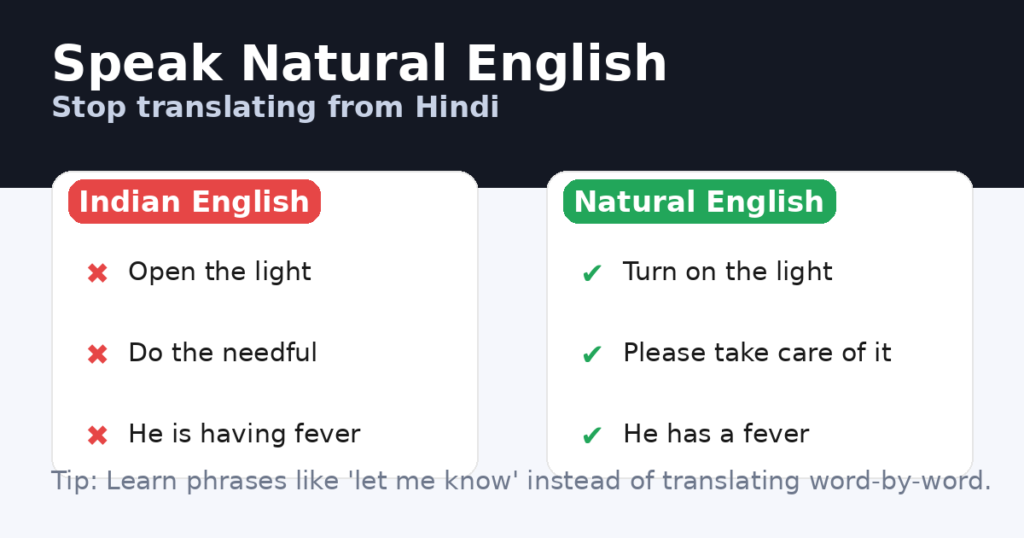
| ❌ Common Indian English | ✅ Natural English |
|---|---|
| Open the light. | Turn on the light. |
| Do the needful. | Please take care of it. |
| He is having fever. | He has a fever. |
| I am coming in bus. | I am coming by bus. |
How to Break the Habit
The best way to stop translating is to immerse yourself. Instead of translating a Hindi sentence, try to learn “Chunks of Language.” Don’t learn “Thank” + “You.” Learn the whole chunk: “You’re very welcome.” When you learn phrases as one single unit, your brain stops trying to translate individual words.
Speak Naturally, Not Literally
Instead of focusing on individual words, start paying attention to how complete sentences are actually used in real conversations.
Remember, making mistakes is part of the learning process—but repeating the same habits can hold you back. The more you notice and correct these patterns, the faster your English will improve.
Simple tip: Pick 2–3 example phrases from this article and start using them in your daily conversations today.
If you found this helpful, save this guide and revisit it whenever you need a quick refresher. Keep practicing—and keep improving your English, one sentence at a time.