
In the CAT VARC section, Reading Comprehension questions are designed to test your precision, not just your general understanding.
Most aspirants can easily eliminate two completely irrelevant options. But then they hit the wall: the 2-option trap.
You narrow down the choices to Option (B) and Option (C). Both look reasonable, both may use words from the passage, and both seem to answer the question. You spend 60–90 seconds deliberating, make a guess, and move on—sometimes with the wrong answer.
The key is not to ask, “Which option sounds right?”
Instead, ask:
“What specific flaw makes one of these options less supported by the passage?”
CAT RC options often follow recognisable patterns that make incorrect answers look plausible. By learning to identify these patterns, you can eliminate wrong choices more systematically and save valuable time.
How we developed this guide: The elimination techniques in this article are presented as practical test-taking heuristics based on common patterns in CAT-style RC questions. They are not official CAT rules or claims about the internal question-setting process of IIMs.
Table of Contents
What Is the 2-Option Trap in CAT RC?
In a CAT RC question, a passage is given. Then, they ask a question with four answer options to choose the best one. The 2-option trap occurs when you have already eliminated two choices but cannot confidently distinguish between the remaining two.
One option may sound more sophisticated, while the other may contain familiar words from the passage.
Don’t choose simply because an option:
- sounds more logical;
- uses words directly from the passage;
- is longer or more detailed;
- agrees with your personal opinion; or
- feels familiar.
Instead, compare the two options against the passage’s exact meaning, scope, logic, and the question it asks.
The goal is not to prove that one option is absolutely false. Your goal is to identify which option is better supported by the passage.
The 2-Option Trap: How to Eliminate Incorrect Choices in CAT Reading Comprehension
Here are common CAT RC trap patterns to consider, as we found in previous years’ CAT papers:
1. The “Extreme Generalisation” Trap
This option takes a nuanced, conditional claim made by the author and inflates it into an absolute statement.
How the Trap Works: Suppose a passage says, “In many developing markets, regulatory hurdles slow down tech adoption”. It might change into “Regulatory hurdles always prevent tech adoption in emerging economies.”
Watch Out For Absolutes: Be particularly careful with words such as: always, never, completely, entirely, only, impossible, every, paramount, solely.
The Rule: If the author makes a qualified or cautious claim, be highly suspicious of an option that turns it into an absolute statement.
Ask: “Has this option made the author’s claim stronger than the passage does?”
If yes, eliminate it.
2. The “Distorted Fact” Trap (The Twist)
This is the most dangerous trap in CAT VARC. The option uses exact phrases and key vocabulary directly from the passage, making it look visually familiar. However, it subtly twists the cause-and-effect relationship or assigns an action to the wrong subject.
See how:
Passage: “Because of rising inflation, central banks increased interest rates, which led to a decline in real estate investments.”
Trap Option: “Real estate investments declined because central banks failed to manage inflation.” (The option uses the same general ideas or words, but it introduces a different claim.)
The Rule: Don’t rely on word matching. Verify the direction of causality (A caused B, not B caused A) and who is performing the action.
An option can contain the passage’s vocabulary and still be wrong.
3. The “Right Statement, Wrong Question” Trap
This option contains a statement that is 100% true according to the passage. However, it does not answer the question being asked. This is especially common when a passage contains several important ideas.
How The Trap Works: If the question asks “Why did the author critique the traditional economic model in Paragraph 3?”, the trap option will correctly summarise a fact from Paragraph 1 or state a broad truth from Paragraph 4 that does not explain why the critique was made.
The Rule: Always re-read the question stem before selecting your final answer. Ask: “Even if this statement is true, does it directly address the question?”
The correct answer must satisfy both conditions:
Supported by the passage + Answers the question asked
4. The “Out of Scope / External Knowledge” Trap
This trap appeals to your real-world logic, prior knowledge, or common sense, but the idea is never stated or implied in the text.
How the Trap Works: An option might say, “The Paris Agreement demonstrates why governments need stronger climate policies.” It may be factually reasonable in the real world. But if the passage never discusses the agreement or anything that supports the claim, the option is outside the scope of the passage.
The Rule: Treat the passage as your primary source of evidence. If an option relies on facts or conclusions outside the boundaries of the text, eliminate it. Or you can check if it paraphrases the author’s ideas.
5. The “Too Broad or Too Narrow” Trap
An option can be related to the passage and still be wrong because it changes the scope of the author’s claim.
Too Broad
Passage: “Some software companies have reported higher productivity after adopting flexible working arrangements.”
Trap Option: “Flexible working arrangements increase productivity.” The passage talks about some companies. The option makes a general claim about flexible working arrangements.
Too Narrow
Passage: “Flexible working arrangements can improve productivity in software companies.”
Trap Option: “Flexible working arrangements improve productivity only in small software companies.” The option adds a restriction that the author never made.
The Rule: Compare the scope of the option with the scope of the passage.
Ask: “Is this answer broader or narrower than what the author actually said?”
This is particularly useful when both remaining options seem related to the passage.
Why Word Matching Can Mislead You
One of the biggest mistakes in CAT RC is assuming that the option containing the most words from the passage must be correct.
It doesn’t.
An incorrect option can deliberately repeat the passage’s vocabulary while altering the relationship between ideas.
Conversely, a correct answer may use completely different words while accurately paraphrasing the author’s argument.
When comparing two options, check five things:
- Meaning: Does it preserve the author’s idea?
- Evidence: Can you locate support in the passage?
- Logic: Has it changed the author’s reasoning?
- Scope: Is it broader or narrower than the passage?
- Certainty: Has it changed a cautious statement into a definite one?
Think meaning matching, not word matching.
Practice Breakdown: The 2-Option Trap in Action
Read the short passage excerpt below and work through the option elimination log:
“While artificial intelligence models have demonstrated astonishing capability in processing natural language, they lack genuine intentionality. An AI system can synthesize thousands of medical journals to recommend a diagnosis, yet it possesses no subjective awareness of illness or healing. Critics who worry that algorithmic diagnostic tools will fully replace human physicians overlook this fundamental distinction: medicine is not merely an exercise in pattern recognition, but an empathetic practice grounded in shared human experience.”
Question: Which of the following best expresses the primary reason why the author believes AI cannot fully replace human physicians?
(a) AI models are fundamentally incapable of pattern recognition and medical data synthesis.
(b) Medicine requires subjective awareness and empathy, which algorithmic systems inherently lack.
(c) Physicians are opposed to AI tools because diagnostic algorithms frequently make errors in natural language processing.
(d) Medical diagnostics will always fail unless human doctors oversee every computational step.
Option Elimination Log
                          OPTION ELIMINATION LOG

  (a) AI models are incapable of pattern recognition...
      └─► [DIRECT CONTRADICTION] Passage states AI has "astonishing capability" in this.

  (b) Medicine requires subjective awareness and empathy...
      └─► [CORRECT] Accurately captures the author's argument on intentionality/empathy.

  (c) Physicians are opposed to AI tools because...
      └─► [OUT OF SCOPE] The passage mentions "critics," not physician opposition or error rates.

  (d) Medical diagnostics will ALWAYS fail unless...
      └─► [EXTREME GENERALIZATION] Uses the absolute "always fail" which the author never claims.
Option (a) — Direct Contradiction: The passage explicitly states that AI possesses “astonishing capability in processing natural language” and synthesizing medical data. This directly contradicts the passage.
Option (c) — Out of Scope: The passage talks about “critics who worry,” but never mentions physicians being opposed, nor does it claim algorithms “frequently make errors.”
Option (d) — The Extreme Trap: Notice the word “always” (“will always fail”). The author argues that medicine requires empathy, not that computational diagnostics are entirely useless or will “always fail.”
Option (b) — The Correct Answer: Captures the core premise: medicine involves empathy and subjective awareness, which AI lacks (“they lack genuine intentionality” / “medicine is… an empathetic practice”).
Notice that option (B) does not simply repeat one sentence from the passage. It combines the passage’s two central ideas—AI’s lack of subjective awareness and medicine’s dependence on empathy—to capture the author’s overall argument.
The 15-Second Elimination Matrix
When you are down to the final two options during a CAT mock test, run them through this rapid filter.
| Step | Checkpoint Question | If YES |
|---|---|---|
| 1 | Does the option use absolute language when the passage is conditional? | Eliminate: Extreme Generalisation |
| 2 | Does it reverse cause and effect or change who performed an action? | Eliminate: Distorted Fact |
| 3 | Is it true but does not answer the specific question? | Eliminate: Wrong Question |
| 4 | Does it introduce information or conclusions unsupported by the passage? | Eliminate: Out of Scope |
| 5 | Is it broader or narrower than the author’s actual claim? | Eliminate: Scope Error |
You can remember the five checks as:
Certainty → Logic → Question → Evidence → Scope
You don’t need to spend a minute analysing every option. Once you identify a decisive flaw, eliminate it and move on.
A Simple CAT RC Elimination Cheat Sheet
When stuck between two options, ask:
- Is it too extreme? (always, never, all, only, completely) → Check whether the passage supports that level of certainty.
- Is the logic distorted? (A caused B becomes B caused A) → Check the direction of the argument.
- Is it answering another question? (The statement may be true but irrelevant to the question.) → Return to the question stem.
- Is it out of scope? (The option depends on information not supported by the passage.) → Treat the passage as your evidence base.
- Is it too broad or too narrow? (The option changes the scope of the author’s claim.) → Compare the exact boundaries of the two statements.
If an option survives all five checks and best represents the passage, it is usually the stronger choice.
Test Your Elimination Skills
Try the following mini-question before looking for the answer.
Passage:
“Although online education has made learning accessible to a wider audience, access alone does not guarantee effective learning. Students also need appropriate course design, opportunities for interaction, and sufficient motivation. Thus, the expansion of online education should not be judged solely by the number of students who can access digital courses.”
Question:
Which of the following best captures the author’s argument?
(a) Online education is ineffective because students generally lack motivation.
(b) Online education has expanded access to learning but should be evaluated using factors beyond accessibility.
(c) Students learn better through face-to-face education than through online courses.
(d) Digital courses should be available only to highly motivated students.
Answer: (b)
Why?
- (a) exaggerates the role of motivation.
- (c) introduces a comparison the passage does not make.
- (d) introduces an unsupported restriction.
- (b) captures both sides of the author’s argument: online education expands access, but access alone is insufficient.
The correct answer is not necessarily the one with the most words from the passage. It is the one that most accurately captures the author’s overall meaning.
Recommended Books for CAT VARC Practice
To practice identifying distractor options and improving your elimination skills, consider using these most trusted CAT VARC preparation books:
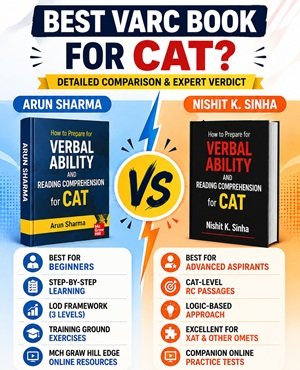
How to Prepare for VARC for CAT by Arun Sharma: Useful for structured VARC practice and working through RC sets of different difficulty levels.
VARC for the CAT by Nishit K. Sinha: Useful for practising RC, critical reasoning, option analysis, and related VARC skills.
Which book of the two will you read? Or will you read both?
We compare the two books. Read it from this link → Nishit Sinha vs. Arun Sharma: Best CAT VARC Book
Final Takeaway
Remember: When you are stuck between two CAT RC options, don’t ask: “Which one sounds better?”
Ask: “Which option is more directly supported by the passage and answers the exact question without changing the author’s meaning, logic, certainty, or scope?”
Check for: Extreme claims → Distorted logic → Wrong question → Out-of-scope information → Scope errors
Once you learn to look for these flaws systematically, the 2-option trap becomes much easier to handle. Practise more with the recommended books to develop your CAT RC skill fast.