In the Bank PO (SBI, IBPS) and Clerk examinations, the Para Jumble (Sentence Rearrangement) section is one of the highest-stakes areas in the English paper. It usually presents a set of 5 to 6 scrambled sentences (labelled A, B, C, D, E, F). Many candidates lose valuable marks because they try to arrange every sentence in the correct order before answering the questions. Under exam pressure, this approach often leads to confusion, wasted time, and negative marking.
But you don’t always need to solve the entire paragraph to score well.
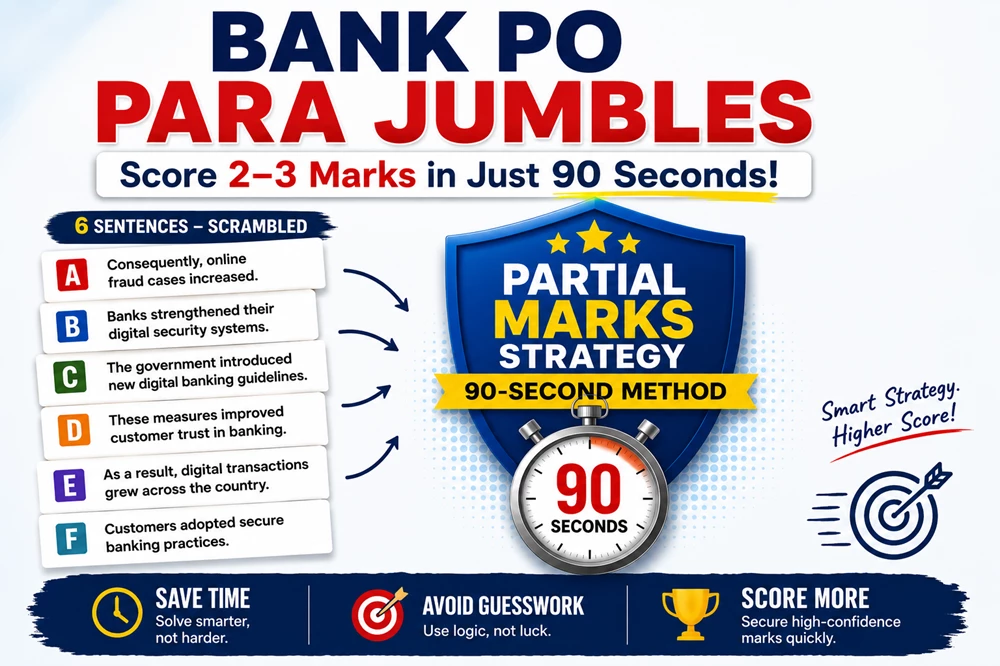
This guide introduces the Partial Marks Strategy—a practical technique that helps you identify the most important clues in a para jumble, answer high-confidence questions quickly, and avoid spending several minutes on difficult sentence arrangements. You’ll learn how to secure 2–3 marks in less than 90 seconds by focusing on the first sentence, the last sentence, and mandatory sentence pairs.
Whether you’re preparing for SBI PO, SBI Clerk, IBPS PO, IBPS Clerk, or other competitive examinations, this strategy can improve both your speed and accuracy.
Table of Contents
What Is the Partial Marks Strategy?
The Partial Marks Strategy is a smart exam technique that focuses on solving only the highest-confidence parts of a para jumble instead of rearranging every sentence.
Rather than spending four or five minutes trying to determine the complete order of six scrambled sentences, you identify the clues that are easiest to recognise:
- the opening sentence
- the concluding sentence
- Mandatory sentence pairs
These clues are often enough to answer many exam questions correctly without reconstructing the entire paragraph.
The goal is maximum marks with minimum risk.
Why Most Candidates Lose Marks in Para Jumbles
Because they believe they must solve the entire paragraph before answering any question. This assumption creates several problems, like these:
- They spend too much time on it, so they lose time for other questions.
- One wrong sentence ruins everything. If they place one sentence in the wrong position, every sentence after it may also become incorrect.
- Exam pressure increases confusion. As the timer counts down, they begin second-guessing themselves. They repeatedly rearrange the same sentences instead of moving on.
- They ignore easy clues. Recognising the clues is often enough to answer several questions correctly.
Why the Partial Marks Strategy Works
The Partial Marks Strategy is based on the way paragraphs are naturally written.
A logical paragraph usually follows this sequence:
Introduction → Explanation → Development → Conclusion
Because of this structure:
- the first sentence introduces the topic.
- the last sentence summarises or concludes it.
- the middle sentences develop the idea.
The opening and closing sentences are generally easier to identify than the middle ones. You should focus on predictable relationships between the middle sentences.
Note: This method is especially useful for competitive examinations that include sentence rearrangement questions. Besides bank exams, it is also useful to candidates appearing in SSC CGL, CHSL, CPO, CDS, and AFCAT. The underlying logic works for almost every sentence rearrangement question.
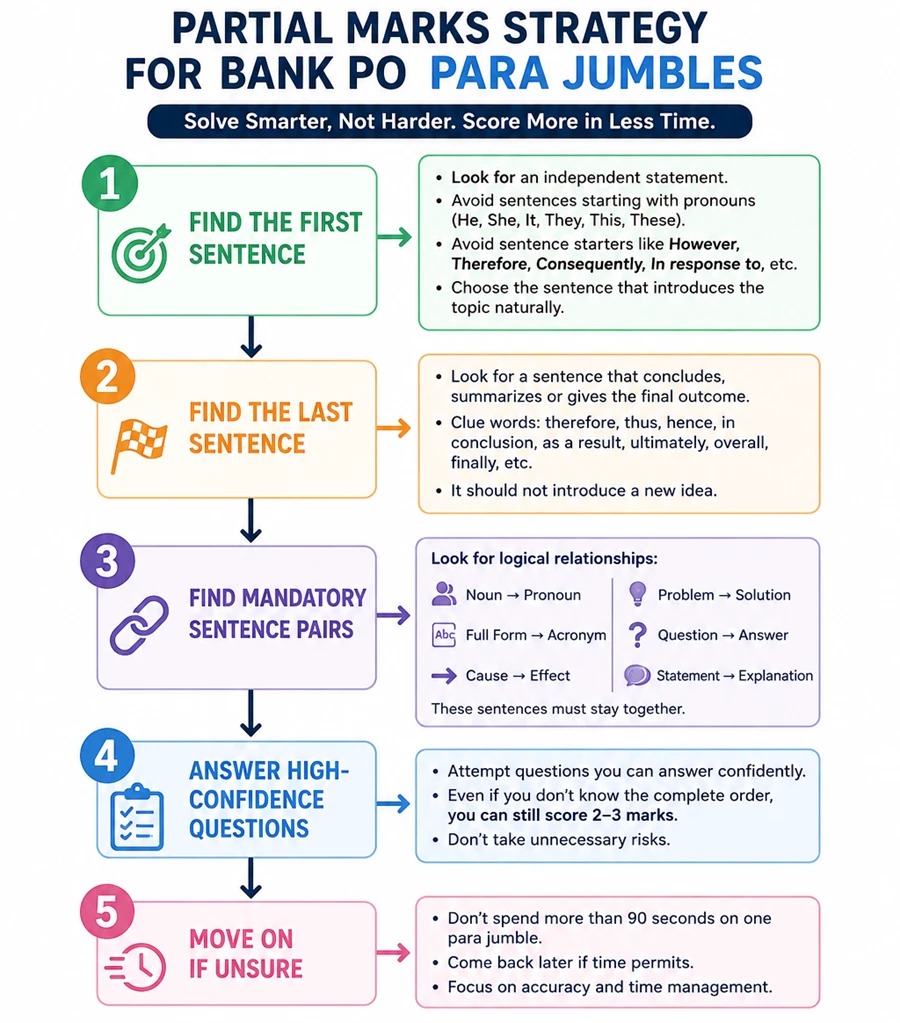
The “Partial Marks” Strategy for Banking Para Jumbles
The core philosophy of this strategy is simple: Isolate the anchors, ignore the noise. Instead of trying to solve the chaotic middle sequence immediately, focus on extracting the absolute First Sentence, the Final Sentence, and any obvious Mandatory Pairs.
Phase 1: Locking the 1st Sentence (The Independent Noun)
The opening sentence of a banking passage must be self-contained. It introduces a theme, a concept, an organisation, or a broader economic trend without relying on prior information.
The Rule of Elimination for the 1st Sentence: Cross out any sentence that starts with such words or phrases:
Pronouns: He, She, They, It, These, Those, This. (They require a prior noun).
Transition Connectors: However, Moreover, Furthermore, Consequently, On the other hand, Similarly.
Continuation Phrases: This initiative, Such measures, These reforms, As a result.
What to Look For: A good opening sentence introduces the topic independently. It should make complete sense without requiring any earlier context.
For example, “The Reserve Bank of India has recently revised its monetary policy framework.”
This sentence can easily begin a paragraph because it introduces the topic independently.
Phase 2: Locking the Last Sentence (The Concluding Result)
The final sentence brings closure to the passage. It often summarises the main argument, states a future outlook, or highlights a final consequence.
What to Look For: Words like Thus, Hence, Therefore, Ultimately, In conclusion, As a direct consequence, Going forward.
Logic Check: A concluding sentence usually resolves the problem or debate introduced in the earlier sentences.
For example, “As a result, the banking sector gradually recovered from the liquidity crisis.”
This sentence clearly sounds like a conclusion because it explains the outcome.
A concluding sentence should answer one simple question: “What happened in the end?” If the sentence naturally answers that question, it is likely the final sentence.
Phase 3: Extracting Mandatory Pairs (The 1+1 Combo)
Even if you cannot place the middle sentences in their exact positions (2nd, 3rd, 4th), it’s fine. Look for mandatory pairs—two sentences that must stay together because one directly depends on the other. A mandatory pair consists of two consecutive sentences that cannot be separated because they share a logical relationship.
Noun-Pronoun Pair: If sentence B introduces “The Financial Stability and Development Council (FSDC)” and sentence D refers to “The council’s recommendations…”, then BD is a mandatory pair.
Acronym Pair: Full form comes before the short form (e.g., “Securities and Exchange Board of India (SEBI)” precedes “SEBI guidelines”).
Cause and Effect: A sentence stating a cause (“Heavy rains flooded the agricultural belt…”) must precede the sentence stating the outcome (“Consequently, food inflation spiked in the third quarter…”).
Usually, sentence flow is also as follows:
- Problem → Solution
- Question → Answer
- Statement → Explanation
- Event → Result
It means that a sentence depends on the other. You should look for this logical relationship.
See the practice sets after the flowchart carefully.
Banking-Pattern Practice Set
Directions: Rearrange the following six sentences (A, B, C, D, E, F) into a meaningful paragraph, then answer the questions that follow.
A. Consequently, small and medium enterprises (SMEs) faced severe liquidity crunches, leading to a temporary halt in their expansion plans.
B. To mitigate this credit crunch, the central bank introduced a targeted long-term repo operation to inject liquidity into commercial banks.
C. Over the past two fiscal years, global supply chain disruptions have severely impacted the cash flows of manufacturing firms across India.
D. This intervention enabled commercial banks to extend softer loans to struggling businesses at lower interest rates.
E. As a result of this timely financial support, the SME sector began showing steady signs of operational recovery by the end of the year.
F. Furthermore, private commercial banks became increasingly risk-averse, tightening their lending norms for high-risk borrowers.
Step-by-Step “Partial Marks” Execution
Step 1: Find the Opening Sentence (1st Mark)
A: Starts with “Consequently” → Eliminated.
B: Starts with “To mitigate this credit crunch” (Which credit crunch? Needs prior context) → Eliminated.
C: Introduces a broad independent statement (“Over the past two fiscal years, global supply chain disruptions…”) without relying on prior pronouns or connectors → LOCK AS 1ST SENTENCE.
Step 2: Find the Final Sentence (2nd Mark)
Look at E: “As a result of this timely financial support, the SME sector began showing steady signs of operational recovery by the end of the year.”
This provides a complete, positive resolution to the entire crisis described in the passage → LOCK AS LAST (6TH) SENTENCE.
Step 3: Identify a Mandatory Pair (3rd Mark)
Sentence B mentions the central bank introducing “targeted long-term repo operations”.
Sentence D starts with “This intervention enabled…”. “This intervention” refers directly to the repo operations in B.
Therefore, BD is an unbreakable mandatory pair.
Sentence A mentions “SMEs faced severe liquidity crunches…” and Sentence B starts with “To mitigate this credit crunch…”. Thus, A leads directly into B.
This gives us the cluster: A → B → D.
Full Sequence Reconstruction (For Verification)
C (Broad Problem: Supply chain disruptions impact manufacturing cash flows)
F (Compounding Problem: Commercial banks tighten lending norms)
A (Impact of the Problem: SMEs face severe liquidity crunches)
B (Solution Introduced: Central bank injects liquidity)
D (Effect of Solution: Banks extend softer loans)
E (Final Outcome: SME sector recovers)
Correct Order: C → F → A →B → D → E
Practice Set 2
Directions: Rearrange the following five sentences into a meaningful paragraph.
A. Consequently, many customers shifted to digital payment platforms.
B. The government introduced several initiatives to promote digital transactions across the country.
C. This change reduced the use of cash in urban areas.
D. Banks also launched user-friendly mobile banking applications.
E. As a result, online financial transactions increased significantly.
Step 1: Find the Opening Sentence
Sentence B (It introduces the main topic independently.)
Step 2: Find the Last Sentence
Sentence E (The phrase “As a result” summarises the overall outcome.)
Step 3: Find Mandatory Pairs
B → D (Banks launched mobile applications because of the government’s initiatives.)
A → C (“This change” clearly refers to customers shifting to digital payment platforms.)
Correct Order: B → D → A → C → E
Practice Set 3
Directions: Arrange the following six sentences.
A. Consequently, loan defaults increased across several sectors.
B. Commercial banks tightened their lending standards.
C. Many businesses experienced severe financial difficulties during the economic slowdown.
D. To reduce financial stress, the central bank announced several liquidity measures.
E. These measures encouraged banks to provide additional credit to eligible borrowers.
F. As a result, economic activity gradually began to recover.
Step 1: Opening Sentence
C (It introduces the problem.)
Step 2: Concluding Sentence
Sentence F (It presents the outcome.)
Step 3: Mandatory Pairs
D → E (“These measures” refers directly to the liquidity measures introduced in Sentence D.)
C → A (Businesses face financial difficulties. Consequently, loan defaults increase.)
B → D (Banks tighten lending. The central bank responds with liquidity measures.)
Correct Order: C → A → B → D → E → F
Practice Set 4
Directions: Arrange the following six sentences.
A. Consequently, inflationary pressures began affecting household budgets.
B. Several global events disrupted international supply chains.
C. Central banks around the world responded by tightening monetary policies.
D. Higher borrowing costs eventually slowed consumer spending.
E. These disruptions increased transportation and production costs.
F. As demand weakened, inflation gradually started easing.
Step 1: Find the Opening Sentence
Sentence B (It introduces the topic independently.)
Step 2: Find Mandatory Pair
B → E (“These disruptions” refers directly to supply chain disruptions.)
Step 3: Cause and Effect
E → A (Higher production costs lead to inflation.)
Step 4: Problem and Response
A → C (Inflation causes central banks to tighten monetary policy.)
Step 5: Final Sequence
C → D → F (Higher interest rates reduce consumer spending. Lower demand eventually slows inflation.)
Correct Order: B → E → A → C → D → F
EXAM TIP
Never let one difficult para jumble consume your entire English section.
Top scorers don’t answer every question. They answer the right questions quickly and avoid unnecessary risks.
The Partial Marks Strategy is about maximising your score—not proving that you can solve every sentence arrangement perfectly.
How the “Partial Marks” Strategy Wins in the Exam
Even if you were confused about the order of the sentences, the strategy secures your core marks safely:
| Question Asked | Strategic Answer | Time Spent | Confidence |
|---|---|---|---|
| Which is the FIRST sentence? | Identify the opening sentence | 30 seconds | 100% |
| Which is the LAST sentence? | Identify the concluding sentence | 30 seconds | 100% |
| Which is the FOURTH sentence? | Find mandatory pairs | 30 seconds | 90% |
Result: Using the Partial Marks Strategy, you can confidently secure 3 out of 5 marks in approximately 90 seconds, while avoiding the risk of losing marks by forcing the complete sentence sequence.
Tactical Decision Matrix for Aspirants
| Exam Situation | Recommended Action | Risk Level |
|---|---|---|
| Clear Opening Sentence + Clear Concluding Sentence | Solve the First Sentence, Last Sentence, and any obvious Mandatory Pairs. Skip guessing the middle sequence if time is limited. | Low Risk / High Reward |
| Most Sentences Begin with Connectors (However, Consequently, Therefore, etc.) | Focus on finding a single Mandatory Pair (Pronoun–Noun, Cause–Effect, Problem–Solution, etc.) and answer only the related questions. | Controlled Risk |
| Highly Abstract or Philosophical Passage | Skip the para jumble and focus on higher-scoring questions such as Error Spotting, Fill in the Blanks, or Cloze Test. | Zero Risk |
Common Mistakes Candidates Make
Even well-prepared aspirants lose marks in para jumbles because they make a few predictable mistakes. Recognising these errors can significantly improve your accuracy.
- Trying to Arrange Every Sentence: Instead, identify the first sentence, the last sentence, and one or two mandatory pairs. Answer the questions you can solve confidently and move on.
- Ignoring Pronoun References: Pronouns always refer to something mentioned earlier. They help you identify the preceding sentences.
- Choosing a Connector as the Opening Sentence: Words like However, Therefore, Consequently, and Moreover indicate continuation. They rarely start a paragraph.
- Ignoring Cause-and-Effect Relationships: The second sentence clearly depends on the first. Always look for logical relationships before trying random combinations.
- Spending Too Much Time: Every extra minute spent on one para jumble is one less minute for other questions of the paper. Smart candidates manage both time and accuracy.
When Should You Use or Avoid the Partial Marks Strategy?
This strategy works best when:
- ✔ The para jumble contains five or six sentences.
- ✔ Questions ask for the first, last, or specific sentence positions.
- ✔ You can easily identify logical clues.
- ✔ Time is running short.
- ✔ You want to maximise marks while minimising risk.
Although highly effective, this strategy is not suitable for every situation. Avoid relying on it when:
- the paragraph contains only three or four simple sentences.
- every relationship is obvious.
- you can confidently solve the complete sequence in under one minute.
- the exam specifically requires the full sequence without individual position-based questions.
Choose the method that best fits the question, not the one you practised most.
Exam-Day Checklist
Before selecting an answer, ask yourself:
✔ Have I identified the independent opening sentence?
✔ Have I identified the concluding sentence?
✔ Did I find any pronoun references?
✔ Did I identify any cause-and-effect relationships?
✔ Did I notice any acronym or abbreviation clues?
✔ Have I spent more than 90 seconds?
If your answer to the last question is Yes, move on to the next question.
Recommended Books for Para Jumble Mastery
The following books help aspirants master para jumbles and other questions in bank exams:
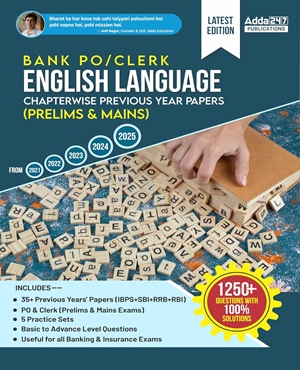
Bank PO & Clerk English Language Chapterwise Previous Year Papers (Prelims & Mains): Offers hundreds of previous-year solved questions, including Para Jumbles.
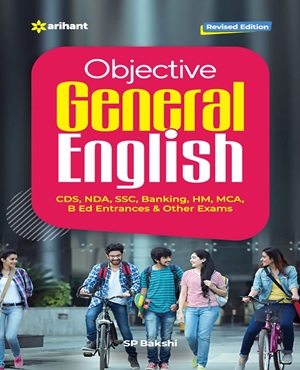
Objective General English by S.P. Bakshi: The chapter on Sentence Rearrangement explains coherence connectors and pronoun linkage rules with exceptional clarity.
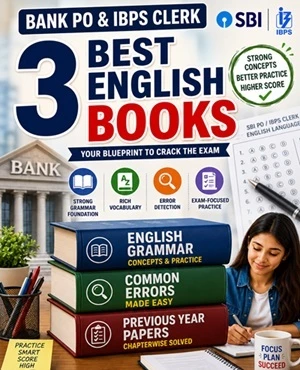
For complete preparation for Bank PO and Clerk Exams, check out these Best Books for Bank PO & IBPS Clerk.
Conclusion
Para Jumbles are not designed to test luck—they assess your ability to recognise logical connections between ideas.
Many candidates lose marks because they try to solve every sentence arrangement perfectly under time pressure. The Partial Marks Strategy offers a more practical approach. By using the strategy, you can answer the questions accurately without reconstructing the entire paragraph.
Practice this strategy consistently with previous years’ papers and mock tests. Over time, you’ll begin to recognise common patterns more quickly, improve your confidence, and solve para jumbles with greater speed and precision.