For CAT aspirants, the Verbal Ability and Reading Comprehension (VARC) section is often the make-or-break element. Unlike Quantitative Aptitude, where formulas yield exact answers, VARC demands deep comprehension, inference drawing, and eliminating options that “feel” right but are logically flawed.
When it comes to offline study resources, two names dominate the market:
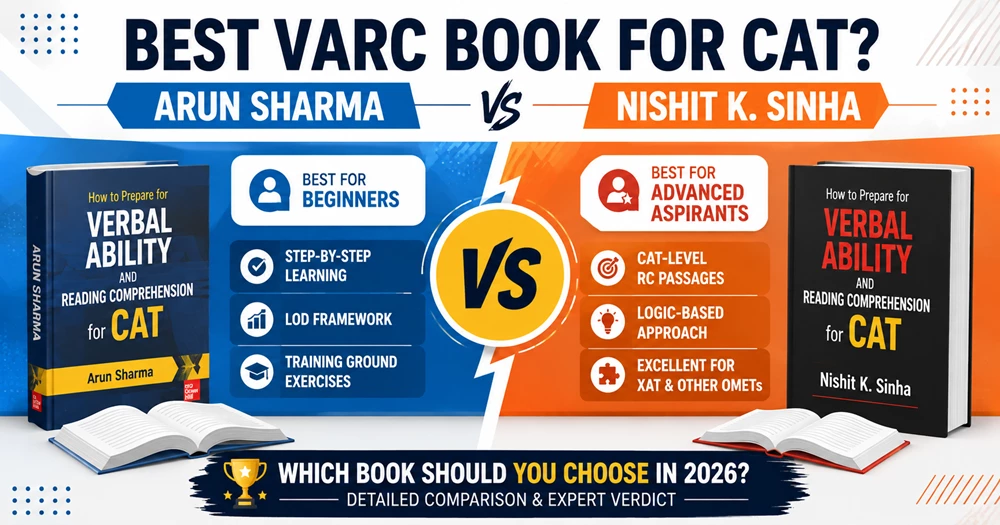
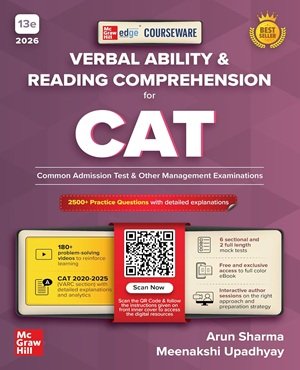
How to Prepare for Verbal Ability and Reading Comprehension for CAT by Arun Sharma & Meenakshi Upadhyay (McGraw Hill)
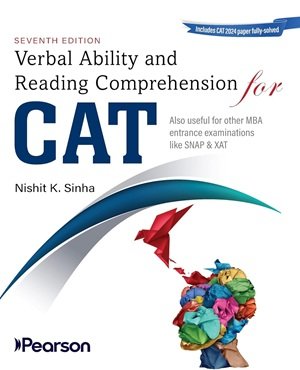
Verbal Ability and Reading Comprehension for the CAT by Nishit K. Sinha (Pearson)
Both authors are legendary mentors—Arun Sharma (IIM-B alumnus, serial 99.99%iler) and Nishit K. Sinha (IIM-L alumnus, mentor to thousands of toppers). However, their pedagogical styles, question structuring, and target audiences differ significantly.
This detailed comparison examines their structure, content quality, learning methodology, Reading Comprehension (RC) practice, Verbal Ability (VA) coverage, and suitability for different skill levels. By the end of this guide, you’ll know which book aligns best with your preparation strategy.
Table of Contents
Quick Verdict
If you don’t have time to read the entire comparison, here’s the short answer:
- Best for Beginners: Arun Sharma
- Best for Intermediate & Advanced Aspirants: Nishit K. Sinha
- Best Reading Comprehension Practice: Nishit K. Sinha
- Best for Self-Study: Arun Sharma
- Best Overall Strategy: Start with Arun Sharma to build strong fundamentals, then move to Nishit K. Sinha for advanced practice and CAT-level inference questions.
Both books are excellent. Your choice depends on your current level, learning style, and target percentile.
Why VARC Is the Most Decisive Section in CAT
Because VARC demands:
- Strong reading comprehension
- Critical thinking and logical reasoning
- The ability to distinguish subtle differences between answer choices
- Effective elimination of options that appear correct but are logically flawed
Recent CAT papers have increasingly emphasised inference-based Reading Comprehension and analytical thinking rather than vocabulary or grammar alone. Therefore, choosing a book that reflects the latest exam pattern is just as important as practising consistently.
About the Authors
Arun Sharma, an IIM Bangalore alumnus, is one of India’s most respected CAT mentors and has helped thousands of aspirants achieve top percentiles. His books are known for their highly structured learning approach and step-by-step progression.
Nishit Sinha, an IIM Lucknow alumnus, is another well-known CAT mentor whose books are widely appreciated for their conceptual clarity and exam-oriented approach. His VARC book focuses heavily on logical reasoning, inference, and modern Reading Comprehension techniques that closely resemble recent CAT papers.
Nishit Sinha vs. Arun Sharma: Which VARC Book is Best for CAT?
Nishit Sinha vs. Arun Sharma At A Glance
| Feature | Arun Sharma & Meenakshi Upadhyay | Nishit K. Sinha |
|---|---|---|
| Publisher | McGraw Hill | Pearson |
| Author Background | IIM Bangalore alumnus | IIM Lucknow alumnus |
| Learning Approach | Structured Level of Difficulty (LOD) progression | Progressive concept-building and logical reasoning |
| Difficulty Progression | Three Levels of Difficulty with Training Ground | Gradual concept development with advanced practice |
| Solution Style | Detailed, step-by-step explanations | Concise, logic-driven explanations |
| Reading Comprehension | Classical, diverse passages with structured analysis | Modern, abstract passages emphasizing inference |
| Verbal Ability | Rule-based techniques and systematic methods | Logic-first approach with focus on argument flow |
| Best For | Beginners and self-study aspirants | Intermediate and advanced aspirants |
| OMET Coverage | Excellent for CAT, XAT, SNAP, and NMAT | Strong emphasis on CAT, XAT, and other OMETs |
1. Structural Approach & Difficulty Gradation
One of the biggest differences between Arun Sharma and Nishit K. Sinha lies in how they teach VARC concepts. While both books cover similar topics, their learning methodologies are designed for different types of CAT aspirants.
Arun Sharma (McGraw Hill)
The “LOD” Framework: Arun Sharma’s trademark structure relies on dividing practice exercises into three clear Levels of Difficulty:
LOD 1: Basic conceptual validation, direct RC questions, and fundamental grammar.
LOD 2: The “CAT Benchmark” level—inference-heavy RCs, tricky Para Jumbles, and subtle option traps.
LOD 3: High-complexity sets meant to challenge top-percentile seekers.
The “Training Ground” Section: A unique feature where the authors walk you through live problem-solving thought processes. It teaches you how to read an RC passage like an expert, annotate key paragraphs, and eliminate wrong options.
If you are preparing without coaching, these guided examples simulate a classroom experience, making self-study significantly easier.
Pros
- Highly structured and beginner-friendly
- Excellent step-by-step explanations
- Clear difficulty progression through LOD levels
- Ideal for self-study
- Builds confidence gradually
Cons
- Some advanced students may find the initial chapters relatively easy.
- The structured approach can feel slower if you already have strong reading skills.
Nishit K. Sinha (Pearson)
Nishit Sinha’s approach prepares readers well for these challenging question types by emphasising reasoning over memorisation:
Progressive Concept Modules: Nishit Sinha structures the book with a focus on logical flow and core reading mechanics rather than rigid LOD blocks.
Non-MCQ (TITA) Practice Focus: With CAT introducing non-MCQ questions (Type-In-The-Answer) for Para Jumbles and Odd One Out, Nishit Sinha’s exercises emphasise structural logic over relying on option elimination.
Comprehensive OMET Inclusion: Includes extensive sections for non-CAT tests like XAT (Decision Making/Critical Reasoning), NMAT, and SNAP (Vocabulary, Idioms, Figures of Speech).
Pros
- Strong focus on logical reasoning
- Excellent practice for modern CAT papers
- High-quality TITA and inference-based questions
- Suitable for advanced learners
- Excellent alignment with XAT and other OMETs
Cons
- Less hand-holding for beginners
- Assumes a reasonable level of reading ability from the start
Our Verdict
If you prefer a guided, classroom-like experience with gradual progression, Arun Sharma is the better choice. On the other hand, if you already have a solid foundation in English and want to sharpen your analytical thinking, Nishit K. Sinha offers a more challenging and exam-oriented learning experience that closely reflects the demands of recent CAT papers.
2. Reading Comprehension (RC) Analysis
Since RC accounts for ~66% of the VARC section in CAT, the quality of reading passages is the ultimate test for any VARC book.
| Feature | Arun Sharma | Nishit K. Sinha |
|---|---|---|
| Reading Style | Classical and structured | Modern and abstract |
| Passage Types | History, Science, Economics, Literature | Philosophy, Sociology, Contemporary Topics |
| Primary Focus | Reading fundamentals and comprehension | Logical inference and analytical thinking |
| Solution Style | Step-by-step explanations with structured analysis | Logic-based option analysis with detailed reasoning |
| Best For | Beginners and students building strong RC fundamentals | Intermediate & advanced aspirants targeting 99+ percentile |
Our Verdict
Both books provide excellent Reading Comprehension practice, but they serve different purposes.
If your goal is to build reading stamina, improve comprehension, and learn a systematic problem-solving process, Arun Sharma offers an excellent foundation. However, if you’re already comfortable with Reading Comprehension and want practice that closely mirrors recent CAT papers, Nishit K. Sinha has a slight edge.
3. Verbal Ability (VA) Analysis (Para Jumbles, Para Summary, Odd Sentence)
While Reading Comprehension (RC) carries the highest weightage in CAT VARC, Verbal Ability (VA) can often be the deciding factor between a good score and an exceptional one. Questions on Para Jumbles, Para Summary, Odd Sentence Out, and Sentence Completion require logical reasoning rather than grammatical knowledge alone.
Here is how Arun Sharma and Nishit K. Sinha approach this crucial section in their books:
Arun Sharma: Uses a formulaic approach to Verbal Ability. For Para Jumbles, it systematically teaches you how to find Mandatory Pairs, noun-pronoun links, and chronological connectors. This systematic approach makes Verbal Ability less intimidating, especially for beginners who often struggle with sentence arrangement and logical sequencing.
Nishit Sinha: Treats Verbal Ability as an extension of critical reasoning. Instead of just giving rules, it focuses on the Argument Flow—identifying the premise, conclusion, and background statement in a paragraph. This analytical method closely resembles the reasoning process required in the latest CAT examinations.
Our Verdict
Both books perform exceptionally well in Verbal Ability, but they serve different purposes.
If you’re new to CAT preparation or prefer learning through structured methods, Arun Sharma offers a smoother learning curve with practical techniques and detailed explanations.
However, if your goal is to master CAT-level reasoning and solve complex VA questions confidently, Nishit K. Sinha has a slight advantage. His emphasis on logical argument flow and critical thinking closely reflects the style of recent CAT papers.
Head-to-Head Feature Comparison
Sometimes, the easiest way to choose between two books is to compare them across the factors that matter most to CAT aspirants.
Here’s a quick comparison:
| Evaluation Metric | Arun Sharma | Nishit K. Sinha | Winner |
|---|---|---|---|
| Beginner Friendliness | Highly structured with step-by-step guidance | Assumes basic reading ability and moves quickly to logical analysis | 🏆 Arun Sharma |
| Solution Clarity | Detailed explanations with systematic elimination | Concise but highly logical explanations | 🤝 Tie |
| Reading Comprehension Quality | Strong traditional and diverse passages | Modern, inference-heavy passages similar to recent CAT | 🏆 Nishit K. Sinha |
| Verbal Ability | Rule-based techniques and structured learning | Logic-first, reasoning-based approach | Depends on Learning Style |
| Online Resources | McGraw Hill Edge with videos and online practice | Companion online practice tests | 🏆 Arun Sharma |
| OMET Coverage | Good coverage for XAT, SNAP, and NMAT | Excellent coverage with stronger emphasis on reasoning | 🏆 Nishit K. Sinha |
| Best for Self-Study | Excellent | Very Good | 🏆 Arun Sharma |
| Best for 99+ Percentile Aspirants | Excellent foundation | Excellent advanced practice | 🤝 Tie |
Which One Should You Buy?
Choosing between Arun Sharma and Nishit K. Sinha isn’t about finding the “better” book—it’s about finding the one that best matches your current preparation level and learning style.
Here’s our recommendation for CAT aspirants.
Choose Arun Sharma if you are:
A Complete Beginner or Non-Engineer: If you haven’t read complex English prose in years and feel anxious about VARC, Arun Sharma’s step-by-step LOD progression builds confidence gradually.
Self-Studying Without Coaching: The “Training Ground” sections and detailed solution breakdowns act like a personal tutor walking you through the paper.
Seeking a Structured Routine: The LOD 1 → LOD 2 → LOD 3 system provides a clear roadmap for daily practice targets.
Choose Nishit Sinha if you are:
An Intermediate/Advanced Reader: If you already read newspapers or editorial magazines regularly and want to jump straight into high-level CAT logic.
Targeting XAT & Other OMETs Alongside CAT: Nishit Sinha provides superior alignment with XAT’s critical reasoning and non-CAT speed tests (SNAP/NMAT).
Struggling Specifically with Options Elimination: If your main problem isn’t understanding the passage but choosing between the final two options, Sinha’s logical trap classifications are immensely helpful.
Our Recommended Preparation Strategy
If your budget allows, buy both books. Many high-percentile CAT aspirants use them together as they complement each other well.
Phase 1 (First 2–3 Months)
Use Arun Sharma to:
- Build reading habits
- Improve Reading Comprehension fundamentals
- Learn systematic Verbal Ability techniques
- Develop confidence through the LOD framework
Phase 2 (Final 2–3 Months)
Use Nishit K. Sinha to:
- Solve abstract Reading Comprehension passages
- Improve inference-based reasoning
- Master option elimination
- Practice CAT-level Verbal Ability
- Prepare for XAT and other MBA entrance exams
Finally, combine your preparation with CAT Previous Year Question Papers (PYQs) and regular mock tests to identify weak areas and improve time management.
Final Verdict
Both books from Arun Sharma and Nishit K. Sinha are among the best available for CAT preparation, and neither is better than the other. After reviewing both books chapter by chapter, we found that each excels in different areas and serves a different type of learner.
No matter which book you choose, remember that consistent practice, regular mock tests, and thorough analysis of your mistakes are the keys to achieving a high VARC score in CAT.
If you remain disciplined and practice consistently, either book can become an invaluable companion on your journey to securing admission to a top MBA college.