
Picture this: you’re halfway through a high-stakes competitive exam like SSC CGL, SBI PO, or UPSC CDS. You’re moving smoothly through a Reading Comprehension passage when, suddenly, you encounter a difficult word asking as follows:
“Select the word that is most similar in meaning to OBDURATE as used in the passage.”
Your mind goes blank because you have never seen this word. Panic sets in, and you are tempted to either make a blind guess or skip the question entirely, losing precious marks.
Here is the truth that top scorers know: Examiners do not expect you to know every word in the dictionary.
A contextual vocabulary question like that does not always ask for a perfect dictionary meaning. The correct answer is often the option that best matches the word’s meaning in that specific sentence or passage.
So you don’t have to memorise several unknown words; you simply need a systematic strategy. Enter The Smart Elimination Method.
What is the Smart Elimination Method?
The method is a four-step strategy for answering contextual vocabulary questions when you do not know the meaning of the target word. It uses context, tone, grammar, and word structure to cross out unlikely options and identify the best answer.
The 4-Step Smart Elimination Framework
Whenever you encounter a tough vocabulary question in a Reading Comprehension passage or sentence-completion set, remember these four logical filters as follows:
Unfamiliar Word in Passage
▼
Step 1: Determine Word Polarity (+ / – / 0)
▼
Step 2: Insert a Simple ‘Dummy Word’
▼
Step 3: Match Part of Speech
▼
Step 4: Decode Prefixes & Root Words
▼
Correct Answer Selected!
Let’s learn each step in detail.
Step 1: Word Polarity Analysis (Positive vs. Negative Tone)
Every sentence creates an emotional or logical direction. Words in it almost always carry a positive (+), negative (-), or neutral (0) polarity dictated by the surrounding text.
How to Apply It:
Read the sentence containing the target word (along with the sentence immediately before and after it).
Look for tone markers (like despite, although, fortunately, tragically, failure, success).
Decide if the target word represents something good (+), bad (-), or neutral (0).
Instantly strike out any options that have the opposite polarity.
For example, read the sentence:
“Despite the economic collapse, the firm remained [Unknown Word].“
The word despite signals a contrast. So, as a collapse is negative (-), the firm’s state must be positive (+). You can immediately eliminate any options given (such as vulnerable or bankrupt) that carry negative connotations.
Step 2: The “Dummy Word” Substitution Trick
The biggest mistake candidates make is looking at the multiple-choice options immediately. But option choices are engineered by examiners to create cognitive bias and trick your brain. Instead, apply this trick:
How to Apply It:
Cover the options with your hand or scratch paper.
Re-read the sentence and replace the difficult word in your mind with a simple, everyday word (a “dummy word”) or short phrase that makes logical sense in that sentence.
Uncover the options and pick the choice that is closest in meaning to your dummy word.
For example, read the sentence:
“The CEO’s [Unknown Word] decision to ignore customer feedback led to a widespread boycott.”
What kind of decision leads to ignoring feedback and getting boycotted? A stubborn, foolish, or bad decision. Replace the unknown word with a dummy word like stubborn. Now look for the option that matches stubborn.
Step 3: Grammar & Part-of-Speech Matching
A synonym or contextual substitute must perform the exact same grammatical function in the sentence as the target word. If the word is an adjective, choose the adjective from the given options. If two adjectives are found, consider other elimination methods.
How to Apply It:
Determine if the target word is acting as a Noun, Verb, Adjective, or Adverb.
Check the suffix of the target word and the options:
Adjectives often end in: -ous, -al, -ic, -able, -ive
Nouns often end in: -tion, -ment, -ity, -ness, -ance
Adverbs often end in: -ly
Verbs often end in: -ate, -ify, -ize
Eliminate any option that belongs to a different part of speech.
Step 4: Root Word & Affix Decoding
If you are still stuck between two options after applying steps 1–3, break the word down into: Prefix + Root + Suffix. But do it as supporting clues—not as proof. This decoding can help distinguish between two plausible options, but context should remain your strongest clue.
High-Frequency Prefixes & Roots to Keep in Mind:
Mal- / Dys- = Bad, ill (Malicious, Dysfunctional)
Ben- / Eu- = Good, well (Benevolent, Euphoric)
In- / Im- / Un- / A- = Not, without (Inert, Apathetic)
Con- / Com- = Together, with (Concur, Cohesive)
Pug / Bell = Fight, war (Pugnacious, Belligerent)
Here is an example with options. First, read the sentence:
“The newspaper received a complaint about a malicious rumour that was deliberately spread to damage the actor’s reputation.”
Question: What word is most nearly similar in meaning to “malicious”?
(A) Kind
(B) Harmful
(C) Honest
(D) Careless
Step 1: Look at the context
The rumour was deliberately spread to damage someone’s reputation. This gives the word “malicious” a clearly negative (-) meaning.
Step 2: Identify the root or affix
The prefix mal- is commonly associated with something bad, harmful, or evil.
So, “malicious” suggests an intention to cause harm.
Step 3: Eliminate unlikely options
- Kind → positive meaning, so eliminate.
- Honest → does not fit the context, so eliminate.
- Careless → suggests lack of attention rather than deliberate harm, so eliminate.
Answer: (B) Harmful
Common Examiner Traps (And How to Avoid Them)
To master the elimination method, you must understand how examiners craft wrong options that may mislead you:
The Literal Meaning Trap: Many words have primary everyday meanings and secondary formal meanings (e.g., Bank, Compromise, Subject, Champion). Examiners frequently test the secondary contextual meaning, not the common dictionary definition.
The “Sounds-Like” Distractor: The options often include words that look or sound visually similar to the target word (e.g., Ingenious vs. Ingenuous or Judicial vs. Judicious) to catch panicked candidates.
The Antonym Swap: Examiners often include the exact opposite of the correct answer among the choices. If you misread the question prompt (e.g., looking for a synonym instead of an antonym), you will fall into this trap.
Near-synonym trap: Two options may both seem related, but only one fits the precise context.
Grammar trap: An option may have the right general meaning but the wrong grammatical form.
Understand these traps and use the 4-step process as a whole to identify the correct option.
Important: Read the Question Carefully
You should read the question carefully and determine whether it asks for:
- synonym
- antonym
- contextual meaning
- closest meaning
- meaning opposite to the passage
- meaning of a phrase/idiom
Careful reading can prevent you from making an easy mistake. It is very important.
When the Smart Elimination Method May Not Work
Option elimination is a strategy for narrowing down choices, not a replacement for vocabulary knowledge. The elimination method may not work when:
- the surrounding context is too short or ambiguous;
- two options have the same general tone;
- the question depends on a secondary or idiomatic meaning;
- the word’s prefix or root is misleading or historically unrelated to its modern meaning;
- more than one answer appears grammatically possible.
In such cases, you should also combine your other clues to identify the correct option.
Live Walkthrough Practice
Now, let us put the entire framework learned in this lesson into practice. When practising the following questions, try to solve each one before reading the explanation. The goal is not merely to recognise the correct answer but to train yourself to use the four elimination steps under exam conditions.
Q1. Read the sentence:
“While the rest of the board members favoured flexibility during the negotiation, the chairman remained surprisingly OBDURATE. He refused to concede even a single clause of the contract, causing the merger talks to stall completely.”
Question: Select the word that is most nearly SIMILAR in meaning to OBDURATE as used in the passage.
(A) Flexible
(B) Stubborn
(C) Indifference
(D) Benevolent
Applying the Method
Step 1: Determine Polarity
- Because of the context clues –“refused to concede,” “causing talks to stall”, the chairman’s behaviour is causing a negative, blocking outcome (-).
- Polarity required: Negative (-) / Rigid.
- Action: Eliminate (D) Benevolent (which means kind/good, positive polarity).
Step 2: Insert a “Dummy Word”
- Sentence: “The chairman remained surprisingly [DUMMY WORD]… He refused to concede…”
- Use a dummy Word: Unyielding or Stubborn.
Step 3: Match Part of Speech
- OBDURATE describes the noun ‘chairman’, so it is an adjective.
- Eliminate (C) Indifference, which is not an adjective.
Step 4: Check Context & Eliminate Distractors
- Choice (A) Flexible is the exact opposite of what the passage describes (Antonym Trap).
- Eliminate (A) Flexible.
Final Result:
By process of elimination, (B) Stubborn is the correct answer—without ever needing to have memorised the word obdurate beforehand!
Q2. Read the sentence:
Despite repeated warnings from the authorities, the factory owner remained recalcitrant and refused to follow the new safety regulations.
Question: Select the word that is most nearly similar in meaning to RECALCITRANT.
(A) Cooperative
(B) Obedient
(C) Defiant
(D) Generous
Applying the Method
Step 1: Determine Polarity
- The owner “refused to follow” safety regulations despite warnings. His behaviour is clearly negative (-).
- Eliminate (D) Generous, which has a positive meaning.
Step 2: Insert a Dummy Word
- Replace the unfamiliar word: “The factory owner remained surprisingly [dummy word] and refused to follow the regulations.”
- Insert a dummy word is “defiant” or “disobedient”.
Step 3: Match Part of Speech
- Recalcitrant is an adjective describing the factory owner.
- All the choices are grammatically possible adjectives, so this step does not eliminate any option.
Step 4: Check Context
- Cooperative → opposite of the context.
- Obedient → opposite of the context.
- Defiant → fits perfectly.
- Generous → unrelated.
Answer: (C) Defiant
Q3. Read the sentence:
The scientist was meticulous in recording every measurement, checking each figure several times before publishing the results.
Question: Select the word that is most nearly similar in meaning to METICULOUS.
(A) Careless
(B) Thorough
(C) Impulsive
(D) Negligent
Applying the Method
Step 1: Determine Polarity
- The scientist checks every measurement several times. The context is clearly positive (+), suggesting careful and accurate work.
- Eliminate (A) Careless and (D) Negligent.
Step 2: Insert a Dummy Word
- Replace the word: “The scientist was [dummy word] in recording every measurement…”
- The dummy word can be thorough or careful.
Step 3: Match Part of Speech
- Meticulous is an adjective, and thorough is also an adjective.
Step 4: Check Context
- Impulsive does not fit someone who carefully checks measurements.
Answer: (B) Thorough
Q4. Read the sentence:
Although the manager initially appeared amiable, he became increasingly hostile when the employees questioned his decision.
Question: Select the word that is most nearly similar in meaning to AMIABLE.
(A) Friendly
(B) Arrogant
(C) Hostile
(D) Rigid
Applying the Method
Step 1: Determine Polarity
- The sentence contrasts the manager’s initial behaviour with his later hostility. The word appears before the contrast introduced by “although,” so the manager initially had a positive and pleasant manner.
Step 2: Insert a Dummy Word
- Replace the unfamiliar word: “Although the manager initially appeared [dummy word], he became increasingly hostile…”
- The dummy word is friendly or pleasant.
Step 3: Match Part of Speech
- Amiable is an adjective describing the manager. All given options are also adjectives.
Step 4: Check Context
- The sentence itself provides a strong contrast: amiable ↔ hostile
- Therefore, hostile is an antonym rather than the answer.
Answer: (A) Friendly
Q5. Read the sentence:
The government’s decision to increase funding for rural schools was prudent, as it addressed a long-standing problem without placing an excessive burden on the national budget.
Question: Select the word that is most nearly similar in meaning to PRUDENT.
(A) Reckless
(B) Sensible
(C) Wasteful
(D) Careless
Applying the Method
Step 1: Determine Polarity
- The decision is presented positively because it solves a long-standing problem without creating excessive financial pressure.
- Eliminate (A) Reckless, (C) Wasteful, and (D) Careless.
Step 2: Insert a Dummy Word
- Replace the word: “The government’s decision was [dummy word]…”
- The dummy word is sensible or wise.
Step 3: Match Part of Speech
- Prudent is an adjective, and sensible is also an adjective.
Step 4: Check Context
- A decision that solves a problem while avoiding high costs is sensible and carefully considered.
Answer: (B) Sensible
The Smart Elimination Checklist
Before marking your final answer on any contextual vocabulary question, use this quick checklist:
[ ] Tone Check: Did I identify whether the context is positive (+), negative (-), or neutral (0)?
[ ] Dummy Word: Did I guess a simple substitute word before reading the options?
[ ] Grammar Check: Does the option match the target word’s part of speech (Noun/Verb/Adj)?
[ ] Trap Alert: Am I sure I didn’t select the antonym or a secondary meaning distractor?
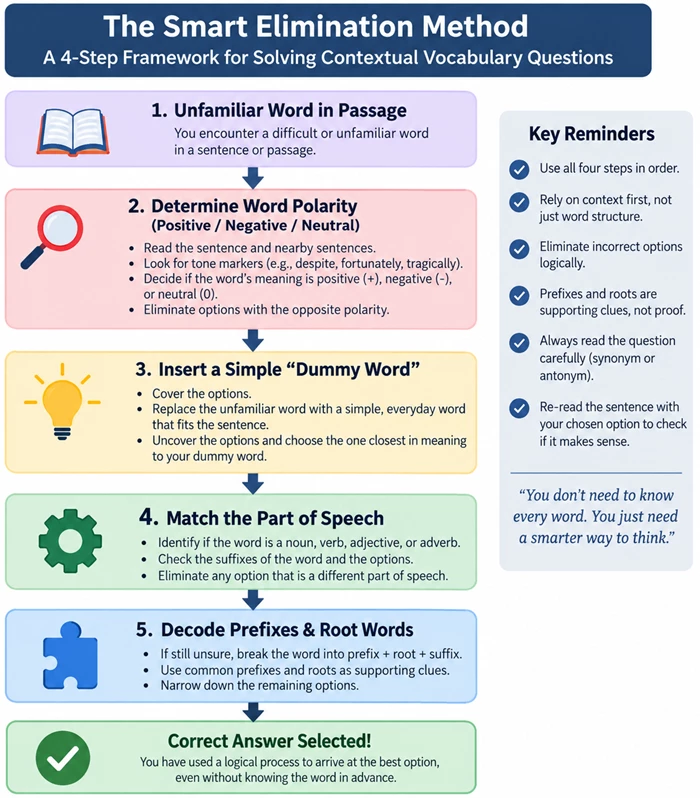
Save the above flowchart on your smartphone or computer for future reference.
Practice Makes Perfect
Contextual vocabulary questions do not test how many pages of a dictionary you have memorised—they test how strategically you read. By shifting your focus to eliminating logically impossible options, you can turn intimidating vocabulary sections into high-scoring opportunities.
Next time you attempt a Reading Comprehension mock test, don’t skip unfamiliar words. Apply the Smart Elimination Method and watch your accuracy soar!
If you want a book for your practice, choose one from this page → Best English Books for Competitive Exams
