
This guide is especially useful for descriptive English, essay, letter, and formal writing tasks in competitive examinations. Exam patterns vary by examination and recruitment cycle, so always check the latest official notification for the exact writing requirements.
When evaluating descriptive papers in competitive examinations—whether for UPSC, SSC, Bank PO, or State PCS—examiners look for one critical element above all else: lexical resource and precision.
Many candidates (or people) believe that scoring high requires filling pages with flowery, decorative prose. In reality, examiners read hundreds of scripts daily and quickly grow tired of fancy jargon stuffed into sentences where it does not belong. What actually earns top marks is the ability to communicate complex, analytical ideas using precise, formal, and academic language.
Weak, everyday phrasing like “big problem,” “very bad impact,” or “fix the situation” lowers the tone of your essay or letter. You can replace those overused terms with targeted, high-impact vocabulary to instantly elevate your writing.
What are high-level words for essay writing?
High-level words are precise, formal vocabulary that helps writers express ideas clearly and effectively. For example, exacerbate, mitigate, pivotal, profound, ramifications, underscore, etc. However, you should use them naturally and accurately. If not, they may make your writing sound complicated.
Here is your complete guide to upgrading your vocabulary for essays and formal letters, complete with before-and-after writing transformations.
High-Level Vocabulary Does Not Mean Difficult Vocabulary
Use a sophisticated word only when it is more precise, natural, and appropriate than the simpler alternative.
High-Impact Vocabulary Upgrades for Essays
Theme 1: Cause, Effect, and Social Impact
When writing on socio-economic issues, climate change, or policy challenges, basic terms like cause, result, or affect make your arguments sound simplistic. Use these high-level alternatives instead to upgrade your sentences:
Exacerbate (Verb): To make a problem, bad situation, or negative condition worse. (Ex., exacerbate poverty, exacerbate tensions)
Catalyst (Noun): An event, policy, or factor that causes significant change or acceleration. (Ex., a catalyst for change)
Profound (Adjective): Having deep, far-reaching significance or serious impact. (Ex., profound impact or change)
Ramifications (Noun): Complex, unintended, or far-reaching consequences of an action.
Before & After Transformation:
🔴 Basic: “Unemployment causes a lot of bad results in rural areas and makes poverty a bigger problem.”
🟢 Upgraded: “Persistent rural unemployment carries severe socio-economic ramifications, serving as a catalyst that exacerbates deep-seated poverty.”
Theme 2: Problem-Solving and Governance
Essays on administration, economic policy, or social reforms require constructive solutions. Upgrade vague words like improve, fix, or stop:
Ameliorate (Verb): To make a bad or painful situation better or more tolerable. (Ex., ameliorate poverty, ameliorate living conditions)
Mitigate (Verb): To lessen the severity, seriousness, or painfulness of a problem. (Ex., mitigate risk, mitigate the impact)
Pivotal (Adjective): Of crucial importance in relation to the success or development of something. (Ex., pivotal role, pivotal moment)
Implement (Verb): To put a decision, plan, policy, or agreement into official effect. (Ex., implement a policy, implement reforms)
Before & After Transformation:
🔴 Basic: “The government should make new rules to fix environmental damage and help poor people.”
🟢 Upgraded: “State authorities must implement targeted regulatory frameworks to mitigate environmental degradation and ameliorate living conditions in vulnerable communities.”
Theme 3: Critical Analysis & Debate
When constructing arguments, addressing counterarguments, or analysing data, replace basic verbs like think, argue, or show:
Contention (Noun): a claim or argument someone puts forward, especially one that may be disputed. (Ex., central contention, main contention)
Paramount (Adjective): More important than anything else; supreme in rank or significance. (Ex., of paramount significance)
Underscore (Verb): To emphasise, highlight, or demonstrate the importance of something. (Ex., underscore the importance or need for something)
Plausible (Adjective): Seeming reasonable or believable. (Ex., plausible explanation, plausible argument)
Before & After Transformation:
🔴 Basic: “I think that education is the most important thing, and recent data shows this clearly.”
🟢 Upgraded: “It is my central contention that educational reform is of paramount importance, a fact underscored by recent demographic data.”
Theme 4: Statistics, Data, and Trends
Essays frequently require you to interpret statistics, survey findings, economic indicators, or changing trends. Instead of overusing words like increase, decrease, show, or difference, use precise vocabulary like:
- Surge (Noun/Verb): A sudden and significant increase in something. (Ex., a surge in demand or unemployment)
- Decline (Noun/Verb): A gradual or noticeable decrease in number, amount, quality, or importance. (Ex., a decline in population; a sharp decline)
- Disparity (Noun): A noticeable and often significant difference or inequality between two or more groups, conditions, or levels. (Ex., income or regional disparity)
- Indicate (Verb): To show, suggest, or provide evidence of a particular fact, situation, or trend. (Ex., data indicate; findings indicate)
Before & After Transformation:
 Basic: “The data shows that unemployment went up a lot in rural areas, while cities had much lower unemployment.”
 Upgraded: “The data indicate a significant surge in rural unemployment, revealing a considerable disparity between rural and urban employment levels.”
Theme 5: Government Policy and Public Administration
When discussing government initiatives, laws, public welfare, or administrative reforms, precise policy vocabulary can make your analysis clearer and more authoritative. Instead of vague expressions like make rules, start a plan, control, or carry out, use words that accurately describe government actions.
- Legislation (Noun): Laws, or the process of making laws, introduced and enacted by a governing authority. (Ex., introduce or enact legislation)
- Regulate (Verb): To control an activity, industry, or process through rules or laws. (Ex., regulate an industry; strictly regulate)
- Intervention (Noun): Action taken by a government, organisation, or authority to influence or improve a situation. (Ex., government or policy intervention)
- Enforce (Verb): To make sure that laws, rules, or regulations are obeyed. (Ex., enforce regulations or the law)
Before & After Transformation:
🔴 Basic: “The government should make stricter rules and make sure companies follow them to reduce pollution.”
🟢 Upgraded: “The government should introduce stringent environmental legislation and effectively enforce regulations to control industrial pollution.”
Academic Transitions & Signposting Phrases for Essays
You can also use transitions to guide the examiner or reader through your train of thought without abrupt stops. Avoid overusing simple connectors like also, but, so, or next.
| Function | Natural Academic Choices | Example |
|---|---|---|
| Addition | Furthermore, Moreover, Additionally | Furthermore, the policy improves access to quality education. |
| Contrast | However, Conversely, Nevertheless | However, implementation remains a significant challenge. |
| Cause and Result | Therefore, Consequently, Thus | Consequently, rural employment opportunities have declined. |
| Concession | Although, While, Nevertheless | Although the policy is ambitious, its implementation remains limited. |
| Emphasis | Notably, Importantly, Indeed | Notably, the survey found a significant gap in access to education. |
| Example | For example, For instance, To illustrate | For instance, digital learning can provide access to educational resources in remote areas. |
| Sequence | First, Subsequently, Finally | Subsequently, the authorities introduced additional measures. |
Commonly Confused Academic Words
Some academic words have similar meanings but are used in different contexts. Understand these distinctions to help you write accurately.
1. Mitigate vs Ameliorate
- Mitigate means to reduce the severity, seriousness, or harmful effects of something.
- Ameliorate means to make a bad or difficult situation better or more tolerable.
Tip: Use mitigate when emphasising the reduction of a problem or its effects, and ameliorate when emphasising improvement in a difficult condition.
2. Exacerbate vs Aggravate
- Exacerbate means to make an already serious problem or negative condition worse.
- Aggravate can also mean to make a problem worse, but it also means to cause irritation or annoyance.
Tip: Exacerbate is particularly useful in formal analytical writing when discussing social, economic, environmental, or policy problems.
3. Plausible vs Possible
- Possible means that something can happen or exist.
- Plausible means that something seems reasonable or believable.
Tip: Something can be possible without being plausible. A plausible explanation appears logically convincing, not merely possible.
4. Contention vs Controversy
- Contention refers to a claim, argument, or point maintained in a debate, or to a disagreement.
- Controversy refers to prolonged public disagreement or debate about an issue.
Tip: Use contention when referring to a particular argument or claim; use controversy when referring to a disputed issue that attracts wider debate.
5. Profound vs Significant
- Significant means important, notable, or considerable.
- Profound suggests great depth, intensity, or far-reaching effect.
Tip: Do not use profound simply as a more complicated version of significant. Use it when you want to emphasise depth or far-reaching influence.
6. Consequence vs Ramification
Both words refer to results or effects, but ramification often suggests complex or far-reaching consequences, especially ones that may not be immediately obvious.
Tip: Consequence is a general term, while ramification is particularly useful when discussing complex, indirect, or far-reaching effects.
7. Implement vs Enforce
- Implement means to put a plan, policy, decision, or strategy into effect.
- Enforce means to make sure that a law, rule, or regulation is obeyed.
Tip: Authorities implement policies, but enforce laws and regulations.
8. Paramount vs Pivotal
- Paramount means more important than anything else; it indicates the highest importance.
- Pivotal means extremely important to the success, development, or outcome of something.
Tip: Use paramount when something has the highest priority, and pivotal when something is crucial to an outcome or process.
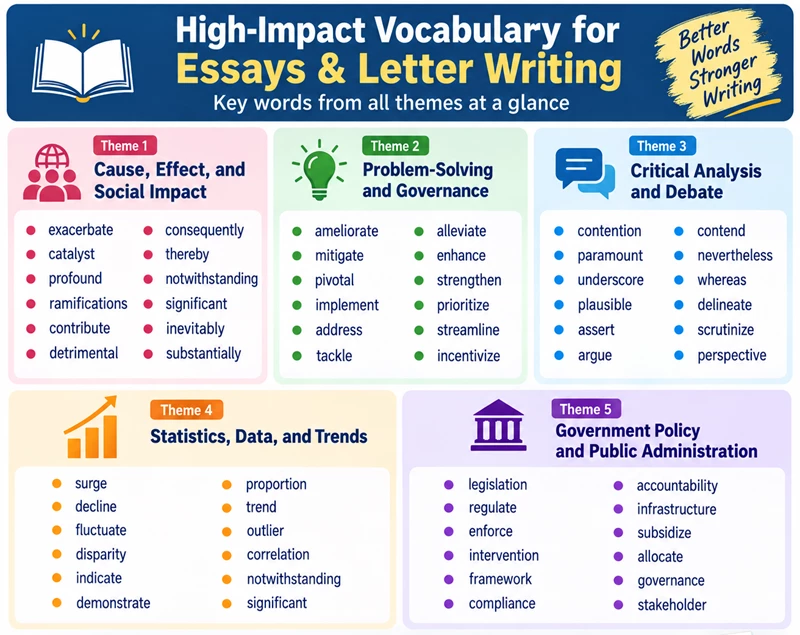
Save the above cheat sheet for quick reference when preparing for essays, formal letters, and descriptive writing.
Formal Vocabulary & Phrasal Upgrades for Letter Writing
Whether drafting an official letter to a government bureaucrat, a newspaper editor, or a corporate entity, your tone must remain professional, restrained, and precise. See the following basic and upgraded examples:
1. Opening & Stating Purpose
🔴 Basic: “I am writing to tell you about the broken streetlights in our area.”
🟢 Formal Upgrade: “I am writing to bring to your attention the persistent issue of non-functional streetlights in our locality.”
2. Expressing Concern
🔴 Basic: “I am worried about the increasing traffic problems in our area.”
🟢 Formal Upgrade: “I wish to express my concern regarding the increasing traffic congestion in our locality.”
3. Expressing Dissatisfaction / Grievance
🔴 Basic: “I am very angry about the bad service provided by your staff.”
🟢 Formal Upgrade: “I wish to express my dissatisfaction regarding the substandard service provided by your staff.”
4. Describing a Problem
🔴 Basic: “The road is in very bad condition.”
🟢 Formal Upgrade: “The road is in a severely deteriorated condition and requires immediate repair.”
5. Requesting Action
🔴 Basic: “Please fix this problem soon.”
🟢 Formal Upgrade: “I kindly request that you take prompt and appropriate action to address this issue.”
6. Seeking Intervention
🔴 Basic: “Please look into this matter.”
🟢 Formal Upgrade: “I kindly request that you look into the matter and take appropriate action.”
7. Making Suggestions
🔴 Basic: “The government should make new rules.”
🟢 Formal Upgrade: “The authorities should consider introducing appropriate regulatory measures.”
8. Requesting Information or Clarification
🔴 Basic: “Please tell me when the applications will open.”
🟢 Formal Upgrade: “I would be grateful if you could provide information regarding the commencement of the application process.”
9. Providing Information
🔴 Basic: “I want to tell you that the event will happen on Monday.”
🟢 Formal Upgrade: “I wish to inform you that the event is scheduled to take place on Monday.”
10. Expressing Appreciation
🔴 Basic: “Thank you for helping me.”
🟢 Formal Upgrade: “I sincerely appreciate your assistance in this matter.”
11. Requesting a Prompt Response
🔴 Basic: “Please reply as soon as possible.”
🟢 Formal Upgrade: “I would appreciate a prompt response regarding this matter.”
12. Closing Statements
🔴 Basic: “Hoping for a fast reply from your side.”
🟢 Formal Upgrade: “I anticipate a prompt resolution to this matter and look forward to your response.”
The 3 Golden Rules of Using High-Level Words Safely
Precision Over Pretension: Never use a complex word unless you are 100% certain of its exact context and grammatical collocations. Using a word incorrectly is far worse than using a simpler word correctly.
Maintain Contextual Register: Reserve administrative vocabulary (remedial action, sub-standard, grievance) for letters, and analytical vocabulary (ramifications, exacerbate, contention) for essays.
Avoid “Vocabulary Stuffing”: One or two precisely chosen words per paragraph carry far more weight than a sentence packed with unreadable jargon. Clear thought must always drive sentence construction.
Put It Into Practice
Try upgrading the following basic paragraph using the words and transitions you learned today:
“Technology has a big impact on young people today. It causes many problems like lack of focus, but it also gives great chances to learn new things. The government must do something to guide students.”
Show Answer
Model Answer:
Technology has a profound impact on young people, providing significant educational opportunities while potentially exacerbating problems such as distraction and reduced concentration. Consequently, the government should implement appropriate measures to promote responsible technology use and help students benefit from digital learning while mitigating its potential negative effects.
Remember: There can be several correct ways to rewrite the paragraph. The objective is not to use as many difficult words as possible, but to communicate the ideas clearly, accurately, and naturally.
Learn more:
Are you preparing for SSC, Banking, UPSC, State PCS, or RBI Grade B exam? If you still want to practice advanced essay, précis, and letter writing, you can read this book → Arihant Descriptive English by S.P. Bakshi
