
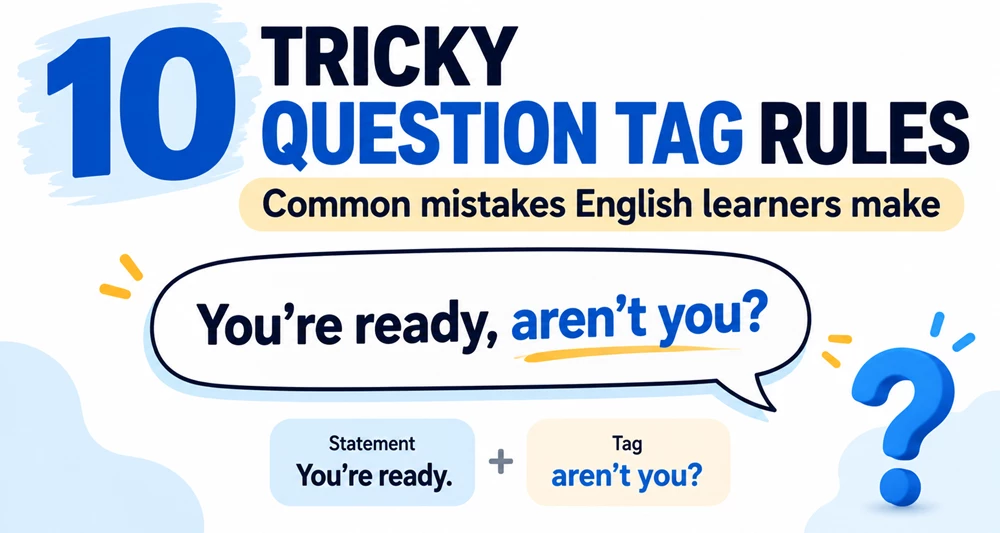
Question tags may seem like one of the easiest topics in English grammar. Most learners quickly memorise the basic rule: a positive statement takes a negative tag, and a negative statement takes a positive tag. But this lesson goes beyond that.
A question tag is a short question added to the end of a statement to ask for confirmation, agreement, or a reaction. Question tags are especially common in conversation and less common in formal writing.
See the examples:
- “She is a doctor, isn’t she?” (isn’t she? is the question tag)
- “They don’t like coffee, do they?” (do they? is the question tag)
It looks simple, but in exams, you may come across tricky questions. When you see sentences like “I am invited,” “Nobody called,” or “He hardly speaks,” you may wonder what their correct question tags are.
This is where the standard rules stop, and the tricky exceptions begin. If you want to avoid losing easy marks in competitive exams or everyday writing, here are the 10 question tag rules that English learners often get wrong—along with the exact formulas to get them right.
How to form a question tag
A question tag is formed in the following steps:
Step 1: Find the auxiliary verb in the main statement.
Step 2: Make the tag positive or negative according to the statement’s polarity.
Step 3: Replace the subject with the appropriate pronoun.
Step 4: If there is no auxiliary, use do / does / did.
For example:
She is tired, isn’t she?
They have finished, haven’t they?
Rahul plays cricket, doesn’t he?
Note: In ordinary modern English, negative question tags are usually contracted: isn’t, aren’t, doesn’t, didn’t, haven’t, etc. The full forms, such as is he not?, are possible but much more formal.
10 Question Tag Rules Every English Learner Often Gets Wrong
Rule 1: The “I Am” Anomaly
When a sentence begins with “I am” in a positive statement, standard grammar logic suggests the tag should be “amn’t I?” or “am I not?”. However, “amn’t” is not accepted in standard English, and “am I not?” is overly formal.
The Rule: Positive “I am” takes “aren’t I?”.
The Exception to the Exception: If the main statement is negative (“I am not”), it follows standard rules and takes “am I?”.
Incorrect: “I am eligible for this role, amn’t I?”
Correct: “I am eligible for this role, aren’t I?”
Negative Statement: “I am not interrupting, am I?”
Rule 2: The Semi-Negative Words (Hardly, Barely, Seldom, Scarcely)
A statement can be negative without the word “not”. Words like hardly, barely, seldom, rarely, and scarcely carry an inherent negative meaning.
The Rule: Treat clauses containing semi-negative adverbs as negative statements. So, use a positive question tag.
Incorrect: “He seldom visits his hometown, doesn’t he?”
Correct: “He seldom visits his hometown, does he?”
Exception: “He regularly visits his hometown, doesn’t he?”
Rule 3: Indefinite Pronouns for People (Everyone, Somebody, Nobody)
Words like everyone, everybody, someone, somebody, no one, and nobody take singular verbs in the main sentence (e.g., “Everyone is here”). However, when converting these to a question tag pronoun, you cannot use he or she.
The Rule: Indefinite pronouns referring to people take the plural pronoun “they” in the tag. You must adjust the tag’s auxiliary verb to match a plural subject.
Incorrect: “Everyone enjoyed the event, didn’t he?”
Correct: “Everyone enjoyed the event, didn’t they?”
Tricky Case (Nobody): “Nobody called yesterday, did they?” (Note: “Nobody” is negative, so the tag is positive).
Rule 4: Indefinite Pronouns for Things (Everything, Something, Nothing)
Unlike pronouns for people, indefinite pronouns referring to non-human objects or abstract concepts function differently.
The Rule: Indefinite pronouns that refer to things take the singular pronoun “it” in the tag.
Incorrect: “Nothing was delivered on time, were they?”
Correct: “Nothing was delivered on time, was it?”
Positive Equivalent: “Everything looks clean, doesn’t it?”
Rule 5: “Few” vs. “A Few” & “Little” vs. “A Little”
Adding the article “a” completely flips the polarity of these words.
The Rule:
“A few” and “A little” mean some (Positive) → require a negative tag.
“Few” and “Little” mean almost none (Negative) → require a positive tag.
Examples:
She has a little free time, doesn’t she?
She has little free time, does she?
A few students passed, didn’t they?
Few students passed, did they?
Rule 6: Imperatives & Commands (Open the Door / Don’t Go)
Imperative sentences do not have an explicit subject or auxiliary tense to flip. So we use modal auxiliaries depending on tone.
The Rule:
Polite / Standard Commands: Take “will you?” (or would/could/can you?).
Negative Commands (Don’t…): Strictly take “will you?”.
Impatient / Urgent Commands: Take “can’t you?”.
Examples:
Standard Command: “Close the window, will you?”
Negative Command: “Don’t waste time, will you?”
Impatient Command: “Keep quiet, can’t you?”
Remember: Imperative tags are strongly influenced by tone and context. Will you? is common, but would you?, could you?, and can you? can be used for requests. Can’t you? often expresses impatience.
Rule 7: The “Let’s” vs. “Let Us” Distinction
You may often assume every sentence starting with “Let” takes “shall we?”. That only applies when “Let’s” is a direct suggestion.
The Rule:
“Let’s” (Short for Let us used as a joint suggestion) → “shall we?”
“Let us” (Used as an imperative meaning allow us to do something) → “will you?”
Examples:
- Let’s go, shall we? = a suggestion that includes the speaker and listener.
- Let us go, will you? = a request/command meaning “allow us to go.”
Rule 8: Main Verb “Have” vs. Auxiliary “Have”
The verb have can act as an auxiliary verb (in perfect tenses) or a main verb (indicating possession or obligation).
The Rule:
Auxiliary Have (Perfect Tenses): Repeat have / has / had in the tag.
Main Verb Have (Possession or Obligation like have to): Use do / does / did in modern standard English.
Examples:
Auxiliary: “They have finished the project, haven’t they?”
Main Verb (Possession): “She has a new laptop, doesn’t she?”
Obligation (Have to): “You have to submit the form, don’t you?”
Note: With have meaning possession, doesn’t he/she? is the normal modern pattern in this type of usage. You may also encounter hasn’t he/she?, especially in some varieties of British English.
Rule 9: “I Think / I Believe” + a Second Clause
In common conversational English, when I think, I believe, or I suppose introduces an opinion about another person or situation, the tag often refers to the main idea in the following clause.
The Rule: For 1st person opinion statements, the question tag targets the dependent main clause, not the introductory clause.
Incorrect: “I think she is right, don’t I?”
Correct: “I think she is right, isn’t she?”
Negative Introductory Clause: “I don’t think he will pass, will he?” (The negative shifts to the dependent clause, making the tag positive).
Rule 10: “Used To” in Past Habits
When describing a discontinued past habit using “used to”, you may feel confusing to choose the right auxiliary.
The Rule: In standard modern English and competitive examinations, sentences with “used to” take “didn’t + subject pronoun”.
Incorrect: “He used to play chess, usedn’t he?”
Correct: “He used to play chess, didn’t he?”
Question Tags: Meaning and Intonation
Question tags are not only about grammar; intonation can also change their meaning.
When the voice falls at the end of a tag, the speaker usually expects the listener to agree or confirm what has been said:
You’re coming with us, aren’t you? ↘
Here, the speaker expects the answer to be “Yes.”
When the voice rises, the speaker is often genuinely asking for confirmation:
You’re coming with us, aren’t you? ↗
The speaker is less certain and expects an actual answer.
In everyday conversation, the same question tag can therefore express confirmation, uncertainty, surprise, or interest, depending on the speaker’s tone and context. Learning both the grammatical pattern and the appropriate intonation can help you use question tags more naturally.
Other Important Question Tag Patterns and Examples
A. “There is / There are”
Examples:
There is a problem, isn’t there?
There aren’t many seats, are there?
B. This / That / These / Those
Examples:
This is your book, isn’t it?
That was interesting, wasn’t it?
These are yours, aren’t they?
C. Modal verbs
Examples:
She can drive, can’t she?
They should leave now, shouldn’t they?
You will help me, won’t you?
We ought to leave, oughtn’t we?
British Council explicitly describes using the modal itself to form the tag.
D. “Never / No / None / Neither”
Examples:
He never complains, does he?
Nobody came, did they?
Nothing happened, did it?
None of them agreed, did they?
E. Same-polarity tags
Example:
So you think you’re clever, do you?
Such tags don’t follow the normal positive-negative pattern because they can express surprise, disbelief, challenge, or a similar pragmatic effect.
Question Tag Rules: Quick Reference Table
Use this table to quickly review some of the most common tricky question tag patterns and the mistakes English learners often make.
| Pattern | Example | Correct Tag | Why? |
|---|---|---|---|
| Positive “I am” | I am selected... | aren't I? | Positive I am normally takes aren't I? |
| Negative-meaning adverb | He rarely speaks... | does he? | Rarely gives the statement a negative meaning. |
| Indefinite pronoun: people | Everyone was present... | weren't they? | Everyone takes they in the tag. |
| Negative pronoun: things | Nothing happened... | did it? | Nothing is negative and takes it. |
| “Few” / “little” | He has little hope... | does he? | Little means almost none, so the statement is negative in meaning. |
| Negative imperative | Don't leave early... | will you? | Negative imperatives commonly take will you? |
| “Let's” suggestion | Let's begin... | shall we? | Let's used for a suggestion takes shall we? |
| “Have to” | You have to go... | don't you? | Have to uses do/does/did in the tag. |
| “I think” + clause | I think he is honest... | isn't he? | The tag commonly refers to the main idea in the following clause. |
| “Used to” | She used to drive... | didn't she? | Used to commonly takes didn't in the tag. |
Tip: On a mobile phone, swipe left or right across the table to see all the columns.
Common Question Tag Mistakes
Be careful of these mistakes, as you may easily get them wrong:
Incorrect: She likes tea, isn’t she?
Correct: She likes tea, doesn’t she?
Incorrect: Nobody came, didn’t they?
Correct: Nobody came, did they?
Incorrect: Let’s go, will we?
Correct: Let’s go, shall we?
Incorrect: I am late, amn’t I?
Correct: I am late, aren’t I?
The 10-second method for solving any question tag
You have learned the rules. In short, memorise this quick method for any question tag:
- Find the auxiliary.
- Check whether the statement is positive or negative.
- Choose the correct pronoun.
- Reverse the polarity (negative for positive or positive for negative).
- Check for special cases such as I am, let’s, imperatives, and negative-meaning words.
Practice Set: Test Your Knowledge
Choose the correct question tag for each sentence.
1. I am responsible for this project, ______?
A) am not I
B) amn’t I
C) aren’t I
D) don’t I
2. Scarcely had he entered the room when the lights went out, ______?
A) didn’t he
B) had he
C) hadn’t he
D) did he
3. Nobody volunteered for the cleanup drive, ______?
A) did he
B) didn’t they
C) did they
D) didn’t he
4. Let us complete our work without interruption, ______?
A) shall we
B) will you
C) don’t we
D) won’t we
5. She has to attend the meeting at 10 AM, ______?
A) hasn’t she
B) doesn’t she
C) isn’t she
D) don’t she
6. Everyone enjoyed the concert, ______?
A) didn’t he
B) did they
C) didn’t they
D) wasn’t they
7. Nothing was damaged during the storm, ______?
A) wasn’t it
B) was it
C) didn’t it
D) did they
8. Let’s discuss the matter tomorrow, ______?
A) will we
B) do we
C) shall we
D) won’t we
9. He hardly ever misses a class, ______?
A) doesn’t he
B) does he
C) did he
D) hasn’t he
10. There is very little time left, ______?
A) isn’t there
B) is there
C) doesn’t there
D) does there
Answer Key
- C) aren’t I
- B) had he
- C) did they
- B) will you
- B) doesn’t she
- C) didn’t they
- B) was it
- C) shall we
- B) does he
- B) is there
