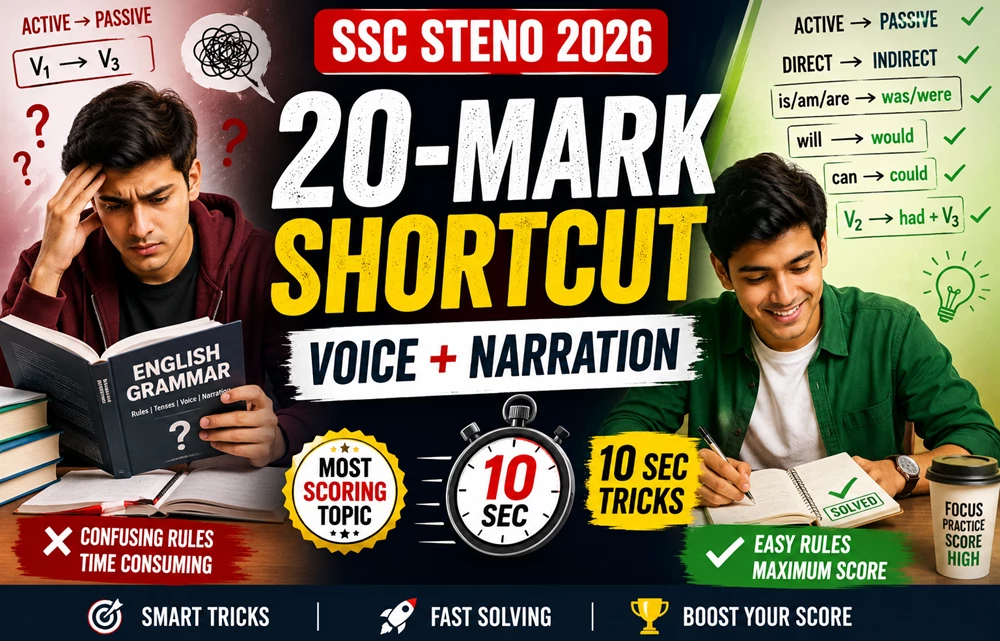
In the SSC Steno Exam 2026, Active & Passive Voice and Direct & Indirect Speech are among the highest-scoring topics in the English section. While other sections like Reading Comprehension require time and focus, these two topics follow fixed grammatical rules. If you know the formula, you can solve the questions quickly and accurately.
Together, these topics account for roughly 20 marks. Mastering them is the easiest way to jump your English score by 15–20 marks.
Note: Although focused on the exam, this lesson is also useful to anyone who wants to master voice and narration conversion.
Why Voice & Narration Are Important in SSC Steno 2026
The SSC Stenographer English section regularly includes questions from:
- Active & Passive Voice
- Direct & Indirect Speech (Narration)
These questions are usually:
- Rule-based
- Fast to solve
- Less time-consuming
- Easy to practice daily
In SSC Steno Grade C or Grade D, mastering the formulas for these topics will help you earn easy marks quickly.
The 20-Mark Shortcut for SSC Steno Exam 2026
1. Active & Passive Voice: The “Tense-Stay” Rule
The biggest mistake students make in Voice questions is changing the tense.
The Golden Rule: In Voice change, the Tense NEVER changes. If the sentence is in the Present Continuous, the answer must stay in the Present Continuous.
For example:
Active: She is writing a letter.
Passive: A letter is being written by her.
Notice that both sentences remain in the Present Continuous Tense. (Remember the rule that the object in the active voice becomes the subject in the passive voice.)
The “Be” Verb Shortcut:
To change into the Passive Voice correctly, look for the correct form of the verb “to be” (is/am/are, was/were, been, being). Look at the table to memorise quickly:
| Active Verb | Passive Transformation |
| V1 (eat) | is/am/are + V3 (eaten) |
| V2 (ate) | was/were + V3 (eaten) |
| V1+ing (eating) | being + V3 (eaten) |
| Has/Have + V3 | has/have + been + V3 |
Examples:
Active: I eat an apple.
Passive: An apple is eaten by me.
Active: I ate an apple.
Passive: An apple was eaten by me.
Active: I am eating an apple.
Passive: An apple was being eaten by me.
Active: I have eaten an apple.
Passive: An apple has been eaten by me.
Quick Tricks to Solve Voice Questions Faster
1. Find the Main Verb First: Identify the tense before looking at the options for the question.
2. Look for the Correct “Be Verb”: Words like the following help you identify the correct passive structure:
- is
- am
- are
- was
- were
- being
- been
3. Eliminate Wrong Tenses Immediately: If the original sentence is in the past tense and an option is in the present tense, eliminate it instantly.
2. Direct & Indirect Speech: The “Backshift” Rule
Unlike Voice, Narration is all about shifting perspective. When you are reporting something said in the past, the tense usually moves one step backwards.
For example:
Direct: He said, “I am tired.”
Indirect: He said that he was tired.
Note: As the reporting verb ‘said’ is in the past, the indirect speech becomes the past.
Common Narration Changes for Quick Revision
| Direct Speech | Indirect Speech |
|---|---|
| is/am/are | was/were |
| will | would |
| can | could |
| have/has | had |
| today | that day |
| tomorrow | the next day |
| yesterday | the previous day |
Examples:
Direct: She said, “I am busy.”
Indirect: She said that she was busy.
Direct: Rahul said, “I will call you.”
Indirect: Rahul said that he would call me.
Direct: He said, “I can solve this.”
Indirect: He said that he could solve that.
Direct: She said, “I will finish it today.”
Indirect: She said that she would finish it that day.
Direct: Ravi said, “We will leave tomorrow.”
Indirect: Ravi said that they would leave the next day.
Pronoun Change Trick
Pronouns often change according to the speaker and listener.
For example:
Direct: Rahul said, “I will help you.”
Indirect: Rahul said that he would help me.
3. The “Elimination” Hack (The 10-Second Method)
In the SSC Steno Exam 2026, don’t waste time “solving” the sentence. Instead, eliminate the wrong ones:
Check the Tense: If the question is in the Past Tense and the option is in the Present, delete it instantly.
Check the Pronouns: In Narration, “I” usually changes to “He/She.” If the option keeps “I,” it’s wrong.
Check Time Words: In Narration, “Today” must become “That day,” and “Tomorrow” must become “The next day.”
Common Mistakes
In our coaching class, most students make these mistakes:
In Voice
- Changing the tense incorrectly
- Forgetting the past participle (V3)
- Missing “being” in continuous tense
In Narration
- Forgetting pronoun changes
- Not changing time expressions
- Using incorrect tense backshift
Be careful of these errors in your practice or exam. Avoiding them can help you score more marks easily.
Best Way to Practice Voice & Narration
For speed and accuracy, practice daily at least:
- 25 Voice questions
- 25 Narration questions
Focus on Previous Year Questions: SSC repeats grammar patterns frequently. Solving previous year papers helps you recognise common question types quickly.
Learn Through Formula Tables: Grammar tables help in quick revision before exams.
How to Maximise Your Scoring
If you are aiming for a Grade C post, you cannot afford even one mistake in this examination. For your study and practice, you can use these books:
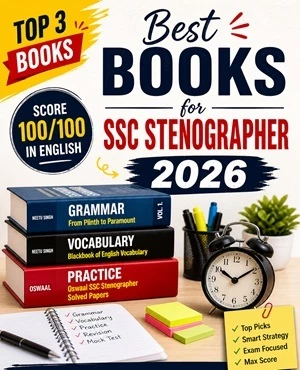
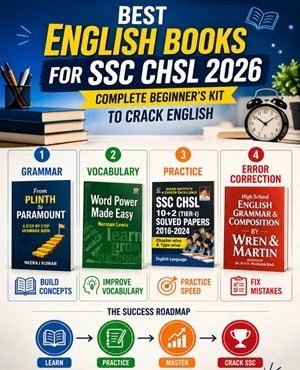
- For Grammar: Read Plinth to Paramount. Learn through simple tables, useful for quick revision.
- For Vocabulary: Read the Blackbook of English Vocabulary. It easily solves vocabulary challenges in SSC exams.
For Practice: Use the Oswaal SSC Stenographer Solved Papers to solve at least 50 questions of Voice and Narration every single day and memorise the rules.
Learn more about these books in our guide → Best English books for SSC Stenographer Exam 2026
Conclusion
Active & Passive Voice and Direct & Indirect Speech are among the most scoring grammar topics in the SSC Stenographer Exam. Since both topics follow fixed rules, you can solve the questions quickly with high accuracy if practised regularly.
Instead of memorising randomly, focus on:
- tense recognition,
- formula patterns,
- elimination tricks,
- and the previous years’ papers.
With regular practice, these grammar topics can become one of the easiest ways to boost your SSC Steno English score.
If you find these shortcuts useful, please share this page or website with your friends and relatives who are preparing for competitive exams.