In the IELTS Writing task (both Task 1 and Task 2), the examiner is looking for “Grammatical Range and Accuracy.” If you write every sentence in the same way, your score will likely be stuck at a Band 6.
To reach Band 7 or higher, you must demonstrate that you can use both Active and Passive voice effectively. Many students think the Passive voice is “wrong,” but it is often useful in academic writing, especially for formal and process-based descriptions.
Understanding the difference between active and passive voice is essential for writing clear, effective, and high-scoring English sentences. Whether you’re preparing for IELTS, improving your grammar, or learning how to write formally, knowing when and how to use each voice can make a big difference. In this guide, you’ll learn simple rules, clear examples, and practical tips to use active and passive voice correctly in your writing.
Table of Contents
1. The Basics: What is the Difference?
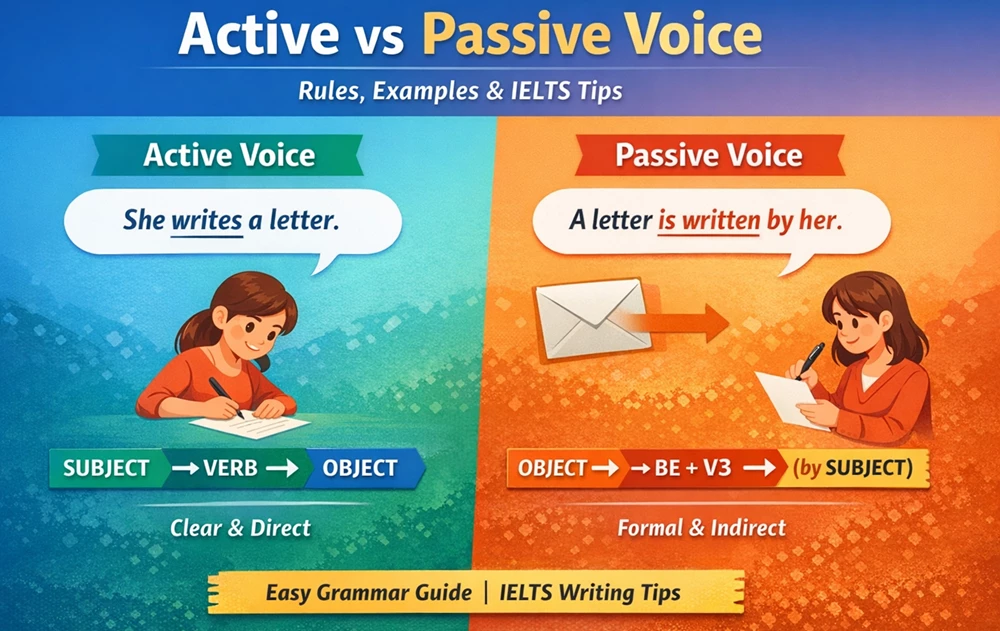
Active Voice (Focus on the DOER)
In the active voice, the subject of the sentence performs the action. It is direct, clear, and easy to read.
Formula:
Subject + Verb + ObjectExample: “The government implemented a new tax policy.”
Passive Voice (Focus on the ACTION)
In the passive voice, the object of the active sentence becomes the subject. The person doing the action is either unknown or less important than the action itself.
Formula:
Object + Be + Past Participle (V3)Example: “A new tax policy was implemented (by the government).”
2. When to use Passive Voice in IELTS
In academic English, the Passive voice is used to sound more objective and formal. Here are two specific places you must use it:
IELTS Task 1: Describing a Process
When describing how something is made (like a diagram of a brick factory or water cycle), the “worker” doesn’t matter. The “process” is the star.
Weak (Active): “The workers pick the tea leaves and put them in a box.”
Strong (Passive): “The tea leaves are picked and placed into boxes.”
IELTS Task 2: Expressing General Opinions
Instead of saying “I think” or “People say,” use the Passive voice to sound like an expert.
Weak (Active): “People believe that technology hurts social skills.”
Strong (Passive): “It is widely believed that technology negatively impacts social skills.”
3. The “By Zombies” Test 🧟♂️
If you aren’t sure if a sentence is Passive, try adding the phrase “by zombies” after the verb. If the sentence still makes sense grammatically, it is Passive!
Example: “The house was built (by zombies).” -> Passive.
Example: “The man ran (by zombies).” -> Does not make sense (Active).
4. Converting for a Higher Band Score
To get a high score, try to “flip” your sentences to show range.
| Band 6 (Simple Active) | Band 7+ (Academic Passive) |
| Scientists discovered a cure. | A cure was discovered by scientists. |
| They should ban plastic bags. | Plastic bags should be banned. |
| We must protect the environment. | The environment must be protected. |
| Schools teach children math. | Children are taught mathematics in schools. |
5. Avoid the “Passive Trap”
While Passive voice is great for formal writing, don’t use it for everything. Overusing it makes your writing heavy and difficult to follow.
The Golden Ratio: Use Active voice for your main arguments and Passive voice for reporting data, describing processes, or stating general academic truths.
Active vs Passive Comparison Table
| Feature | Active Voice | Passive Voice |
|---|---|---|
| Focus | Subject performs the action | Object receives the action |
| Structure | Subject + Verb + Object | Object + be + Past Participle (+ by Subject) |
| Example | She writes a letter. | A letter is written by her. |
| Clarity | Clear and direct | Less direct |
| Usage | Everyday and general writing | Formal, academic, or process writing |
Common Mistakes in Active and Passive Voice
Even when you understand the rules, it’s easy to make mistakes with active and passive voice. Here are some of the most common errors learners should avoid:
1. Confusing Passive Voice with Past Tense
Many students think a sentence is passive just because it is in the past tense.
She wrote a letter. (This is active, not passive)
A letter was written by her. (This is passive)
Remember: Passive voice always uses “be + past participle”.
2. Using the Wrong Verb Form
In passive voice, the main verb must always be in the past participle (V3) form.
Incorrect: The work is do by him.
Correct: The work is done by him.
3. Forgetting the “Be” Verb
A passive sentence is incomplete without the correct form of “be”.
Incorrect: The homework completed by her.
Correct: The homework was completed by her.
4. Overusing Passive Voice
Some learners try to make every sentence passive to sound more formal.
Incorrect: The essay was written, and the ideas were explained, and the conclusion was given.
Correct: I wrote the essay, explained the ideas, and gave the conclusion.
Tip: Use passive voice only when necessary, not everywhere.
5. Using Passive When Active is Clearer
Active voice is usually more direct and easier to understand.
Incorrect: The cake was eaten by John.
Correct: John ate the cake.
6. Adding “by + subject” Unnecessarily
Sometimes, the doer of the action is not important.
Incorrect: The road was built by workers.
Correct: The road was built.
Tip: Omit “by + subject” when it is obvious or not needed.
Quick Tip: Use active voice for clarity and simplicity, and passive voice when the action is more important than the doer.
IELTS Practice Challenge
Convert these active sentences into professional passive sentences:
-
“The local council built a new park last year.”
-
“Many people consider English a global language.”
-
“The company will launch the product in June.”
(Answers: 1. A new park was built by the local council… 2. English is considered a global language… 3. The product will be launched in June.)
 Watch an active and passive voice video.