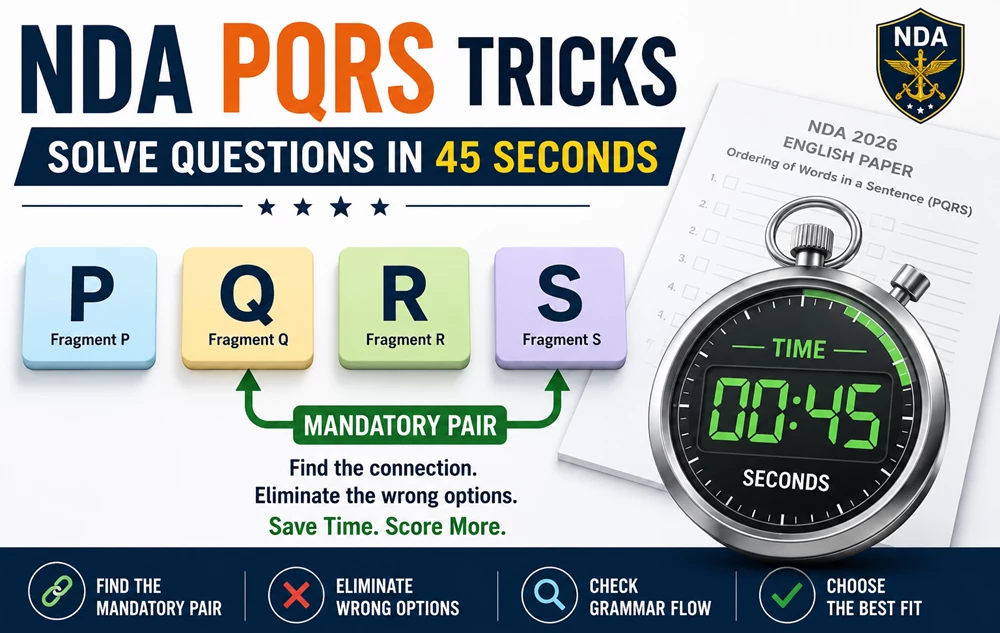
For NDA aspirants, the “Ordering of Words in a Sentence” section (commonly known as PQRS) in the English paper is worth valuable marks if they can answer without wasting time. P-Q-R-S are fragments of a sentence to be joined in the correct sequence.
Many aspirants treat this section like a reading exercise—they rearrange the fragments in their heads over and over until it “sounds right.” This is a massive time trap.
To clear this section quickly and correctly, you must treat it like an assembly line. By looking for structural joints—such as Mandatory Pairs—you can eliminate wrong options in seconds. Instead of reading every option, you should look for structural clues that lock fragments together.
In this guide, you’ll learn the 45-Second Rule, a simple strategy that helps you solve NDA PQRS questions quickly and accurately.
Note: Besides the NDA exam, this guide is useful for other competitive exams and for English learners to develop sentence structural skills.
What Is the 45-Second Rule?
Before checking the answer choices provided, spend a few seconds looking for:
- Mandatory pairs
- Grammar connectors
- Relative clauses
- Fixed expressions
Once you find one strong connection, eliminate all options that break it.
Think of PQRS like assembling a puzzle. You don’t need to complete the whole picture immediately. First, connect the pieces that obviously belong together.
Structural Tricks to Solve NDA PQRS Quickly
1. Find the Mandatory Pair
A mandatory pair is a combination of fragments that must stay together because grammar demands it. You must find it first.
For example, a pronoun must follow its noun. If fragment P ends with a noun like “the Supreme Court” and fragment R begins with “it ruled that”, you have found a structural lock. Now, PR is a mandatory pair.
Any option that separates P and R can be eliminated immediately.
2. Look for Preposition & Conjunction Bridges
Fragments ending in prepositions (of, for, with, to, in) or conjunctions (and, but, because, although) cannot stand alone. They usually need a specific word or phrase after them.
For example, if fragment Q ends with “interested in”, look for a fragment starting with a noun or a gerund (an -ing word). If fragment S starts with “learning code”, then QS is your mandatory pair.
Because the phrase “interested in learning coding” is grammatically complete.
So, whenever a fragment ends with a preposition or conjunction, immediately search for the phrase that completes it.
3. Identify Relative Clauses (starting with Who, Which, That, etc.)
Relative pronouns must sit immediately next to the noun they modify.
If R ends with “the officer” and P begins with “who commanded the regiment”, RP is an unbreakable pair.
4. Spot Fixed Grammar Expressions
Some English structures always occur together. For examples:
- No sooner … than
- Either … or
- Neither … nor
- Not only … but also
- So … that
If a fragment begins with “No sooner did the fighter jet…”, the relevant fragment must contain “than.”
The 3-Step PQRS Method
As learned above, follow the steps to find the right options quickly:
Step 1: Find one strong connection among the fragments. Look for pronouns, prepositions, relative clauses, and fixed expressions.
Step 2: Eliminate any wrong option that separates your mandatory pair.
Step 3: Verify the remaining choice.
If the sentence is found to be logical and grammatically correct, that is the answer.
See the following solved practice set using the method.
NDA PQRS Structural Practice Set
Directions: Rearrange the fragments P, Q, R, and S to form a grammatically correct and meaningful sentence.
1. The structural layout of the camp
P: and to ensure maximum security
Q: was designed to withstand harsh weather
R: for the deployed troops
S: conditions in the high-altitude sector
(a) QSPR (b) PRQS (c) QSRP (d) SPRQ
Solution: Look at Q: “was designed to withstand harsh weather”. What matches “weather”? S: “conditions in…”. Therefore, QS is a mandatory pair. Now look at R: “for the deployed troops”. It naturally connects with P: “and to ensure…”. The sentence flows as Q → S → R → P.
Correct Answer: (c)
2. The commanding officer
P: who had served in multiple counter-insurgency operations
Q: praised the young cadets
R: for showing exemplary courage
S: during the surprise cross-border ambush
(a) PQRS (b) PRQS (c) QPSR (d) RQPS
Solution: P starts with a relative clause (“who had served…”). This must modify the subject “The commanding officer”. So, the sentence must start with P. Next, what did the officer do? He praised (Q) them for their courage (R) during the ambush (S).
Correct Answer: (a)
3. No sooner did the fighter jet
P: than the radar systems at the base
Q: cross the international border
R: picked up its thermal signature
S: and sounded a high-alert warning
(a) QPSR (b) QPRS (c) PQRS (d) PRQS
Solution: Remember the correlative formulas: “No sooner” is always followed by “than”. The main clause starts with “No sooner did the fighter jet…” which needs a base verb → Q: “cross the international border”. The next part must begin with the word “than”, which is P. Thus, QP is an unbreakable pair.
Correct Answer: (b)
4. The strategic defence policy
P: to modernise the country’s ageing fleet
Q: aims to allocate significant funds
R: while enhancing maritime security
S: of fighter aircraft over the next decade
(a) QPRS (b) RQPS (c) QPSR (d) PRSQ
Solution: The subject is “The strategic defense policy”. It needs a verb → Q: “aims to allocate…”. What is it allocating funds for? P: “to modernize the country’s aging fleet”. What kind of fleet? S: “of fighter aircraft…”. This gives us Q-P-S. Finally, R adds the concluding clause.
Correct Answer: (c)
The Elimination Matrix
When you are stuck between two choices, use this checklist:
| Step | Action | What to Do |
|---|---|---|
| 1 | Find the Joint | Locate a mandatory pair from the options |
| 2 | Eliminate Options | Remove any options that separate the pair |
| 3 | Test the Ending | Check whether the final fragment completes the sentence logically |
| 4 | Confirm Meaning | Ensure the entire sentence remains meaningful |
Using this method usually reduces the four options to one or two, saving you time. You don’t need to check all four options.
Common Mistakes NDA Aspirants Make
Don’t waste time in the exam with these mistakes:
- Reading Options First: This often confuses because many options may look correct.
- Ignoring Grammar Signals: Words such as “who,” “than,” and “because” often reveal the correct sequence instantly.
- Depending Only on Meaning: PQRS is not just about meaning. It is about grammatical structure.
Always find the structural clue before evaluating meaning.
Best Books for NDA PQRS Practice
Without practice, PQRS questions can waste time unnecessarily. To avoid tensions during the actual exam, we recommend these books to practice consistently in advance:
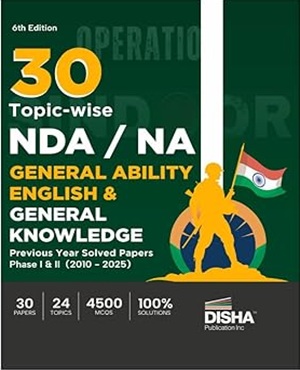
Disha’s NDA/NA Topic-wise Solved Papers: Crucial for practice. It gives you actual UPSC-constructed PQRS patterns, helping you see exactly how UPSC use their traps.
Objective General English by S.P. Bakshi: Provides a strong foundation in sentence structure, grammar, and sequencing techniques that directly support PQRS solving skills.
For a complete study and practice set including the two books, follow this link → Best Books for NDA English Paper
Final Tip
In the NDA exam, treat PQRS as a puzzle.
As learned above, find one mandatory pair, eliminate the wrong choices, and let grammar guide you to the answer.
With enough practice, you can solve most PQRS questions in under 45 seconds.