In the UPSC CDS 2026 English paper, the “Ordering of Sentences” (the dreaded S1-S6 section) is one of the most scoring areas if you know the right approach. With 20 questions dedicated to this section alone, toppers usually treat them like a logic puzzle.
Unlike a standard jumbled sentence, S1 (the first sentence) and S6 (the last sentence) are fixed. Your task is to arrange the four middle sentences — P, Q, R, and S — in the correct order. If you treat this like a puzzle rather than a reading task, you can solve each one in under 45 seconds.
This guide explains the best CDS S1-S6 sentence ordering tricks, common mistakes, and proven methods to improve speed and accuracy.
Table of Contents
What Is S1-S6 Sentence Ordering in CDS?
In these questions, the first and last sentences are already given. You must identify the correct sequence of the remaining four sentences.
The challenge is not difficult grammar. It is mainly to test your understanding of:
- logical flow
- sentence connection
- pronoun reference
- chronological order
- transition words
That is why a smart strategy matters more than difficult vocabulary. This means that, even with difficult words, you should have a trick to quickly identify the correct sequence.
CDS S1-S6 Sentence Ordering Tricks
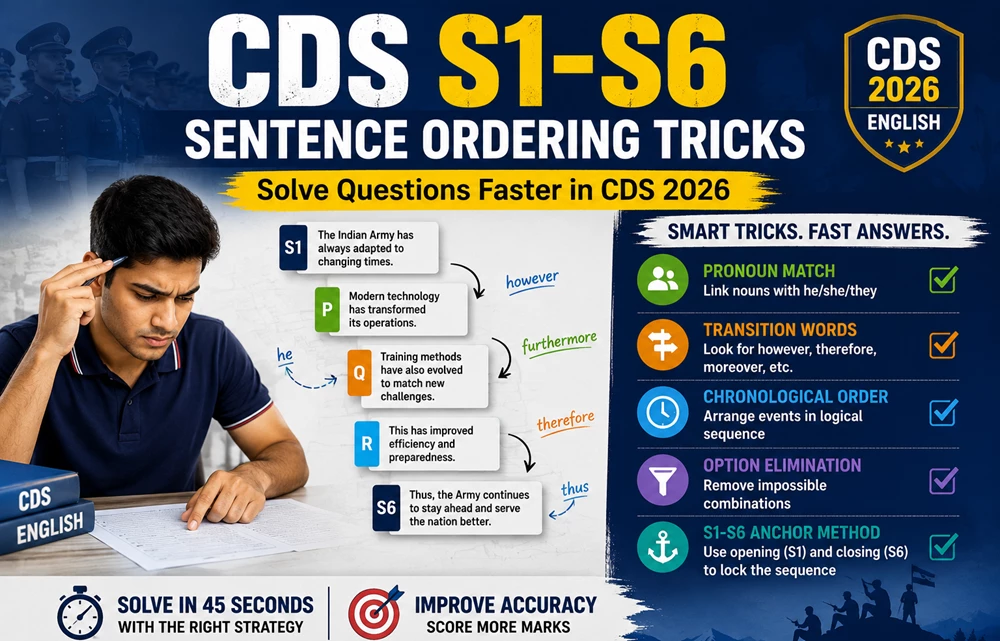
1. The “Mandatory Pair” Hack
Don’t try to arrange all four sentences at once. Look for two sentences that must follow each other.
The Pronoun Link: If one sentence introduces a noun and another sentence uses a pronoun, they are likely a mandatory pair.
The Transition Words: Look for “Turn Signals” like However, Therefore, Consequently, or Furthermore. These words indicate whether the next sentence supports or contradicts the previous one.
For example:
- P: General Rawat addressed the cadets.
- R: He emphasised discipline and leadership.
Here, P-R becomes a strong pair because “He” refers to “General Rawat.”
This is one of the fastest CDS sentence ordering tricks.
Transition Words
These words act like traffic signals in sentence ordering.
These usually show contradiction:
- however
- but
- although
- nevertheless
These continue the same idea:
- furthermore
- moreover
- additionally
.These usually appear near the conclusion:
- therefore
- thus
- consequently
.If you identify these transition words correctly, you can eliminate wrong options quickly.
2. The Chronological & Logical Flow
UPSC often asks sentence ordering questions based on historical passages, scientific processes, military developments, or social changes.
Time Sequence: If one sentence mentions “1947” and another mentions “the post-independence era,” the logic is simple: 1947 comes first.
General to Specific: S1 usually introduces a broad concept. The middle sentences (P, Q, R, S) provide specific details, and S6 concludes with a result or final thought.
Always arrange events from:
- past to present
- cause to effect
- introduction to conclusion
3. The “Opening and Closing” Anchor
Since S1 and S6 are given, use them as anchors. Many candidates ignore the two fixed sentences, but they actually provide the biggest clues.
Check S1’s neighbour: Which sentence (P, Q, R, or S) continues the specific thought started in S1?
Check S6’s predecessor: Which sentence naturally leads to the conclusion in S6? Often, S6 contains words like “Thus”, “Finally”, “Therefore”, or “In conclusion” that identify the final link.
Solved Example of CDS Sentence Ordering
S1: India’s space program has grown rapidly over the last decade.
P: Several successful satellite launches increased global confidence in ISRO.
Q: This growth also encouraged private companies to enter the sector.
R: The government introduced new reforms to support space innovation.
S: As investment increased, research and technology development accelerated further.
S6: As a result, India has become a major force in the global space industry.
Correct Order:
R → P → S → Q
Why?
- R comes first because government reforms started the growth process.
- P follows logically because successful launches happened after the reforms.
- S continues the development by showing increased investment and technological progress.
- Q then explains how this overall growth encouraged private companies to participate.
- S6 gives the conclusion and overall result.
This is how logical flow works in sentence ordering questions:
- cause → development → expansion → conclusion
These clues help you solve S1-S6 questions much faster in the CDS exam.
Common Mistakes Students Make in S1-S6 Questions
Don’t make these mistakes:
- Reading Only for Grammar (Correct grammar does not always mean correct sequence.)
- Ignoring Pronouns (Words like he, she, they, this, and these must refer to something introduced earlier.)
- Not Checking the Ending Properly (Candidates often focus only on the beginning and ignore the sentence that connects to S6.)
CDS S1-S6 Strategy Table
| Strategy | What to Do | Benefit |
|---|---|---|
| Pronoun Match | Link nouns with he/she/they | Find sentence pairs quickly |
| Transition Words | Look for however, therefore, moreover | Understand sentence flow |
| Chronological Order | Arrange events logically | Improve accuracy |
| Option Elimination | Remove impossible combinations | Save time in the exam |
| S1-S6 Anchor Method | Check opening and closing links | Confirm final sequence |
How to Solve CDS Sentence Ordering Faster
To improve speed, follow this strategy:
- Read S1 and S6 first.
- Then, find mandatory sentence pairs. (See which sentence follows the other.)
- Identify transition words. They help in sentence sequence.
- Check chronological flow.
- Eliminate impossible options.
- Confirm the final sequence logically.
Practice regularly. It’ll become easier to solve the questions.
Recommended Practice Tools for 2026
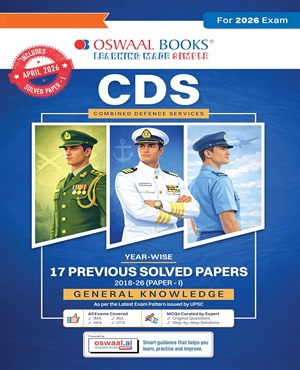
You need enough practice to solve sentence ordering questions faster in the CDS exam. For the 2026 pattern, Oswaal CDS 17 Previous Years’ Solved Papers | Year-wise (2018 to 2026(I) is highly recommended for your practice.
The book consists of 6400+ practice questions covering English (2280+), General Studies (2280+), and Elementary Mathematics (1900+).
For your study, check out our recommended → Best English Books for UPSC CDS 2026
Final Tips
The biggest mistake candidates make is trying to “read” S1-S6 questions casually. These questions are meant to be solved logically.
The more previous-year questions you solve, the faster your pattern recognition becomes. So, practice more.