
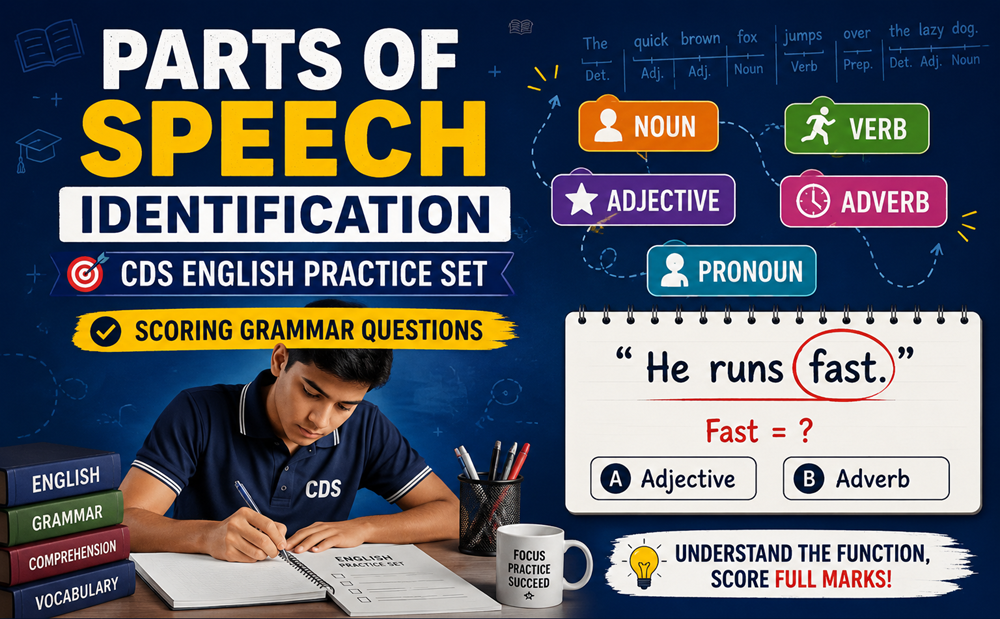
In the CDS 2026 English paper, we found UPSC reintroduced questions on Parts of Speech Identification. The section is among the fastest to score marks. While other sections like Reading Comprehension or S1-S6 require intense focus and time, these questions can be solved in seconds—provided you understand functional grammar.
The UPSC doesn’t just ask you to define a noun; it tests how a word behaves in a specific sentence. A word like “fast” can be a noun, a verb, an adjective, or an adverb depending on its “job.”
For example:
- Fast can be an adjective: a fast runner
- Fast can also be an adverb: run fast
That is why learning the function of words is more important than memorising labels. With practice, you can grab fast, confident marks in the exam.
Note: Apart from the CDS exam, this guide is useful for other exams and for learners who want to master the use of parts of speech in English sentences.
What You Will Learn in This Practice Set
By solving these CDS-level questions, you will learn how to:
- Identify nouns, pronouns, adjectives, adverbs, and conjunctions
- Understand how the same word changes its role in different sentences
- Avoid common CDS grammar traps
- Solve Parts of Speech questions quickly in the exam
- Improve overall English grammar accuracy
Identifying Parts of Speech: The CDS Strategy Guide
1. The “Function over Form” Rule
The most common mistake aspirants make is “labelling” a word permanently. In the CDS exam, you must look at what the word is doing:
- Is the word naming something? It is a Noun.
- Is it replacing a noun? It is a Pronoun.
- Is it describing a noun? It is an Adjective.
- Is it modifying a verb, adjective, or another adverb? It is an Adverb.
- Is it connecting clauses? It is a Conjunction.
- Is it showing a relationship? It is a Preposition.
The function of a word within a sentence determines its part of speech.
2. Tricky CDS Patterns to Watch
| Word | Sentence | Part of Speech |
|---|---|---|
| Around | They wandered around. | Adverb |
| They sat around the fire. | Preposition | |
| Each | Each boy got a prize. | Adjective |
| Each of them got a prize. | Pronoun | |
| Fast | He is a fast runner. | Adjective |
| He runs fast. | Adverb | |
| While | Let’s rest a while. | Noun |
| While I was walking, it started raining. | Conjunction |
CDS Practice Set: Parts of Speech Identification
Directions: In each of the following sentences, identify the part of speech of the bolded word.
1. The ants fought the wasps bravely.
(a) Adjective
(b) Adverb
(c) Verb
(d) Noun
2. The preacher said, “No one is above the all-powerful.”
(a) Adverb
(b) Adjective
(c) Preposition
(d) Verb
3. Rakesh is too old to run fast.
(a) Adverb
(b) Adjective
(c) Intensifier
(d) Noun
4. The secretary himself visited the affected families.
(a) Personal Pronoun
(b) Reflexive Pronoun
(c) Emphatic Pronoun
(d) Adjective
5. Which book are you reading these days?
(a) Interrogative Pronoun
(b) Relative Pronoun
(c) Interrogative Adjective
(d) Noun
6. Sit down and rest a while.
(a) Adverb
(b) Noun
(c) Preposition
(d) Conjunction
7. He has offered her another chance.
(a) Adjective
(b) Pronoun
(c) Verb
(d) Noun
8. Hurrah! We won the game.
(a) Conjunction
(b) Interjection
(c) Noun
(d) Pronoun
9. The most beautiful actor in the industry was awarded today.
(a) Noun
(b) Adverb
(c) Adjective
(d) Verb
10. Since children have so much homework to do, their playtime is very limited.
(a) Verb
(b) Adjective
(c) Noun
(d) Pronoun
Answer Key & Logic
(b) Adverb – It modifies the verb “fought.”
(c) Preposition – It shows the relationship between “no one” and “the all-powerful.”
(a) Adverb – “Too” modifies the adjective “old” (it is an Adverb of Degree).
(c) Emphatic Pronoun – It is used for emphasis. Note: In CDS, if “Emphatic” isn’t an option, “Reflexive” is often the secondary choice.
(c) Interrogative Adjective – It modifies the noun “book.” (If it stood alone, it would be a pronoun).
(b) Noun – Here, “a while” refers to a period of time.
(a) Adjective – It modifies the noun “chance.”
(b) Interjection – It expresses a sudden feeling of joy.
(b) Adverb – It tells “when” the action happened (Adverb of Time).
(c) Noun – It acts as the subject of the clause “is very limited.”
Common Mistakes
When they don’t read carefully, CDS aspirants often make these mistakes.
1. Confusing Adjectives and Adverbs
- He is a fast runner. → “Fast” describes the noun “runner”. It is an adjective.
- He runs fast. → “Fast” modifies the verb “runs”. It is an adverb.
2. Confusing Pronouns and Adjectives
- Which book is yours? → “Which” modifies “book”. It is an interrogative Adjective.
- Which is yours? → “Which” stands alone. It is an interrogative pronoun.
3. Treating Every “-ly” Word as an Adverb
Most “-ly” words are adverbs, but not always.
Example:
- Friendly person → “Friendly” is an adjective.
4. Ignoring Context
The same word may belong to different parts of speech depending on usage.
Example:
- Rest a while. (It is a noun)
- Wait while I finish. (It is a conjunction)
Quick Tips for CDS Exam
These tips help you find the correct option fast:
- Read the complete sentence before choosing the answer.
- Identify which word the highlighted word is modifying.
- Check whether the word is naming, describing, connecting, or replacing (identify the part of speech).
- Eliminate impossible options first.
- Practice functional grammar exercises.
A Recommended Book for CDS English Practice
You don’t need to read many books for your practice. I recommend Arihant’s Pathfinder, which focuses on the CDS exam pattern. The book contains practice sets for the English paper, including questions on parts of speech identification, which is exactly how UPSC frames its questions.
To study more and prepare yourself enough, you can also check out → Best English Books for UPSC CDS Exam.

Final Takeaway
Parts of Speech Identification questions in CDS are highly scoring. If you learn the different roles that words can play in a sentence, they are fast and easy marks you can grab.
If you practice regularly, you can solve these questions in seconds and improve your overall CDS English score significantly.