When I reviewed the previous years’ SSC CHSL papers, I noticed a funny pattern: examiners aren’t actually looking for Shakespeare-level English. They are looking for your ability to spot the same five specific traps they’ve been setting since the 10+2 exam began.
If you master these five rules, you aren’t just “learning grammar”—you are learning how to beat the examiner at their own game.
In this guide, you’ll learn the most repeated SSC CHSL grammar rules, why they matter, and how to avoid the exact mistakes candidates make in the exam. Understanding these rules is important not only for those preparing for this competitive exam, but also for general English learners.
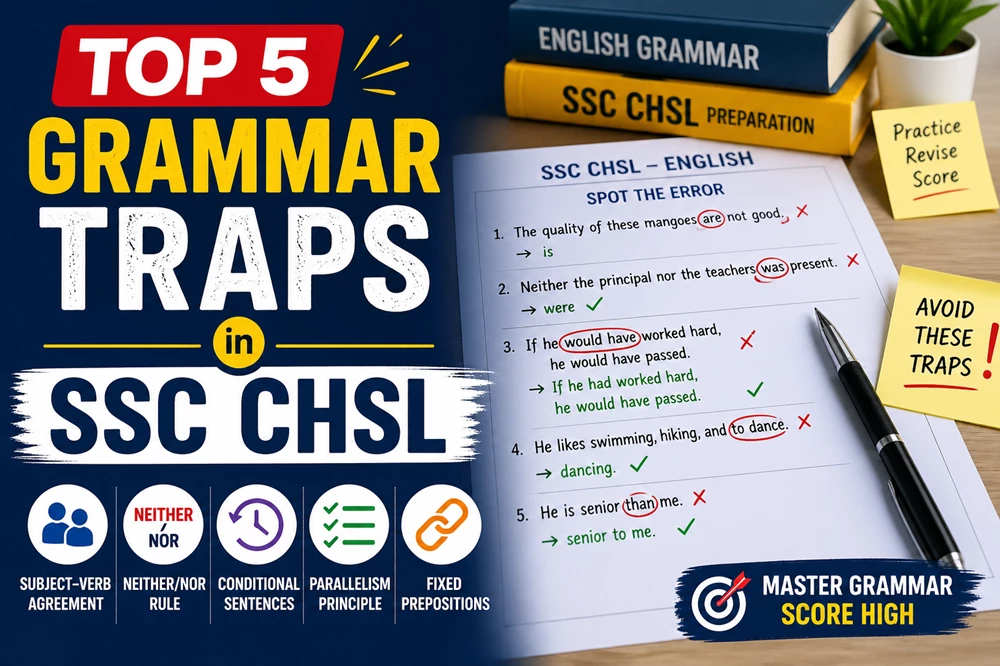
1. The “Distance” Trap (Subject-Verb Agreement)
Examiners love to separate the subject from the verb with a long phrase to confuse you.
The Rule: The verb must agree with the real subject, not the noun closest to it.
The Trap: The quality of these mangoes are not good. (Incorrect)
The Fix: The quality (Singular Subject) of these mangoes is not good. (Correct)
Exam Tip: Look out for phrases like “as well as,” “along with,” and “together with.” The verb always follows the first subject, not the second one. In Spot the Error questions, this is one of the easiest ways to trick you.
2. The “Neither/Nor” Proximity Rule
This is a favourite for Spot the Error questions in the SSC CHSL exam.
The Rule: When subjects are joined by or or nor, the verb agrees with the subject nearest to it.
The Trap: Neither the principal nor the teachers was present. (Incorrect)
The Fix: Neither the principal nor the teachers (Plural) were present. (Correct)
Exam Tip: Always look at the nearest subject before the verb—not the first one. This rule appears frequently in Spot the Error and Sentence Improvement questions.
3. The “Unreal Past” (Conditional Sentences)
If I had a rupee for every time a conditional sentence appeared in CHSL, I’d be retired.
The Rule: For past unfulfilled conditions, use: If + Had + V3 ….. Would have + V3.
The Trap: If he would have worked hard, he would have passed. (Incorrect)
The Fix: If he had worked hard, he would have passed. (Correct)
Exam Tip: Never use “would have” in the if-clause. It is very common in error detection and sentence correction questions.
4. The Parallelism Principle
Your sentence needs balance. If you start with one form, you must finish with it.
The Rule: Verbs in a list must have the same “ing” or “to” form.
The Trap: He likes swimming, hiking, and to dance. (Incorrect)
The Fix: He likes swimming, hiking, and dancing. (Correct)
Exam Tip: Check lists carefully—if one word breaks the pattern, that’s your error. It is a common hidden error in sentence structure questions.
5. The Fixed Preposition “Magnet”
SSC CHSL doesn’t just test prepositions; it tests fixed pairs. Certain words are “magnets” for specific prepositions.
The Rule: Some words always take specific prepositions—you can’t change them.
Common Pairs to Memorise:
- Abstain from
- Refrain from
- Congratulate on (not for)
- Accustomed to
- Senior/Junior to (not than)
Quick Test:
Choose the correct sentence:
A) He is senior than me.
B) He is senior to me.
✅ Correct Answer: B
Exam Tip: These are memory-based. The more you revise, the faster you’ll recognise them in the exam. They are very common in Fill in the Blanks and Error Detection.
Quick Practice Test: Can You Spot These Grammar Traps?
Most students get at least 3 wrong—let’s see how you do. Try to achieve 10/10 before seeing the answers given below:
Q1. The bouquet of roses ___ beautiful.
A) are
B) is
Q2. Many of them ___ in the field.
A) are
B) is
Q3. Neither the teacher nor the students ___ ready.
A) was
B) were
Q4. Neither the players nor the captain ___ present.
A) were
B) was
Q5. If she ___ harder, she would have succeeded.
A) would have tried
B) had tried
Q6. If they had left earlier, they ___ the train.
A) would catch
B) would have caught
Q7. He enjoys reading, writing, and ___.
A) to paint
B) painting
Q8. She likes to sing, dance, and ___.
A) act
B) acting
Q9. He is fond ___ music.
A) of
B) on
Q10. She insisted ___ going there.
A) on
B) for
✅ Answers
- B) is
- B) are
- B) were
- B) was
- B) had tried
- B) would have caught
- B) painting
- A) act
- A) of
- A) on
How to Practice These Rules for SSC CHSL
Understanding these rules is only 20% of the battle. The other 80% is seeing them again and again in actual exam questions.
What to Study Next:
Once you’re comfortable with these rules, you should move on to:
- Error Detection practice sets
- Sentence Improvement questions
- Cloze tests and comprehension
This is where these rules actually start helping you score marks.
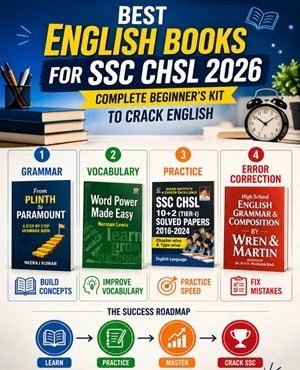
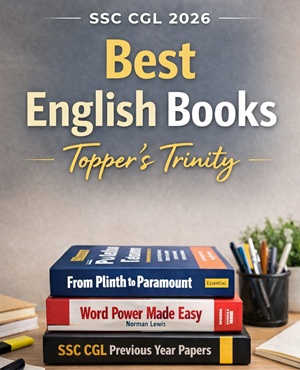
If you’re a beginner, I always recommend starting with a book that explains these rules. For the best resources to master these rules and other important ones, check out our curated First Attempt Kit for CHSL Beginners, where we review the top-rated grammar and practice books for the 2026 exam.