50 Most Repeated One-Word Substitutions for SSC CHSL (2021–2025)

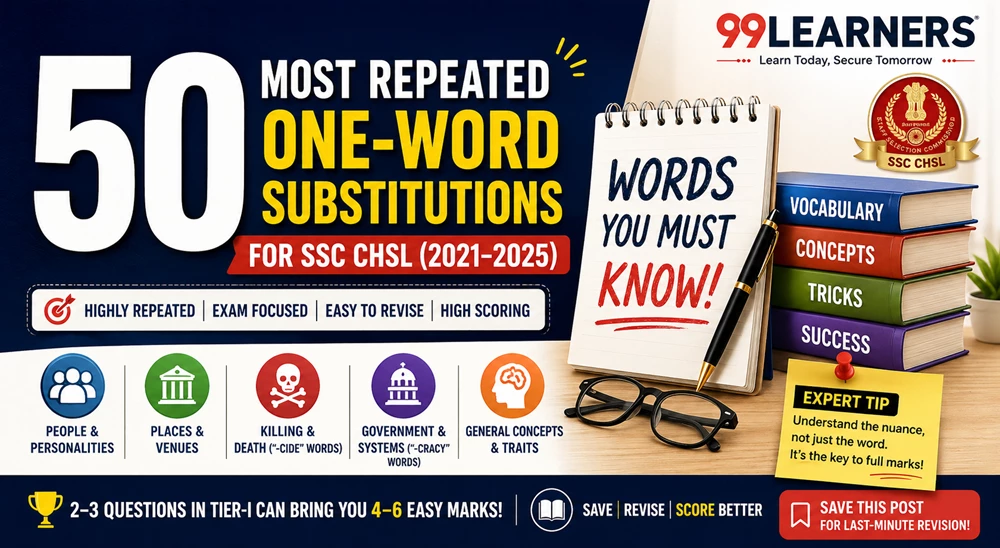
Image of repeated one word substitutions for CHSL

In the SSC CHSL exam, One-Word Substitution (OWS) is one of the easiest scoring topics. In Tier I, you can expect 2–3 questions, which means a quick 4 to 6 marks with minimal effort—if you prepare smartly.

What makes OWS a “smart” topic is its high repetition rate. Based on the papers from previous years (2021–2025), here are the 50 most frequently repeated one-word substitutions, categorised by theme to help you memorise them faster. These words appear again and again in exams, making them highly important for 2026 aspirants.

Why This List Matters

This list:

  • Covers most repeated questions from SSC CHSL papers
  • Helps you revise faster before the exam
  • Focuses on high-probability words, not unnecessary lists
  • Improves both accuracy and speed

In the following list, a memory clue or root is added for each word.

1. People & Personalities (The Most Common Theme)

  • Stoic (stoic = unaffected): A person who is indifferent to pleasure or pain. (Example: Even after losing his job, he remained stoic and refused to complain.)

  • Fastidious (fastidium = disgust): One who is very selective and hard to please. (Example: She is so fastidious about cleanliness that she wipes down every surface twice a day.)

  • Philanthropist (phil = love, anthropos = mankind): Someone who loves and helps mankind (Charity). (Example: The billionaire philanthropist donated $50 million to build schools in rural Africa.)

  • Misanthrope (misos = hate, anthropos = mankind): A person who hates or avoids human society. (Example: Years of betrayal turned him into a misanthrope who avoided all social gatherings.)

  • Bibliophile (biblio = book): A great lover and collector of books. (Example: As a true bibliophile, she owns over 2,000 books and visits the library every weekend.)

  • Teetotaler (tee-total = total abstinence): Someone who never touches alcohol. (Example: He’s been a teetotaler his whole life and has never touched a drop of alcohol.)

  • Somnambulist (somnus = sleep, ambulare = to walk): A person who walks in their sleep. (Example: Her husband is a somnambulist, so they had to install safety locks on all the bedroom windows.

  • Insolvent / Bankrupt (in = not, solvere = to loosen/pay): One who is unable to pay their debts. (Example: The company was declared insolvent after failing to pay its creditors for six months.)

  • Polyglot (poly = many, glotta = tongue/language): A person who speaks many languages. (Example: Being a polyglot, she can effortlessly switch between English, Mandarin, and Spanish.)

  • Ambidextrous (ambi = both, dexter = right-handed/skillful): Someone who can use both hands with equal ease. (Example: As an ambidextrous painter, he can use both hands to create identical brushstrokes.)

  • Altruist (alter = other): A person unselfishly concerned for the welfare of others. (Example: The altruist gave his last meal to a homeless stranger without expecting anything in return.)

  • Ascetic (asketes = monk/hermit): One who leads a simple, strict life for religious reasons. (Example: The monk lived an ascetic life in a tiny hut with only a mat and a bowl.)

  • Fatalist (fatum = fate): A believer in the power of fate. (Example: With a fatalist mindset, he believed the train crash was simply destiny and not worth worrying about.)

  • Gregarious (grex = flock/herd): Someone who loves being in the company of others (sociable). (Example: Her gregarious nature makes her the life of every party she attends.)

  • Iconoclast (eikon = image, klastes = breaker): One who attacks traditional beliefs or institutions. (Example: The young artist was an iconoclast who rejected all traditional painting techniques.)

  • Incorrigible (in = not, corrigere = to correct): A person whose bad habits cannot be changed. (Example: Despite years of detention, he remains an incorrigible prankster.)

  • Invincible (in = not, vincere = to conquer): Someone too strong to be defeated. (Example: After winning ten consecutive matches, the boxer felt practically invincible.)

  • Mercenary (merces = pay/wages): A soldier who fights primarily for money. (Example: He had no loyalty to the cause—his motives were purely mercenary and driven by money.)

  • Optimist (optimus = best): One who looks at the bright side of things. (Example: Even when it rains on her picnic, the optimist says, “At least the garden will bloom.”)

  • Pessimist (pessimus = worst): One who looks at the dark side of things. (Example: The pessimist saw the broken glass and immediately assumed the whole project was doomed.)

  • Recluse (recludere = to shut away): A person who lives a solitary life. (Example: After retiring, she became a recluse and rarely left her countryside cottage.)

2. Places & Venues

  • Aviary (avis = bird): A large enclosure or building for keeping birds. (Example: The zoo’s new aviary houses over 200 tropical parrots and macaws.)

  • Apiary (apis = bee): A place where bees are kept. (Example: He tends to his apiary every morning and harvests fresh honey each spring.)

  • Abattoir (abattre = to beat down / slaughter): A building where animals are butchered (Slaughterhouse). (Example: The cattle were transported to the abattoir early in the morning for processing.)

  • Arsenal (arsenale = dockyard / workshop): A place where weapons and ammunition are stored. (Example: The military arsenal contained enough ammunition to supply the entire battalion.)

  • Archives (archivum = public records): A place where historical documents or records are kept. (Example: She spent months in the city archives researching her family’s genealogy.)

  • Asylum (asylon = refuge / sanctuary): An institution for the care of the mentally ill. (Example: The political refugee sought asylum in a neutral country.)

  • Mortuary (mors = death): A room where dead bodies are kept before burial. (Example: The family gathered at the mortuary to pay their final respects.)

  • Mint (Moneta = Roman goddess of coinage): A factory where coins are made. (Example: The government decided to mint new coins featuring the king’s portrait.)

  • Orchard (ortus = garden / yard): A piece of land where fruit trees are grown. (Example: Every autumn, they pick fresh apples from their family orchard.)

3. Killing & Death (The “-cide” Suffix)

  • Fratricide (frater = brother): Killing of one’s brother. (Example: The soldier was court-martialed for fratricide after accidentally firing on his own unit.)

  • Matricide (mater = mother): Killing of one’s mother. (Example: The shocking crime of matricide sent shockwaves through the small, close-knit town.)

  • Patricide (pater = father): Killing of one’s father. (Example: In ancient Rome, patricide was punished by being thrown into the river in a leather sack.)

  • Homicide (homo = man/human): Killing of one human being by another. (Example: The police are investigating the case as a homicide)

  • Regicide (rex = king): Killing of a king. (Example: The beheading of the monarch was the most famous act of regicide in English history.)

4. Government & Systems (The “-cracy” Suffix)

  • Democracy (demos = people): Government by the people. (Example: In a true democracy, every citizen’s vote carries equal weight in electing leaders.)

  • Autocracy (autos = self): Government by one person with absolute power. (Example: The general seized control and established an autocracy, ruling with absolute authority.)

  • Monarchy (monos = single/one, archein = to rule): Government by a king or queen. (Example: The United Kingdom is a constitutional monarchy where the king reigns but does not govern.)

  • Plutocracy (ploutos = wealth): Government by the wealthy. (Example: Critics argue that the country has become a plutocracy.)

  • Oligarchy (oligos = few, archein = to rule): Government by a small group of people. (Example: The small council of generals formed an oligarchy and controlled all military and civilian decisions.)

5. General Concepts & Traits

  • Obsolete (ob = against/away, solere = to be used): Something that is no longer in use because it is outdated. (Example: The floppy disk has become completely obsolete in the age of cloud storage.)

  • Credulous (credere = to believe): A person who believes things too easily. (Example: The credulous investor fell for every fake get-rich-quick scheme he encountered.)

  • Gullible (gull = to swallow/cheat): Easily persuaded to believe something (often used for scams). (Example: She is so gullible that she believed the moon was made of cheese.)

  • Inaudible (in = not, audire = to hear): A sound that is unable to be heard. (Example: His whisper was inaudible from more than three feet away.)

  • Illegible (il = not, legere = to read): Handwriting that is impossible to read. (Example: The doctor’s handwriting was so illegible that the pharmacist couldn’t decipher the prescription.)

  • Extempore (ex = out of, tempore = time/on the spot): A speech delivered without any prior preparation. (Example: The professor gave an extempore when the guest speaker failed to arrive.)

  • Utopia (ou = not, topos = place — “nowhere”): An imaginary ideal society free of all suffering. (Example: The novel describes a utopia where poverty, war, and greed do not exist.)

  • Vulnerable (vulnus = wound): Open to being easily hurt or attacked. (Example: The elderly are especially vulnerable to severe complications from the flu.)

  • Amnesty (amnestia = forgetfulness/oblivion): An official pardon for political offences. (Example: The government granted amnesty to all political prisoners on Independence Day.)

Common Confusions You Must Know

Many candidates lose marks due to small differences in the meaning of such word pairs:

  • Credulous vs Gullible → Both mean “easily believing,” but gullible is often used in trick/scam situations
  • Optimist vs Pessimist → Positive vs negative outlook
  • Ascetic vs Recluse → Simple life vs isolated life

Understanding these differences is key to the 2026 exams.

Practice Quiz (Test Yourself)

1. A person who loves books:
A) Philanthropist
B) Bibliophile
C) Recluse
D) Ascetic

2. Government by a few people:
A) Democracy
B) Monarchy
C) Oligarchy
D) Autocracy

3. A speech without preparation:
A) Utopia
B) Extempore
C) Amnesty
D) Credulous

4. One who cannot be corrected:
A) Invincible
B) Incorrigible
C) Stoic
D) Fatalist

5. A place where coins are made:
A) Arsenal
B) Mint
C) Archive
D) Mortuary

Answers: 1-B, 2-C, 3-B, 4-B, 5-B

Smart Strategy for SSC CHSL 2026

Memorise the above words and their meanings. To score full marks:

  • Revise this list often by visiting this page
  • Focus on confusing pairs and their small differences in meaning
  • Practice CHSL MCQs regularly to train for the exam skill
  • Use these words in sentences for better retention

Expert Tip for CHSL Aspirants

If you master these 50 repeated one-word substitutions, you are already ahead of most aspirants. Save this page and revise it before your exam for quick marks. But you still need to explore more words.

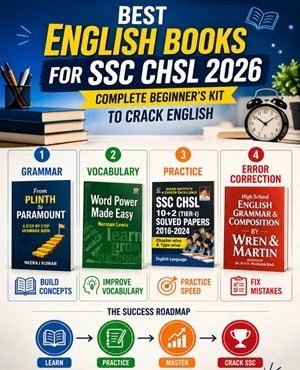
One easy way to strengthen your vocabulary further for the CHSL exam is to learn root words. We’ve reviewed the top-performing books on grammar, vocabulary, and preparation resources. Check out this link > Best English Books for SSC CHSL Preparation.
Leave a Comment

Your email address will not be published. Required fields are marked *