The Cloze Test is often the most feared part of the SSC CHSL English paper. Unlike a simple grammar question, it tests your ability to understand a story while it’s still being written. Most students fail here because they try to fill the blanks one by one without understanding the “Big Picture.”
In my years of coaching in our classroom, I’ve found that the highest scorers don’t just “guess”; they use the Context Clue Method. This technique allows you to decode the missing words by looking at the “signals” hidden in the surrounding sentences.
If you want to improve accuracy and speed, you need a smarter approach.
This guide reveals SSC CHSL Cloze Test tips using the Context Clue Method, along with a proven strategy to solve questions step by step.
1. The “Tone” Signal
Before you even look at the options, determine the passage’s mood. Is it scientific, emotional, critical, or praising?
Example: If a passage is about “Climate Change,” the tone will likely be serious or urgent. You won’t pick words like “hilarious” or “casual” to fill the blanks.
This helps you instantly eliminate wrong options.
2. The “Grammar Neighbour” Check
Look at the words immediately before and after the blank. They often dictate which word is required.
Prepositions: If the blank is followed by “to,” you are looking for words like accustomed, lead, prior, or addicted.
Articles: If the blank is preceded by “an,” the word must start with a vowel sound.
- Nouns: If an adjective precedes the blank, it is likely a noun.
For example:
“She is addicted ___ coffee” → here, “to” is required.
This trick alone can solve many questions quickly.
3. Use the “Collocation” Trick
Some words are best friends—they always travel together. These are called collocations.
Example: We say “make a mistake,” not “do a mistake.” We say “heavy rain,” not “strong rain.”
CHSL Hack: Memorising fixed preposition pairs and common phrases will help you solve 2 out of 5 blanks in seconds.
The 3-Pass Strategy for 100% Accuracy
Instead of solving randomly, follow this structured approach:
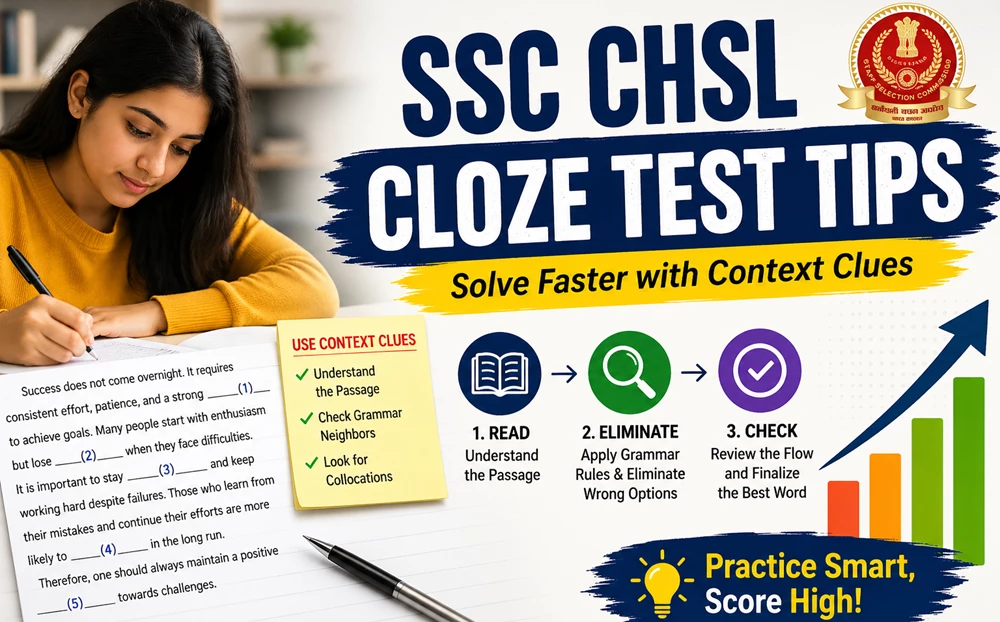
Pass 1 (The Speed Read): Read the entire passage without looking at the options. Understand the Main Idea before filling in any blanks.
Pass 2 (The Elimination): Fill in the blanks you are 100% sure of. For the tricky ones, eliminate options that don’t fit the Grammar Neighbour rule. Skip confusing ones.
Pass 3 (The Flow Check): Read the completed passage again. Check if it sounds natural and logical. Replace any word that feels “forced”.
Common Mistakes to Avoid
Don’t do:
- Solving blanks without reading the full passage
- Ignoring grammar rules
- Choosing options based on familiarity only
- Not checking the final flow
Fix: Always follow the 3-pass strategy.
Solved Example (Quick Practice)
Passage:
Success does not come overnight. It requires consistent effort, patience, and a strong ___(1)___ to achieve goals. Many people start with enthusiasm but lose ___(2)___ when they face difficulties. It is important to stay ____(3)____ and keep working hard despite failures. Those who learn from their mistakes and continue their efforts are more likely to ___(4)___ in the long run. Therefore, one should always maintain a positive ___(5)___ towards challenges.
Options:
(1)
A) decide
B) decision
C) determination
D) deciding
(2)
A) motivate
B) motivation
C) motivated
D) motivating
(3)
A) focus
B) focused
C) focusing
D) focusly
(4)
A) success
B) succeed
C) successful
D) successfully
(5)
A) attitude
B) altitude
C) gratitude
D) aptitude
Answers with Explanation:
(1) → C) determination
“Strong” is an adjective → needs a noun
✔ “strong determination” is a correct collocation
(2) → B) motivation
“Lose” is followed by a noun
✔ “lose motivation” is grammatically correct
(3) → B) focused
“Stay” is followed by an adjective
✔ “stay focused” is correct usage
(4) → B) succeed
“To” is followed by the base verb
✔ “to succeed” is correct
(5) → A) attitude
“Positive” requires a noun
✔ “positive attitude” fits the context perfectly
Final Completed Passage:
Success does not come overnight. It requires consistent effort, patience, and a strong determination to achieve goals. Many people start with enthusiasm but lose motivation when they face difficulties. It is important to stay focused and keep working hard despite failures. Those who learn from their mistakes and continue their efforts are more likely to succeed in the long run. Therefore, one should always maintain a positive attitude towards challenges.
Quick Revision Checklist
Before submitting your answers, ask:
✔ Did I understand the passage?
✔ Does the word fit grammatically?
✔ Does it match the tone?
✔ Does the sentence sound natural?
Final Tip
Cloze Test is not about memorising words—it’s about understanding how English works in real context.
If you practice the Context Clue Method + 3-Pass Strategy, you’ll see speed and accuracy for the score.
Recommended Resources for Practice
Remember, you are competing with thousands of candidates in the SSC CHSL exam to secure a job. So, you need to practice for speed and accuracy. To master the cloze test, you need passages that mirror the actual SSC CHSL exam pattern.
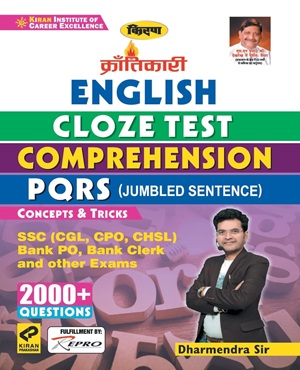
Kiran English Cloze Test & PQRS is perfect for your practice. It contains over 2,000 questions from previous years, allowing you to see every possible trap SSC has ever set.
 Watch our YouTube Shorts on daily English tips, vocabulary, quizzes, and challenges →