Time management is the biggest challenge for most students in the IELTS Reading module. You have to read three long passages and answer 40 questions in just 60 minutes—so reading every single word is simply not practical.
This is where IELTS Reading skimming and scanning techniques become essential. High-scoring candidates don’t read everything—they read smartly.
This article focuses on the two most critical skills used by high-scoring candidates: Skimming and Scanning. When used together, these “secrets” allow you to find the correct answers without reading the entire text.
While the article focuses on the IELTS exam, the techniques are useful to general speed readers.
1. Skimming: Understanding the Main Idea Quickly
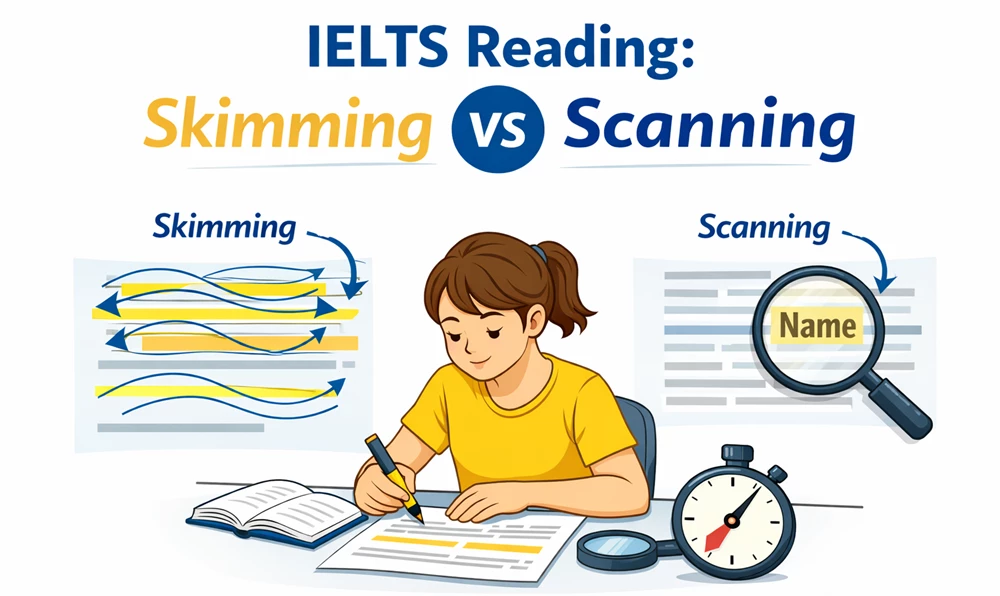
Skimming is the process of reading a text quickly to understand the main idea or the general theme. At this stage, you aren’t looking for details yet; you are just trying to understand “what is this paragraph about?”
How to Skim Effectively:
Read the Title and Subheadings: These give you the overall context immediately.
Focus on the “Topic Sentence”: In most academic texts, the first sentence of a paragraph tells you the main idea.
Read the Final Sentence: The last sentence often summarises the point or transitions to the next idea.
Ignore Difficult Words: If you see a word you don’t know, skip it. You only need the “big picture” at this stage.
Remember: Skimming is especially useful for Matching Headings and main idea questions in IELTS Reading.
2. Scanning: Finding Specific Facts Fast
Scanning is what you do when you are looking for a specific piece of information, like a phone number in a directory or a name in a list. Instead of reading everything, you move your eyes rapidly over the page to locate the exact information.
How to Scan Effectively:
Identify the Keyword: Look at the question first. Is it asking for a date? A person’s name? A specific country?
Look for Visual Clues: Capital letters (for names), numbers (for dates), or italicised/bold words are easy for your eyes to catch.
Don’t Read Everything, Just Search: Move your eyes quickly (you can follow a “Z” pattern) across the page until you find the keyword. Once you find it, stop and read only that sentence carefully.
Note: Scanning is most useful for fill-in-the-blank, True/False/Not Given, and short-answer questions.
3. The Smart 3-Step Strategy for IELTS Reading
To maximise your score, follow this skimming and scanning for every passage in 3 steps:
The 1-Minute Skim: Quickly skim the passage to understand the layout and the main topic.
Analyse the Question: Read the question and underline the keywords. Decide if you need to find a specific fact (Scanning) or understand an opinion (Skimming).
The Targeted Search: Use scanning to find the location of the answer in the text, then read that specific section slowly to ensure you have the right detail.
4. Common Mistakes to Avoid
Many students know these techniques—but use them incorrectly.
Avoid these common mistakes:
- Reading every word slowly: This wastes time and reduces accuracy.
- Scanning without understanding the question: Always identify keywords first.
- Confusing skimming with guessing: Skimming is about understanding the idea—not randomly reading.
- Not re-reading the answer sentence: Always double-check the context before choosing your answer.
5. The 10-Minute Daily Drill
To master these skills, try this exercise every day:
Open an English news article or a Wikipedia page.
Give yourself 30 seconds to skim and write down the three main points of the article.
Choose a keyword (name, number, or date) and see how many seconds it takes you to find it on the page.
With daily practice, your reading speed and accuracy will improve quickly.
Pro-Tip for 99Learners
Many “Heading Match” questions in the IELTS Reading test require skimming skills, while “Fill in the Blanks” questions require scanning. Mastering these techniques can help you save valuable time during the exam and reduce stress.
Conclusion
You don’t need to read everything to score high in IELTS Reading—you just need to read smart.
By combining skimming for understanding and scanning for details, you can locate answers faster, manage your time better, and improve your overall performance.
Start practicing these techniques daily, and you’ll see a big difference in your speed and confidence.
FAQs: IELTS Reading Skimming and Scanning
1. What is the difference between skimming and scanning in IELTS Reading?
Skimming is used to understand the main idea, while scanning is used to find specific information like names, dates, or numbers.
2. Should I read the whole passage first in IELTS Reading?
No. It’s better to skim the passage quickly and then use scanning to locate answers.
3. How can I improve my IELTS Reading speed?
Practice skimming and scanning daily using short articles, and focus on identifying keywords quickly.
4. Is skimming enough to answer all IELTS Reading questions?
No. Skimming helps with main ideas, but scanning is needed for specific details. Both skills must be used together.
For more technical terms and their definitions, don’t forget to check our Learner’s Dictionary of English Grammar.
If you are looking for complete practice tests and training, check out the book or course shown below.