In the UPSC IAS Mains Compulsory English Paper, Precis Writing carries a massive 75 marks. It is easily the most technical and disciplined section of the entire exam.
The evaluator isn’t just checking your vocabulary—they are looking at your ability to condense complex, bureaucratic, or philosophical prose into exactly one-third of its original length.
UPSC provides a specific Grid-Based Sheet (a booklet containing rows of small boxes) for this section. You must write exactly one word per box. If you copy-paste sentences directly or violate the strict layout guidelines, you face immediate, heavy mark deductions.
Unlike in our school days, the UPSC follows strict rules regarding word count, presentation, and structure.
In this guide, you will learn:
- UPSC Precis Writing Rules
- Word count and grid sheet format
- Common mistakes to avoid
- A solved example
- A final checklist before submission
What Is Precis Writing in UPSC?
Precis writing is the process of condensing a passage to approximately one-third of its original length while preserving its main message and logical flow.
The examiner evaluates:
- Ability to understand key ideas
- Writing in your own words
- Clarity and coherence
- Grammar and sentence construction
- Following UPSC instructions accurately
The goal is not merely to shorten content; it is to communicate the author’s ideas in the passage briefly and effectively.
Mastering the Grid: Step-by-Step Precis Rules for IAS Mains
1. The Strict Mechanical Rules
The One-Third Law: For example, if the given passage is 450 words, your precis must be between 140 and 160 words. Going significantly over or under will trigger penalties.
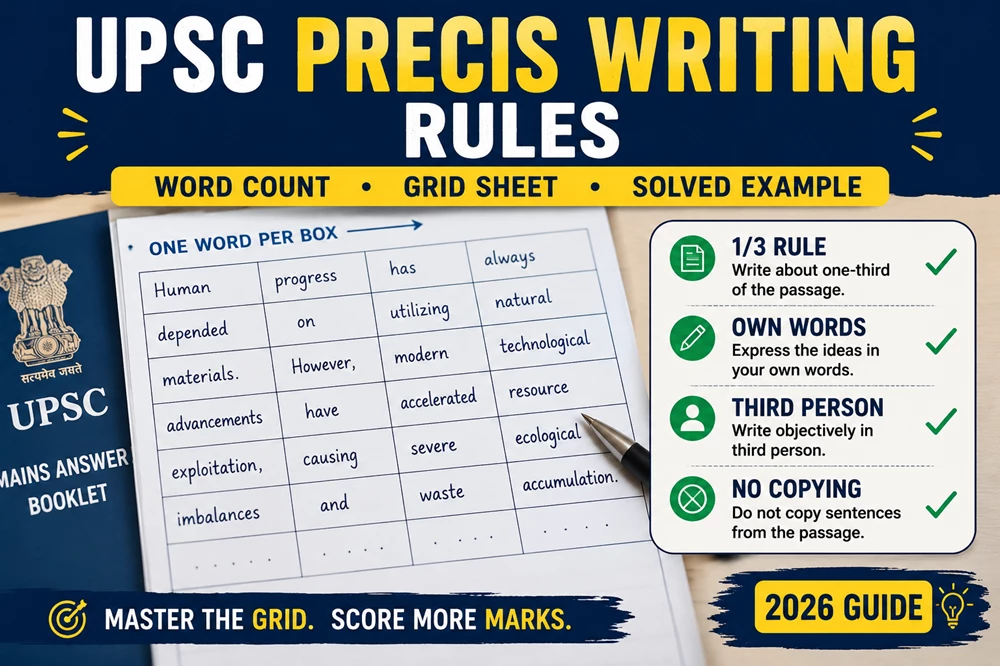
The Box Layout: Write only one word in each box. Every individual word—including articles (a, an, the) and prepositions (to, in, for)—takes up exactly one box.
Punctuation Placements: Punctuation marks like periods, commas, or semicolons do not get their own separate boxes. Place them in the bottom-right corner of the box containing the word they follow.
2. Core Formatting & Composition Rules
No Title Allowed: Unlike state PSCs or school exams, the standard instructions for the UPSC Compulsory English paper state: “Do not give or suggest a title to it.” So, don’t give any title for the precis.
Always Use Your Own Words: Never copy full phrases or copy-paste chunks directly from the given passage. You must read and digest the author’s logic and rephrase it using clear, functional English synonyms. For example, instead of “Rapid exploitation of resources”, rewrite as “Fast resource consumption”. Examiners expect you to understand and reframe ideas rather than copy them.
The Third-Person Rule: Even if the passage uses “I” or “We,” write your precis objectively in the third person (e.g., “The author states…”, “The text argues…”). Remove all personal anecdotes and examples.
Common Mistakes
Many aspirants lose marks because of these mistakes:
- Copying sentences directly from the passage
- Significantly long or short of the word limit (one-third of the passage length)
- Including unnecessary examples
- Adding personal views
- Missing the central idea
- Ignoring grid format instructions
- Writing in first person
Step-by-Step UPSC Precis Practice Set
The following passage is for example only. The passage in the actual exam may be longer.
The Original Passage (180 Words)
The history of human civilisation is intimately bound up with the history of the materials that humans have learned to exploit. Early human eras are defined by the primary materials utilised for tools, such as the Stone Age, the Bronze Age, and the Iron Age. In modern times, the acceleration of technological progress has drastically expanded this list to include advanced polymers, silicon semiconductors, and synthetic nanomaterials. However, our rapid exploitation of resources has created an unprecedented ecological imbalance. Industrial systems extract billions of tons of raw elements annually, disrupting natural cycles and generating critical quantities of waste. Economists argue that a structural shift is required to prevent systemic collapse. We must transition from a linear ‘extract-use-dispose’ industrial economy to a circular production loop. In a circular framework, waste products are completely eliminated because materials are continuously recycled, reused, and reintegrated into production cycles. This shift is not merely a technical adjustment; it represents a fundamental restructuring of modern society’s relationship with the natural environment.
The Strategic Extraction Strategy
Before filling out the boxes, break down the core argument into points without illustrative examples (like the Stone/Bronze ages or specific nanomaterials) as follows:
Human development has always relied on material exploitation.
Modern technological growth has escalated this extraction, causing a critical ecological crisis.
To avoid collapse, the economy must shift from a linear model to a circular reuse framework.
This change requires fundamentally transforming civilisation’s connection with nature.
The Final Precis Draft (59 Words)
Target length: 180 / 3 = 60 words. Write the precis that fits exactly within the strict one-third limit as follows:
Human progress has always depended on utilising natural materials. However, modern technological advancements have accelerated resource exploitation, causing severe ecological imbalances and waste accumulation. To prevent systemic collapse, society must transition from a linear disposal model to a circular framework where materials are continuously recycled. This shift demands a fundamental restructuring of humanity’s relationship with nature.
The UPSC Grid Sheet Example
This is exactly how your response must look inside the official Question-cum-Answer Booklet (QCAB):
Word Count: 59 Words
Final UPSC Precis Checklist
Before submitting your answer, check your precis:
✅ Is the précis close to one-third of the original passage?
✅ Did I write in my own words?
✅ Did I avoid personal opinions?
✅ Did I remove unnecessary examples?
✅ Did I maintain logical flow?
✅ Did I follow the grid format?
✅ Did I write in third person?
Recommended Preparation Book
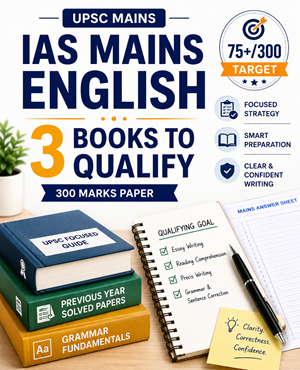
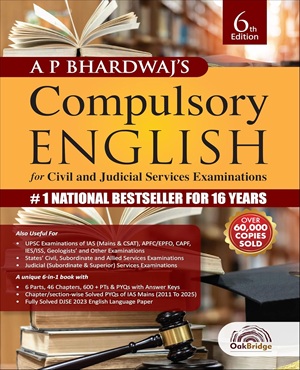
You must practice regularly to write your precis confidently in the exam. Compulsory English for IAS Mains by A.P. Bhardwaj covers grammar usage, sentence correction rules, and guides for Essay and Precis writing. The book helps you with the solved previous years’ papers in it.
For the grid sheet practice, make grid sheets on plain paper or buy a notebook for the purpose.
For your complete preparation, you can also check out our recommended → IAS Mains Compulsory English Book Set
Final Words
Precis writing is not just about shortening a given passage. It is about identifying important ideas and presenting them with precision and clarity. Regular practice with word limits and grid formats can help you improve speed and accuracy.
Master the rules and practice consistently to score well in the UPSC Compulsory English paper.