
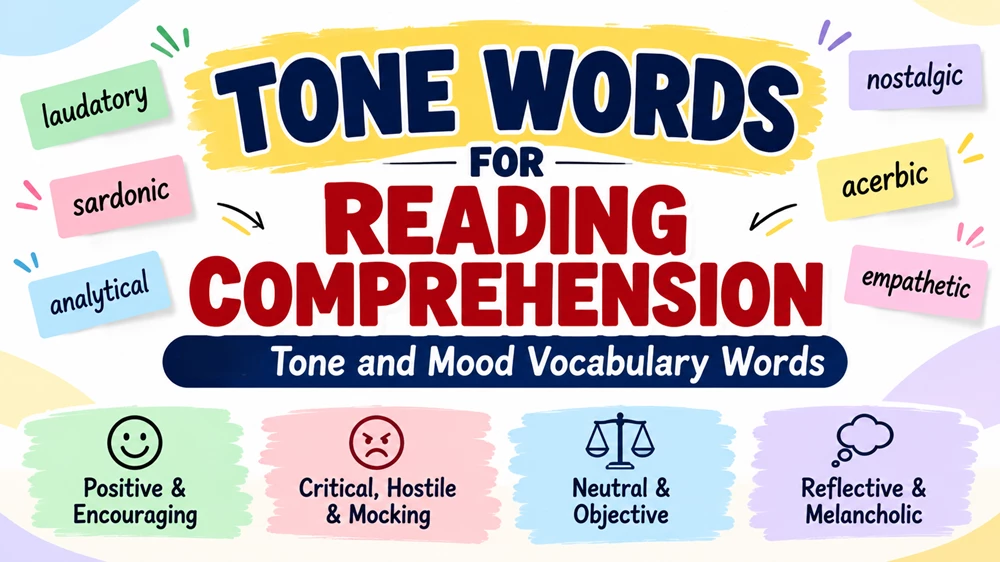
If you’re preparing for competitive exams such as SSC CGL, Banking PO, UPSC CDS, or CAT VARC, reading comprehension is an important area to focus on. Some RC questions may ask, “What is the author’s tone in the passage?”
Unlike straightforward factual questions, tone-based questions require careful reading. You need to notice subtle changes in vocabulary, sentence structure, and the author’s attitude. Simply choosing words like “happy,” “angry,” or “sad” may not be enough when the options include more nuanced terms such as sardonic, ebullient, acerbic, or elegiac.
Learning tone-related vocabulary is useful beyond exam preparation. It can also improve your own writing by helping you express emotions more subtly, analyse literature, and communicate complex ideas with greater precision.
Understanding Tone vs. Mood
Before exploring the vocabulary, it is important to understand the difference between Tone and Mood:
Tone is the author’s attitude toward the subject matter or audience. It shows how the writer feels about what they are discussing (e.g., critical, enthusiastic, clinical).
Mood is the emotional atmosphere created for the reader. It describes how the passage makes you feel as you read it (e.g., gloomy, tense, whimsical).
For example, an author may use a clinical and detached tone while describing a historical tragedy. However, the mood created for the reader may still feel sombre and heavy.
Here are 35 vocabulary words that can help you answer RC questions and make your own writing more expressive.
Table of Contents
Category 1: Positive & Encouraging Tones
These words describe passages where the author celebrates an achievement, advocates an optimistic solution, or displays deep admiration for a subject.
1. Ebullient (Adjective)
Meaning: Overflowing with enthusiasm, fervour, or high spirits.
Pronunciation: /ɪˈbʊl.i.ənt/
Sample Snippet in Ebullient Tone: “The breakthrough in renewable fusion energy does not merely promise cheaper electricity; it opens the door to an era of boundless clean power that can revitalise our industrial landscape.”
2. Reverent (Adjective)
Meaning: Showing deep, solemn respect and veneration.
Pronunciation: /ˈrev.ər.ənt/
Sample Snippet in Reverent Tone: “As we stood beneath the towering, centuries-old canopy of the redwoods, a quiet stillness fell over the group, honouring trees that had witnessed human history unfold across millennia.”
3. Optimistic (Adjective)
Meaning: Expecting favourable outcomes; hopeful about the future.
Pronunciation: /ˌɒp.tɪˈmɪs.tɪk/
Sample Snippet in Optimistic Tone: “Despite current economic headwinds, the rapid expansion of digital literacy programs in rural regions suggests a bright, prosperous decade ahead for emerging workforce markets.”
4. Laudatory (Adjective)
Meaning: Expressing formal praise, commendation, or admiration.
Pronunciation: /ˈlɔː.də.tər.i/
Sample Snippet in Laudatory Tone: “Dr Sharma’s pioneering research in pediatric oncology represents a monumental leap forward, setting a gold standard that will save countless young lives across the globe.”
5. Empathetic (Adjective)
Meaning: Demonstrating a deep understanding, sensitivity, and sharing of another person’s feelings or struggles.
Pronunciation: /ˌem.pəˈθet.ɪk/
Sample Snippet in Empathetic Tone: “Navigating career transitions mid-life is fraught with anxiety; feeling overwhelmed by sudden uncertainty is an entirely natural human response that deserves support rather than judgment.”
6. Sanguine (Adjective)
Meaning: Cheerfully confident, optimistic, and buoyant, especially in the face of a difficult or challenging situation.
Pronunciation: /ˈsæŋ.ɡwɪn/
Sample Snippet in Sanguine Tone: “Even as negotiations stalled late into the night, the lead mediator remained sanguine, convinced that both parties shared enough common ground to reach a breakthrough by morning.”
7. Whimsical (Adjective)
Meaning: Playfully quaint, fanciful, or humorous in an appealing, lighthearted way.
Pronunciation: /ˈwɪm.zɪ.kəl/
Sample Snippet in Whimsical Tone: “The old clockmaker’s workshop was filled with mechanical birds that chirped on the hour, tiny brass gears that danced in teacups, and pendulum clocks shaped like smiling moons.”
8. Fervent (Adjective)
Meaning: Having or showing passionate, burning intensity of spirit or conviction.
Pronunciation: /ˈfɜː.vənt/
Sample Snippet in Fervent Tone: “She delivered a fervent plea to the city council, arguing that preserving the public library was not an administrative choice, but a moral duty to future generations.”
Category 2: Critical, Hostile & Mocking Tones
These tones appear when an author attacks policies, mocks societal flaws, expresses severe disapproval, or writes with sharp scepticism.
9. Acerbic (Adjective)
Meaning: Sharp, forthright, and biting in tone; harshly critical.
Pronunciation: /əˈsɜː.bɪk/
Sample Snippet in Acerbic Tone: “The administration’s sudden interest in environmental protection is as convincing as a wolf championing sheep rights, served up just in time for election season.”
10. Sardonic (Adjective)
Meaning: Grimly mocking, cynical, or sneeringly sarcastic.
Pronunciation: /sɑːˈdɒn.ɪk/
Sample Snippet in Sardonic Tone: “Ah, another corporate restructuring designed to ’empower employees’—which curiously always begins by eliminating two thousand jobs and doubling executive bonuses.”
11. Derisive (Adjective)
Meaning: Expressing ridicule, contempt, or scoffing mockery.
Pronunciation: /dɪˈraɪ.sɪv/
Sample Snippet in Derisive Tone: “To suggest that a weekend seminar can turn an amateur into a seasoned financial consultant is not just naive; it is thoroughly laughable.”
12. Caustic (Adjective)
Meaning: Sarcastic in a scathing, severely bitter, and damaging manner.
Pronunciation: /ˈkɔː.stɪk/
Sample Snippet in Caustic Tone: “His review was caustic enough to burn through the director’s ego, calling the multi-million dollar film a ‘masterclass in expensive boredom.'”
13. Pessimistic (Adjective)
Meaning: Expecting negative outcomes or focusing consistently on the worst aspects of a situation.
Pronunciation: /ˌpes.ɪˈmɪs.tɪk/
Sample Snippet in Pessimistic Tone: “No amount of policy tweaking will stave off the collapse of the local manufacturing industry; the structural damage is simply too deep and irreversible.”
14. Cynical (Adjective)
Meaning: Distrustful of human sincerity or motives; believing people act solely out of self-interest.
Pronunciation: /ˈsɪn.ɪ.kəl/
Sample Snippet in Cynical Tone: “Don’t mistake the corporation’s latest charity campaign for altruism; it is a calculated public relations exercise meant to offset recent tax scandals.”
15. Contemptuous (Adjective)
Meaning: Showing deep hatred, disdain, or scorn for something considered worthless or inferior.
Pronunciation: /kənˈtemp.tʃu.əs/
Sample Snippet in Contemptuous Tone: “The committee dismissed the public’s environmental concerns with a contemptuous wave of the hand, treating community petitions as minor nuisances.”
16. Patronising (Adjective)
Meaning: Displaying an offensive, condescending attitude of superiority while pretending to be helpful.
Pronunciation: /ˈpæt.rə.naɪ.zɪŋ/
Sample Snippet in Patronising Tone: “The executive explained basic spreadsheet functions to senior engineers in a patronising tone, assuming technical staff lacked fundamental software knowledge.”
17. Indignant (Adjective)
Meaning: Feeling or showing strong anger and annoyance at what is perceived as unfair or unjust treatment.
Pronunciation: /ɪnˈdɪɡ.nənt/
Sample Snippet in Indignant Tone: “How can the board justify cutting entry-level employee health benefits while simultaneously raising executive compensation by thirty per cent?”
18. Vitriolic (Adjective)
Meaning: Filled with extreme, bitter criticism, hatred, or malice.
Pronunciation: /ˌvɪt.riˈɒl.ɪk/
Sample Snippet in Vitriolic Tone: “The online debate quickly devolved into a vitriolic exchange of personal insults, drowning out any reasonable discussion of policy.”
Category 3: Objective, Informative & Neutral Tones
Common in academic journals, scientific reports, news articles, and balanced policy analyses, these tones prioritise facts over emotion.
19. Didactic (Adjective)
Meaning: Intended to teach, but it can also imply a moralising or overly instructional manner. (Cambridge Dictionary)
Pronunciation: /daɪˈdæk.tɪk/
Sample Snippet in Didactic Tone: “To construct an effective paragraph, first state your main claim clearly, provide supporting evidence, and conclude by connecting the argument back to your primary thesis.”
20. Pragmatic (Adjective)
Meaning: Dealing with matters sensibly, practically, and realistically based on actual conditions rather than theoretical ideals.
Pronunciation: /præɡˈmæt.ɪk/
Sample Snippet in Pragmatic Tone: “Rather than waiting for a complete overhaul of our software infrastructure, our most pragmatic option is to deploy a temporary patch to stabilise server speeds.”
21. Analytical (Adjective)
Meaning: Using logical reasoning, systematic analysis, and detailed examination to break down a topic.
Pronunciation: /ˌæn.əˈlɪt.ɪ.kəl/
Sample Snippet in Analytical Tone: “A breakdown of Q3 sales data indicates that the drop in revenue corresponds directly with supply chain disruptions in regional hubs rather than declining market demand.”
22. Impartial (Adjective)
Meaning: Fair, unbiased, and neutral; treating all sides of an issue equally without favouring one.
Pronunciation: /ɪmˈpɑː.ʃəl/
Sample Snippet: “Proponents argue that artificial intelligence accelerates medical diagnoses, while opponents express privacy concerns; both positions present valid considerations for regulators.”
23. Clinical (Adjective)
Meaning: Detached, impersonal, or highly objective, often resembling the style of a clinical report.
Pronunciation: /ˈklɪn.ɪ.kəl/
Sample Snippet in Clinical Tone: “The patient exhibited a resting heart rate of 88 bpm, mild tremor in the upper extremities, and localised swelling near the joint, with no reporting of acute pain.”
24. Matter-of-fact (Adjective)
Meaning: Direct, straightforward, unemotional, and adhering strictly to established facts.
Pronunciation: /ˌmæt.ər.əvˈfækt/
Sample Snippet in Matter-of-fact Tone: “The flight was delayed four hours due to engine maintenance, causing twelve passengers to miss their connecting international flights.”
25. Expository (Adjective)
Meaning: Serving to explain, clarify, or set forth detailed information on a complex subject.
Pronunciation: /ɪkˈspɒz.ɪ.tər.i/
Sample Snippet in Expository Tone: “Photosynthesis is the process by which green plants convert light energy into chemical energy, utilising carbon dioxide, water, and sunlight to produce glucose and oxygen.”
26. Philosophical (Adjective)
Meaning: Calm, reflective, and thoughtful when contemplating abstract truths or handling difficult circumstances.
Pronunciation: /ˌfɪl.əˈsɒf.ɪ.kəl/
Sample Snippet in Philosophical Tone: “Success and failure are merely temporary markers along a longer journey; what defines a career is not the outcome of a single project, but the continuous pursuit of knowledge.”
Category 4: Complex, Melancholic & Reflective Tones
These tones appear in memoirs, personal essays, introspective passages, and narrative texts that examine loss, memory, time, or internal conflict.
27. Nostalgic (Adjective)
Meaning: Demonstrating a sentimental, affectionate longing for the past.
Pronunciation: /nɒsˈtæl.dʒɪk/
Sample Snippet in Nostalgic Tone: “Walking down the cobblestone street brought back memories of childhood summers—the scent of fresh roasted coffee, distant laughter, and endless afternoon hours.”
28. Visceral (Adjective)
Meaning: Characterised by deep, instinctual, emotional, or gut-level feelings rather than intellectual reasoning.
Pronunciation: /ˈvɪs.ər.əl/
Sample Snippet in Visceral Tone: “A visceral wave of dread hit her as the sirens began to blare across the quiet harbour, triggering instincts buried since her early days in disaster response.”
29. Sombre (Adjective)
Meaning: Dark, serious, gloomy, and solemnly quiet in mood or tone.
Pronunciation: /ˈsɒm.bər/
Sample Snippet in Sombre Tone: “The mayor delivered a sombre address to the town hall, calling for a day of mourning to honour the emergency workers lost in the recent flood.”
30. Elegiac (Adjective)
Meaning: Expressing deep sorrow, lamentation, or mournful reflection for something lost, past, or deceased.
Pronunciation: /ˌel.ɪˈdʒaɪ.æk/
Sample Snippet in Elegiac Tone: “His final novel reads as an elegiac tribute to a bygone agrarian lifestyle, capturing a world slowly erased by urban expansion.”
31. Pensive (Adjective)
Meaning: Engaged in deep, serious, or melancholy thought.
Pronunciation: /ˈpen.sɪv/
Sample Snippet in Pensive Tone: “She sat by the window long after sunset, watching the rain strike the glass in quiet, pensive contemplation of the choices that lay ahead.”
32. Wistful (Adjective)
Meaning: Expressing a vague, gentle, or regretful longing for something unreachable or past.
Pronunciation: /ˈwɪst.fəl/
Sample Snippet in Wistful Tone: “He gave a wistful smile as he flipped through the old album, wondering how different life might have been had he accepted the job overseas.”
33. Ambivalent (Adjective)
Meaning: Having mixed, uncertain, or contradictory feelings or ideas about a subject simultaneously.
Pronunciation: /æmˈbɪv.ə.lənt/
Sample Snippet in Ambivalent Tone: “While she welcomed the promotion and higher salary, she felt ambivalent about relocating away from her family and long-term community.”
34. Apprehensive (Adjective)
Meaning: Anxious, fearful, or uneasy that something bad, unknown, or unpleasant will happen.
Pronunciation: /ˌæp.rɪˈhen.sɪv/
Sample Snippet in Apprehensive Tone: “Investors grew increasingly apprehensive as the deadline approached without any official statement regarding the company’s debt restructuring plan.”
35. Ruminative (Adjective)
Meaning: Deeply meditative; prone to turning thoughts over and over in the mind continuously.
Pronunciation: /ˈruː.mɪ.nə.tɪv/
Sample Snippet in Ruminative Tone: “The essay offers a ruminative look at how solitude shapes artistic creation, examining decades of journal entries to trace the evolution of personal thought.”
Don’t confuse these tone words
Some tone words look similar, but see how they are different:
Sardonic vs. sarcastic
Sardonic → grimly mocking or cynical
Sarcastic → uses mocking/ironic language, often to ridicule
Acerbic vs. caustic vs. vitriolic
Acerbic → sharp and biting
Caustic → scathing and cutting
Vitriolic → extremely bitter and hostile
Laudatory vs. reverent
Laudatory → strongly praising
Reverent → showing profound respect
Optimistic vs. sanguine
Optimistic → expecting a favourable result
Sanguine → confidently optimistic even in difficult circumstances
Nostalgic vs. wistful
Nostalgic → affectionate longing for the past
Wistful → gentle, often slightly sad longing
Pensive vs. ruminative
Pensive → deeply thoughtful
Ruminative → repeatedly turning thoughts over in the mind
How to Identify the Author’s Tone in 30 Seconds
Follow these steps and try to answer in less time:
Step 1: Identify the author’s attitude
Ask: Is the author praising, criticising, questioning, explaining, warning, mocking, remembering, or remaining neutral?
Step 2: Look for tone clues
Pay attention to word choice, adjectives, verbs, imagery, rhetorical questions, comparisons, irony, sarcasm, and other emotionally or evaluatively charged language.
Step 3: Determine the direction of the tone
Is the attitude positive, negative, neutral, sceptical, emotional, humorous, or reflective?
Step 4: Check the whole passage
Don’t choose a tone based on a single striking word or sentence. Select the tone that best describes the author’s overall attitude toward the subject.
30-Second Tone Shortcut
Praise → laudatory, admiring, appreciative
Criticism → critical, acerbic, caustic
Mockery → sarcastic, sardonic, derisive
Doubt → sceptical, doubtful, cynical
Hope → optimistic, sanguine
Sad reflection → wistful, nostalgic, elegiac
Neutral analysis → analytical, objective, matter-of-fact
Teaching → didactic, instructive
To improve your reading comprehension experience, also read this guide → How to Read Faster and Score Better in RC
Tone Classification Matrix
Use this quick-reference summary matrix to categorise tone words during your revision:| Tone Category | Key Characteristics | Selected Tone Words |
|---|---|---|
| Positive / Enthusiastic | Focuses on solutions, praise, hope, or deep respect. | Ebullient, Laudatory, Sanguine, Reverent, Fervent |
| Critical / Hostile | Uses sharp, sarcastic, mocking, or angry phrasing. | Acerbic, Sardonic, Caustic, Indignant, Vitriolic |
| Neutral / Objective | Prioritizes facts, logical analysis, or neutral instruction. | Analytical, Clinical, Pragmatic, Didactic, Impartial |
| Reflective / Melancholic | Focuses on loss, deep thought, memories, or internal conflict. | Elegiac, Nostalgic, Pensive, Ambivalent, Ruminative |
Can a passage have more than one tone?
Yes. An author may begin objectively, introduce evidence, and then become critical or sarcastic. In a multiple-choice question, look for the tone that best describes the passage as a whole unless the question specifically asks about a particular paragraph or section.
Test Your Understanding: Identify the Author’s Tone
Read each passage carefully and choose the option that best describes the author’s tone.
Question 1
The new community library has transformed the neighbourhood. Its well-stocked shelves, free digital resources, and welcoming study spaces have given hundreds of students a quiet place to learn. It is difficult to imagine a better investment in the future of the community.
What is the author’s tone?
A) Cynical
B) Laudatory
C) Apprehensive
D) Matter-of-fact
Answer: B) Laudatory
Explanation: The author expresses strong praise and admiration for the library and its impact on the community. This makes the tone laudatory.
Question 2
The company announced another “employee-first” initiative on Monday. Apparently, the best way to show concern for employees is to increase their workload while reducing their benefits. Workers can now celebrate this remarkable improvement from their unpaid overtime desks.
What is the author’s tone?
A) Reverent
B) Didactic
C) Sardonic
D) Sanguine
Answer: C) Sardonic
Explanation: The author uses grim, mocking language and irony to criticise the company’s claim. The sarcastic comparison between an employee-first policy and worsening conditions creates a sardonic tone.
Question 3
To write an effective argumentative paragraph, begin with a clear claim. Follow it with relevant evidence, explain how the evidence supports the claim, and finish by connecting the discussion to your main argument. This structure helps readers follow the reasoning easily.
What is the author’s tone?
A) Didactic
B) Elegiac
C) Vitriolic
D) Wistful
Answer: A) Didactic
Explanation: The author is primarily teaching or instructing the reader how to structure an argumentative paragraph. Therefore, the tone is didactic.
Question 4
As she walked past the old railway station, she remembered the afternoons when her father would wait for her after school. The station had changed beyond recognition, but for a moment she could almost hear his voice calling her name. She smiled softly, wishing she could return to those simpler days.
What is the author’s tone?
A) Analytical
B) Wistful
C) Indignant
D) Clinical
Answer: B) Wistful
Explanation: The passage expresses a gentle, slightly regretful longing for a past that cannot be recovered. That makes the tone wistful.
Question 5
The survey shows a steady decline in attendance over the last three years. The largest decrease occurred among students aged 16 to 18, while participation among younger students remained relatively stable. The data therefore suggests that age-related factors may have contributed to the overall decline.
What is the author’s tone?
A) Fervent
B) Derisive
C) Analytical
D) Contemptuous
Answer: C) Analytical
Explanation: The author examines data systematically and draws a measured conclusion from the evidence without using emotional or judgmental language. The tone is therefore analytical.
Key Takeaway
Learning tone vocabulary isn’t about memorising complicated words. It’s about understanding the author’s (or your writing’s) attitude from the context. Begin with common tone categories, explore the differences between similar words, and practise identifying tone in complete passages.
