In competitive exams like SSC CGL, Bank PO, NDA/CDS, State PSCs, and OMETs (SNAP, NMAT), exam-setters know that students often memorise idioms using quick scanning rather than deep comprehension. To test that you really understand them, they construct questions using Confusable Idiom Pairs (pairs that look alike).
What are confusable idioms?
Confusable idioms are expressions that look or sound similar but have different meanings. They are easy to confuse because they may share the same word, image, or structure.
In competitive exams, confusing one idiom with another can turn an easy question into a costly mistake. Read the following in-depth breakdown of common high-risk confusable idiom pairs, categorised by theme. You’ll also see a practice set to test your elimination skills.
Learn them and prepare for your exam.
Table of Contents
Look-Alike Idiom Pairs That Can Be Confused in Competitive Exams
                        THE LOOK-ALIKE TRAP MECHANISM

  "Burn your bridges"     ──► Sever all ties / destroy retreat path

  "Burn the midnight oil" ──► Work/study late into the night

  Shared Keyword: "BURN" ──► Exam-setters swap these in the questions to trap careless readers!
1. The “Fire & Burn” Confusable Pairs
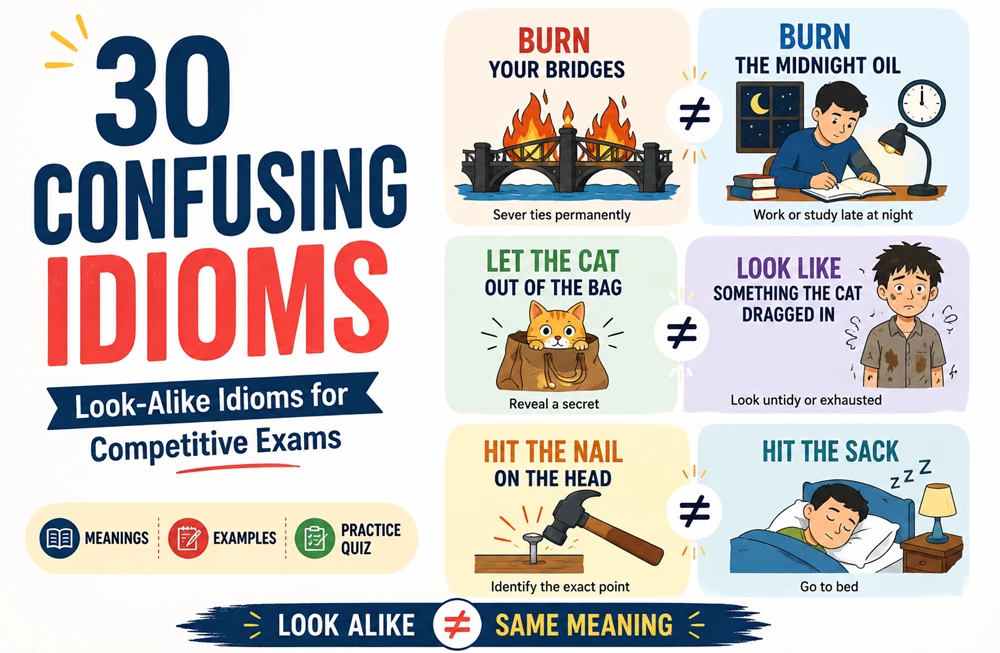
Pair 1: Burn your bridges vs. Burn the midnight oil
Burn your bridges: To permanently sever ties or destroy a path of retreat.
Context: “By publicly criticising his manager, Rohit burned his bridges with the firm.”
Burn the midnight oil: To work or study late into the night.
Context: “With the SSC CGL Tier-1 exam next week, she is burning the midnight oil.”
Key difference: Bridges = sever ties; midnight oil = work late.
Pair 2: Add fuel to the fire vs. Play with fire
Add fuel to the fire: To worsen an already volatile or angry situation.
Context: “Interrupting the angry customer only added fuel to the fire.”
Play with fire: To take foolish, dangerous risks that could lead to trouble.
Context: “Investing your life savings in unverified crypto stocks is playing with fire.”
Key difference: Add fuel = make a bad situation worse; play with fire = take a dangerous risk.
Pair 3: Go through fire and water vs. Set the Thames on fire
Go through fire and water: To face great difficulties or dangers for someone or something.
Context: “The loyal soldier was willing to go through fire and water for his nation.”
Set the Thames on fire: To accomplish something extraordinary or miraculous (often used negatively to denote lack of excitement).
Context: “His debut performance was decent, but it hardly set the Thames on fire.”
Key difference: Fire and water = face hardships; Thames on fire = do something extraordinary.
2. The “Water & Sea” Confusable Pairs
Pair 4: In deep water vs. Like water off a duck’s back
In deep water: In serious trouble or difficulty.
Context: “The company found itself in deep water after failing its statutory audit.”
Like water off a duck’s back: Criticism or advice that produces no effect on someone.
Context: “Strict warnings from teachers are like water off a duck’s back to him.”
Key difference: Deep water = trouble; duck’s back = criticism that has no effect.
Pair 5: Pour cold water on vs. Fish in troubled waters
Pour cold water on: To discourage or dismiss an idea or plan.
Context: “The CFO poured cold water on the marketing team’s expansion budget.”
Fish in troubled waters: To take advantage of a chaotic or difficult situation for personal gain.
Context: “Corrupt middlemen tried to fish in troubled waters during the supply shortage.”
Key difference: Cold water = discourage an idea; troubled waters = exploit a difficult situation.
Pair 6: At sea vs. Between the devil and the deep blue sea
At sea: Confused, lost, or unable to understand something.
Context: “When the professor started quantum mechanics, most students were at sea.”
Between the devil and the deep blue sea: Facing a choice between two equally undesirable options.
Context: “Trapped between accepting a pay cut and facing unemployment, he was between the devil and the deep blue sea.”
Key difference: At sea = confused; devil and deep blue sea = caught between two bad choices.
3. The “Animal & Nature” Confusable Pairs
Pair 7: Dark horse vs. White elephant
Dark horse: A person or team whose ability or likelihood of success is not widely known but who succeeds unexpectedly.
Context: “No one expected Neeraj to win, but he proved to be a dark horse.”
White elephant: A costly, useless possession that is burdensome to maintain.
Context: “The unused stadium on the outskirts has become a financial white elephant.”
Key difference: Dark horse = unexpected success; white elephant = costly burden.
Pair 8: Cast pearls before swine vs. A pearl of wisdom
Cast pearls before swine: Offering valuable things to people who do not appreciate them.
Context: “Explaining classical music appreciation to that unruly crowd is like casting pearls before swine.”
A pearl of wisdom: A wise, valuable piece of advice.
Context: “Grandfather shared a pearl of wisdom that guided my career choices.”
Key difference: Pearls before swine = valuable things are unappreciated; pearl of wisdom = valuable advice.
Pair 9: Let the cat out of the bag vs. Look like something the cat dragged in
Let the cat out of the bag: To accidentally reveal a secret.
Context: “Ananya let the cat out of the bag regarding the surprise retirement party.”
Look like something the cat dragged in: Looking extremely untidy, exhausted, or scruffy.
Context: “After working an 18-hour shift, he walked home looking like something the cat dragged in.”
Key difference: Cat out of the bag = reveal a secret; cat dragged in = look untidy or exhausted.
4. The “Body Parts” Confusable Pairs
Pair 10: Cost an arm and a leg vs. Chance your arm
Cost an arm and a leg: Extremely expensive.
Context: “Buying the latest flagship smartphone will cost an arm and a leg.”
Chance your arm: To take a risk in the hope of achieving something, despite low odds.
Context: “He decided to chance his arm and apply for the senior director position.”
Key difference: Arm and leg = very expensive; chance your arm = take a risk.
Pair 11: Keep one’s chin up vs. Take it on the chin
Keep one’s chin up: remain cheerful and optimistic in times of hardship.
Context: “Despite losing the first round, the athlete managed to keep her chin up.”
Take it on the chin: Accepting bad news, adversity, or punishment courageously without complaining.
Context: “When the market crashed, the firm took it on the chin and rebuilt its strategy.”
Key difference: Chin up = stay positive; take it on the chin = accept adversity bravely.
Pair 12: Bite your tongue vs. Bite the bullet
Bite your tongue: Forcing yourself not to speak to avoid causing conflict or trouble.
Context: “I wanted to argue with the referee, but I had to bite my tongue.”
Bite the bullet: Enduring a painful or difficult situation that is unavoidable.
Context: “After delaying the dental checkup for months, he finally bit the bullet.”
Key difference: Tongue = stay silent; bullet = face something difficult.
5. The “Time & Life” Confusable Pairs
Pair 13: In the nick of time vs. Behind the times
In the nick of time: Just in time, right at the last possible moment before disaster.
Context: “The ambulance arrived in the nick of time to save the patient.”
Behind the times: Old-fashioned, outdated, or out of touch with modern trends.
Context: “A company that refuses to adopt digital tools will quickly fall behind the times.”
Key difference: Nick of time = just in time; behind the times = outdated.
Pair 14: Lead by the nose vs. Have a nose for
Lead by the nose: To completely dominate or manipulate someone into following blindly.
Context: “The gullible partner was led by the nose in every financial deal.”
Have a nose for: Having an intuitive talent for discovering or finding something (e.g., news, trouble).
Context: “As an investigative journalist, she always had a nose for a good story.”
Key difference: Lead by the nose = control someone; have a nose for = have an instinct for finding something.
Pair 15: Hit the nail on the head vs. Hit the sack
Hit the nail on the head: Describing or identifying the exact truth or cause of a problem.
Context: “Her diagnosis of the team’s communication failure hit the nail on the head.”
Hit the sack: To go to bed / go to sleep.
Context: “After 10 hours of continuous studying, it was time to hit the sack.”
Key difference: Nail on the head = identify the exact point; hit the sack = go to bed.
High-Yield Practice Set (Exam-Level Questions)
Directions: Choose the idiom that best completes each sentence.
Q1. Despite facing immense pressure and public criticism after the product delay, the CEO ________ and accepted full personal responsibility for the oversight.
(a) bit her tongue
(b) took it on the chin
(c) cast pearls before swine
(d) played with fire
Q2. Trying to explain modern artificial intelligence algorithms to an audience that lacks basic computer literacy is often akin to ________.
(a) setting the Thames on fire
(b) burning your bridges
(c) casting pearls before swine
(d) fishing in troubled waters
Q3. We were completely ________ when the interviewer started asking questions on advanced econometrics rather than basic microeconomics.
(a) in deep water
(b) at sea
(c) behind the times
(d) in the red
Q4. The municipal government spent millions constructing a massive convention center in a rural area, but without public transport access, it remains a total ________.
(a) dark horse
(b) white elephant
(c) pearl of wisdom
(d) cold water
Q5. The manager rejected the proposal immediately, effectively ________ the team’s plans for expansion.
(a) pouring cold water on
(b) fishing in troubled waters
(c) burning the midnight oil
(d) playing with fire
Q6. Even after receiving repeated warnings from his colleagues, Ravi continued making risky investments. He was clearly ________.
(a) at sea
(b) playing with fire
(c) behind the times
(d) burning his bridges
Q7. The emergency team arrived ________, just minutes before the building collapsed.
(a) in the nick of time
(b) behind the times
(c) hit the sack
(d) at sea
Practice Set Explanations
Q1 Answer: (b) took it on the chin. Context demands accepting adversity/criticism courageously. Option (a) means remaining silent, and Option (d) means taking unnecessary risks.
Q2 Answer: (c) casting pearls before swine. Context refers to offering complex knowledge to an audience unable to appreciate it. Option (a) means doing something remarkable.
Q3 Answer: (c) at sea. Context indicates confusion or being out of depth during an interview. Option (a) means being in severe trouble/danger, whereas “at sea” specifically implies mental confusion.
Q4 Answer: (b) white elephant. Context specifies a costly possession that is burdensome and useless. A “dark horse” (a) refers to a surprising winner.
Q5 Answer: (a) pouring cold water on. “Pour cold water on” means to discourage or dismiss an idea or plan. Here, the manager rejected the expansion proposal.
- Q6 Answer: (b) playing with fire. In the sentence, “Play with fire” means to take foolish or dangerous risks that could lead to trouble. Ravi’s risky investments fit this meaning.
- Q7 Answer: (a) in the nick of time. “In the nick of time” means just in time, at the last possible moment before something bad happens. The team arrived shortly before the collapse.
Quick Revision
| Confusable Idioms | Quick Difference |
|---|---|
| Burn your bridges vs. Burn the midnight oil | Burn your bridges = sever ties permanently. Burn the midnight oil = work or study late at night. |
| Add fuel to the fire vs. Play with fire | Add fuel to the fire = make a bad situation worse. Play with fire = take a dangerous risk. |
| Go through fire and water vs. Set the Thames on fire | Go through fire and water = face great hardships or dangers. Set the Thames on fire = do something extraordinary. |
| In deep water vs. Like water off a duck’s back | In deep water = be in serious trouble. Like water off a duck’s back = criticism has no effect. |
| Pour cold water on vs. Fish in troubled waters | Pour cold water on = discourage an idea or plan. Fish in troubled waters = take advantage of a difficult situation. |
| At sea vs. Between the devil and the deep blue sea | At sea = be confused or unable to understand. Between the devil and the deep blue sea = face two equally undesirable choices. |
| Dark horse vs. White elephant | Dark horse = an unexpected successful contender. White elephant = a costly but useless or burdensome possession. |
| Cast pearls before swine vs. A pearl of wisdom | Cast pearls before swine = offer something valuable to people who do not appreciate it. A pearl of wisdom = a valuable piece of advice. |
| Let the cat out of the bag vs. Look like something the cat dragged in | Let the cat out of the bag = reveal a secret. Look like something the cat dragged in = look untidy, scruffy, or exhausted. |
| Cost an arm and a leg vs. Chance your arm | Cost an arm and a leg = be extremely expensive. Chance your arm = take a risk. |
| Keep one’s chin up vs. Take it on the chin | Keep one’s chin up = remain positive during hardship. Take it on the chin = accept adversity bravely. |
| Bite your tongue vs. Bite the bullet | Bite your tongue = remain silent. Bite the bullet = face or endure something difficult. |
| In the nick of time vs. Behind the times | In the nick of time = just in time. Behind the times = outdated or old-fashioned. |
| Lead by the nose vs. Have a nose for | Lead by the nose = control or manipulate someone. Have a nose for = have a natural ability to find or notice something. |
| Hit the nail on the head vs. Hit the sack | Hit the nail on the head = identify the exact point or truth. Hit the sack = go to bed. |
Do you want to learn more English idioms? Learn idioms by category to memorise for your exam easily. Check out these → Theme-based Idioms Books