In competitive exams like SSC CGL, Bank PO, NDA/CDS, CAT, and SNAP, Idioms and Phrases account for a significant portion of vocabulary marks. Yet, most aspirants prepare using the method: Alphabetical Memorisation (A-to-Z lists). They usually buy and read a dictionary of idioms and phrases. Alphabetical lists in the book can just be useful for lookup and revision, but not for learning for exams.
Trying to memorise 1,000 idioms in alphabetical order creates mental overload. You read words starting with “B” (like bite the bullet, bark up the wrong tree, burn the midnight oil) one by one. By the time you reach “M,” you have forgotten most of the idioms you have read. Because they share no logical or thematic connection between them; they are hard to retain in your brain.
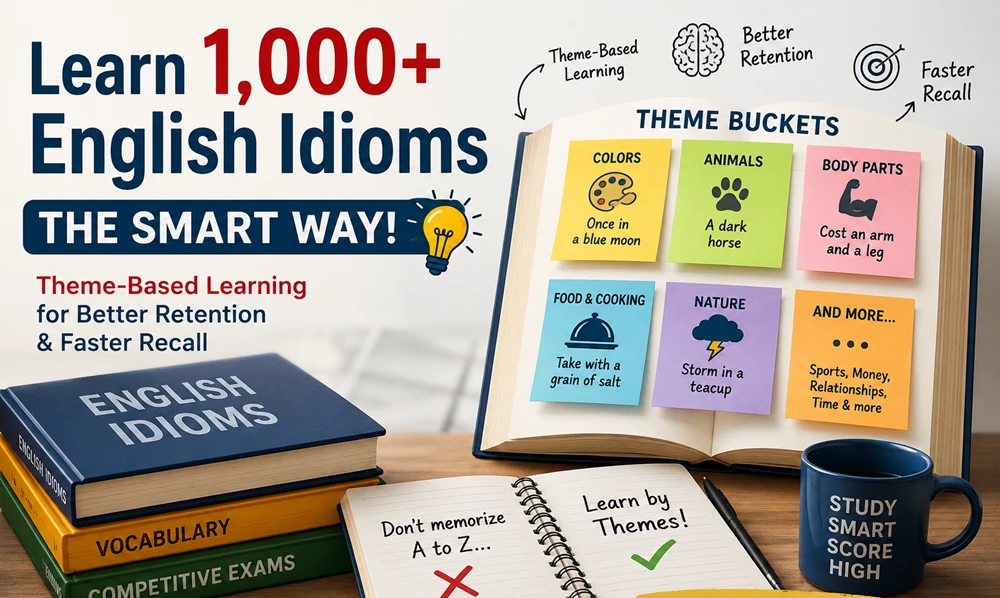
One practical solution better than alphabetical memorisation is Theme-Based Mastery. By grouping idioms into visual, conceptual categories, you leverage natural mental association—making related idioms easier to connect, review, and recall.
To learn 1,000+ idioms, you don’t need to memorise them as 1,000 unrelated facts. Group them by meaning, image, or topic, learn them in context, and review them through active recall.
Why It Works:
Instead of memorising a list of unrelated idioms alphabetically, for example:
- Bite the bullet
- Burn the midnight oil
- Bark up the wrong tree
It is better to memorise them by building a mental category, for example:
Effort / difficulty
- Bite the bullet — face a difficult situation
- Burn the midnight oil — work late
- Go the extra mile — make an extra effort
- Pull one’s weight — do one’s share
The goal is not merely to memorise the definitions. It is to build a mental “folder” called effort/difficulty, making the idioms easier to connect and remember.
Theme-Based Mastery: Learn 1,000+ Idioms for Competitive Exams
1. The Most Useful Theme Categories for Learning English Idioms
When you study idioms by category, your brain creates a single conceptual anchor and attaches multiple expressions to it. The following are categories and examples you can create, as we have seen idioms most frequently in competitive exams:
Bucket 1: Colours (Emotions & States)
Red: In the red (in debt/losing money), Catch red-handed (caught in the act), Red tape (bureaucratic delay).
Blue: Once in a blue moon (rarely), Out of the blue (unexpectedly), Feeling blue (depressed).
Green: Greenhorn (inexperienced), Green-eyed monster (jealousy), Give the green light (approval).
Bucket 2: Animals (Human Behaviour & Traits)
Dark Horse: An unexpected winner or hidden talent.
White Elephant: A costly possession with no practical utility.
Paper Tiger: An organisation or person that appears powerful but is actually weak.
Cast pearls before swine: Offering valuable things to people who cannot appreciate them.
Bucket 3: Body Parts (Action & Effort)
Cost an arm and a leg: Extremely expensive.
Keep your chin up: Remain optimistic during tough times.
Cold feet: Sudden loss of courage before an event.
All ears: Paying full, eager attention.
Bucket 4: Food & Cooking (Situations & Results)
Take with a grain of salt: View a statement with scepticism.
Bite off more than you can chew: Take on a commitment you cannot fulfil.
In a pickle: In a difficult or embarrassing situation.
Bucket 5: Elements & Nature (Conflict & Chaos)
Steal someone’s thunder: Take credit for another person’s achievements.
Storm in a teacup: Excessive excitement or worry over a trivial matter.
Burn bridges: Permanently sever relationships or options.
In this way, you can also create other categories like:
- Nature and weather
- Sports and games
- Money and business
- Relationships and people
- Time and speed
If you do so, they are far easier to recall.
2. The 3-Step Active Recall System
To ensure the 1,000+ idioms stick permanently in your long-term memory, apply this active recall system while reading your category-wise books:
Contextual Sentence Creation: Never remember just the definition. Write a single sentence connecting the idiom to your real-life situation or a current affairs event (e.g., “The new infrastructure project turned out to be a white elephant for the municipality.”).
Flashcard Grouping (using Anki or Physical): You can create digital or paper flashcard decks tagged by Theme, not alphabetically. Front side: Image/Theme + Idiom; Back side: Meaning + Example.
The “Odd One Out” Test: Group four idioms taken from different themes and test your ability to isolate their underlying meanings under exam pressure.
For example:
Which one doesn’t belong?
- Cost an arm and a leg
- Keep your chin up
- All ears
- Once in a blue moon
Answer: Once in a blue moon (The other three belong to the body-part category).
Remember: Without revision, you may not retain what you learned. So, keep a review schedule on Day 1 → Day 3 → Day 7 → Day 14 → Day 30.
Don’t Learn Idioms This Way
These mistakes will make idioms hard to recall. Avoid them:
- Memorising A–Z lists without context
- Learning only the Hindi meaning
- Memorising the meaning but not the example sentence
- Studying several idioms once but not reviewing them
- Learning obscure idioms before high-frequency ones asked in exams
Building idiom categories may take a lot of time. I suggest reading a book with categorised idioms and phrases to save time when preparing for exams. Here are our best recommendations.
3. Top Category-Wise Vocabulary Books for Competitive Exams
To achieve Theme-Based Mastery, read these reference workbooks, which organise idioms into thematic modules rather than flat alphabetical lists.
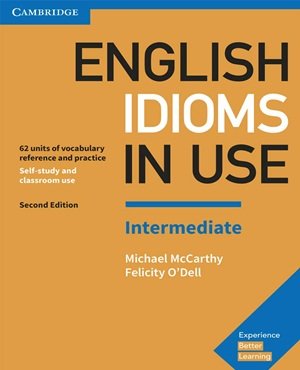
1. English Idioms in Use by Michael McCarthy & Felicity O’Dell (Cambridge)
Best for: Building idiom knowledge and usage. Useful for CAT, banking and other exams where strong English vocabulary matters.
Why it Works: This is the gold standard for category-based learning. It organises idioms by themes (e.g., Work, Communication, Feelings, Society) and provides left-hand explanation pages paired with right-hand practice exercises.
Although this book is not written for a specific exam, it helps in learning English idioms very easily. The only setback is its high price. But if you can afford it, it is worth reading.
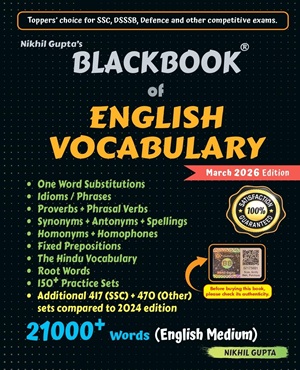
2. Black Book of English Vocabulary (2026 Edition) by Nikhil Gupta
Best for: SSC CGL, CHSL, CPO, and Railway exams.
Why it Works: Features dedicated compilations of previous years’ idioms sorted by frequency and common category clusters, complete with Hindi-English bilingual definitions.
This vocabulary book is designed for most competitive examinations in India. In addition to idioms, it fulfils all English vocabulary needs for an aspirant. Hence, it is one of the most popular books for exam preparation.
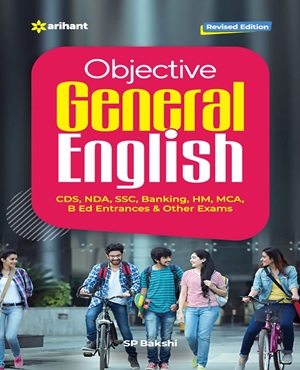
3. Objective General English by S.P. Bakshi (Arihant)
Best For: NDA, CDS, UPSC CSAT, and State PSCs.
Why it Works: Includes specialised sub-sections that separate core idioms, phrasal verbs, and prepositions into distinct functional groups.
One of the best-selling books for various competitive exams in India, especially for English preparation. Beyond vocabulary, it deals with several aspects of English questions.
| Book | Best for | Main strength | Limitation |
|---|---|---|---|
| English Idioms in Use | General English / CAT / advanced learners | Context-based learning and practice | Less exam-specific |
| Blackbook of English Vocabulary | SSC and government exams | PYQ-oriented vocabulary preparation | A broad vocabulary resource rather than a book focused only on idioms |
| Objective General English | Broad competitive-exam preparation | Combines grammar, vocabulary, and practice | Not a dedicated idiom resource |
Learn & Test Your Knowledge:
Disclaimer: This post contains affiliate links. If you buy through them, we may earn a small commission at no extra cost to you. This helps us keep 99learners free! Read our affiliate disclosure.