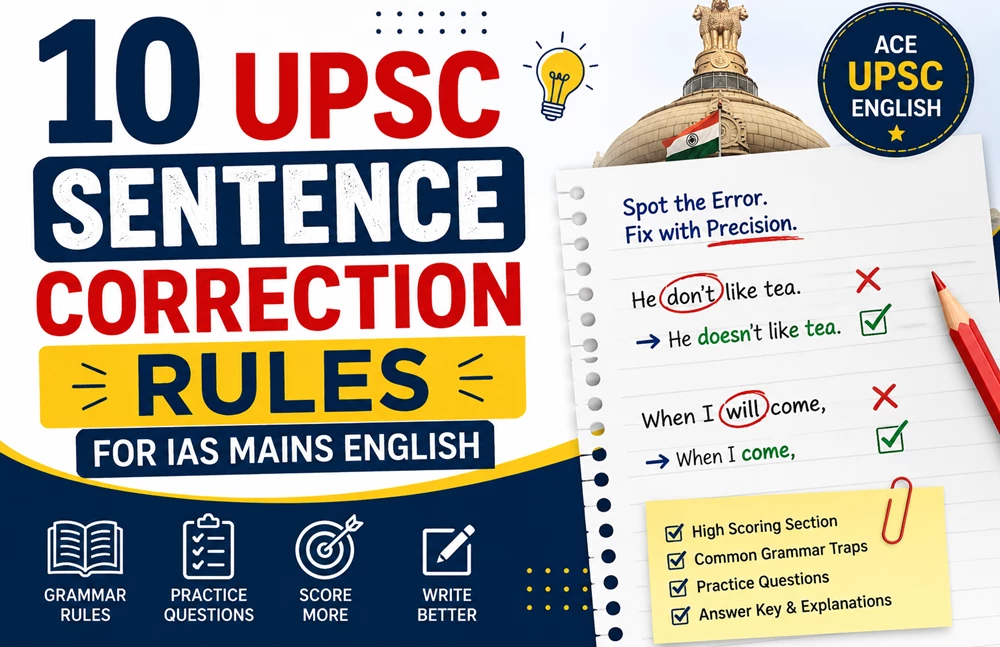
In the IAS Mains Compulsory English Paper, Section 4(a) is a high-scoring area: 10 sentences, 10 marks. The instructions contain a strict warning: “Do not make unnecessary changes in the original sentence.” The UPSC does not want you to rewrite the sentence to make it sound “prettier” or more sophisticated. They want you to identify a specific structural error, fix it with precision, and leave the rest of the sentence exactly as it is.
In this guide, you will learn 10 important sentence correction rules frequently tested in UPSC, along with examples and a practice set with detailed explanations.
Note: Although it is specially focused on the compulsory English paper in the UPSC Civil Service Mains Exam, this guide is also useful for any other exams and for general English learners.
The 10 Golden Rules of UPSC Mains Sentence Correction
1. The “Prefer” Preposition Trap
The Trap: Using “than” with words like prefer, preferable, senior, junior, superior, or inferior.
The Rule: These comparative adjectives are derived from Latin and are followed by the preposition “to”.
Example:
- Incorrect: My sister prefers dogs than cats. (UPSC 2021)
- Correct: My sister prefers dogs to cats.
2. Comprise vs. Consist
The Trap: Adding “of” immediately after the active verb “comprise.”
The Rule: Comprise means “to consist of” or “be composed of.” It contains the preposition inside its own meaning. You don’t need to use “of” unless it is in the passive voice.
Example:
- Incorrect: The University comprises of several Departments. (UPSC 2021)
- Correct: The University comprises several Departments.
3. The “No Sooner… Than” Correlative
The Trap: Pairing No sooner with “when” or “then,” or forgetting to invert the subject and verb.
The Rule: No sooner must be paired with “than”. Furthermore, it requires inversion (the auxiliary verb did/had/is must come before the subject).
Example:
- Incorrect: No sooner I am out, then the students make a noise.
- Correct: No sooner am I out than the students make a noise.
4. No ‘Will’ in the If/When Clause
The Trap: Using “will” or “shall” in both the conditional clause and the main clause.
The Rule: In a first conditional sentence, the clause containing the time marker (when, if, as soon as, until, before) must be in the Simple Present Tense, while the main clause stays in the Future Tense.
Example:
- Incorrect: When I will reach home, I will let you know the details. (UPSC 2021)
- Correct: When I reach home, I will let you know the details.
5. “One of the” + Plural Noun + Singular Verb
The Trap: Using a singular noun after “one of the,” or mismatching the verb.
The Rule: “One of the” implies choosing one individual from a group. Therefore, the noun must be plural, but the main verb remains singular because the true subject is “One.”
Example:
- Incorrect: One of my student has got the prestigious scholarship. (UPSC 2021)
- Correct: One of my students has got the prestigious scholarship.
6. The Redundant “Return Back”
The Trap: Using unnecessary modifying words that repeat a meaning already built into the verb.
The Rule: Words like return, recede, or retreat already mean to move back. Adding “back” creates a grammatical redundancy.
Example:
- Incorrect: The team returned back home late in the evening.
- Correct: The team returned home late in the evening.
If you want to learn more about redundancy, read this guide → Stop Using These 10 Redundant Phrases in English
7. Subject-Verb Agreement with “Every” and “Each”
The Trap: Treating a compound list joined by “and” as plural when it is preceded by “every” or “each.”
The Rule: When “Every” or “Each” modifies a singular subject, the verb must be singular, no matter how many items follow.
Example:
- Incorrect: Every man, woman, and child were rescued. (UPSC 2022)
- Correct: Every man, woman, and child was rescued.
If you want to learn in detail, read this guide → 10 Advanced Rules of Subject-Verb Agreement
8. Double Comparatives
The Trap: Mixing comparative modifiers like “more” or “less” with an adjective that already ends in “-er”, or mixing “most” with “-est”.
The Rule: Never use two comparative modifiers side by side.
Example:
- Incorrect: The fresher the fruit, the best it tastes. (UPSC 2021)
- Correct: The fresher the fruit, the better it tastes.
9. Since/For with Present Perfect and Present Perfect Continuous
- The Trap: Using simple present or present continuous for actions that started in the past and continue into the present.
- The Rule: Use Present Perfect Continuous for ongoing actions and Present Perfect for states or situations.
Examples:
- Incorrect: They know each other since January.
- Correct: They have known each other since January.
- Incorrect: I am studying here for two years.
- Correct: I have been studying here for two years.
If you want to learn about the usage of ‘For’ and ‘Since’, read this → Since vs. For: The Definitive Guide
10. Polite Pronoun Order in Coordination (2-3-1 Rule)
The Trap: Putting yourself first when listing multiple pronouns or nouns in a normal context.
The Rule: Good etiquette and grammatical rules dictate that for positive or regular statements, the order of persons must be Second Person (You) → Third Person (He/She/They/Name) → First Person (I).
Example:
- Incorrect: I and Chetan did all the work.
- Correct: Chetan and I did all the work.
UPSC Sentence Correction Quick Revision Table
| Rule | ❌ Incorrect | ✅ Correct |
|---|---|---|
| Prefer | Prefer tea than coffee | Prefer tea to coffee |
| Comprise | Comprises of | Comprises |
| No sooner | No sooner…then | No sooner…than |
| Conditional Rule | When I will come | When I come |
| One of | One of my student | One of my students |
UPSC Mains Structural Practice Set
Directions: Rewrite the following sentences after making necessary corrections. Do not make unnecessary changes to the original structure.
He congratulates you for your historic success in the examination.
Unless he does not report for duty immediately, he will be suspended.
I don’t approve to your smoking in public spaces.
The climate of Ooty is better than Chennai.
Being a rainy day, the district magistrate decided to stay inside the camp.
He works hard lest he should not fail the qualification benchmark.
The criminal was accompanied with his legal associates.
I have seen him an hour before at the district library.
Ten candidates have passed the physical screening, one failed.
The reason why he resigned from the commission was because of ill health.
Answer Key & Structural Logic
He congratulates you on your historic success in the examination.
Logic: The verb “congratulate” takes the fixed preposition “on”, not “for.”
Unless he reports for duty immediately, he will be suspended.
Logic: “Unless” itself is a negative conditional word meaning “if not.” Adding “does not” creates an incorrect double negative.
I don’t approve of your smoking in public spaces.
Logic: The verb “approve” takes the fixed preposition “of”.
The climate of Ooty is better than that of Chennai.
Logic: You must compare like things. You cannot compare the climate of Ooty to the city of Chennai itself; you must compare it to the climate (that of) Chennai.
It being a rainy day, the district magistrate decided to stay inside the camp.
Logic: Dangling modifier error. “Being a rainy day” needs a proper subject of reference (“It”); otherwise, the sentence is grammatically ambiguous and implies that the district magistrate is a rainy day.
He works hard lest he should fail the qualification benchmark.
Logic: “Lest” means “for fear that” and has a negative connotation built in. It should be followed by Subject + should + Verb in base form without “not.”
The criminal was accompanied by his legal associates.
Logic: When a living agent or person accompanies someone, we use “by”. We use “with” for inanimate things (e.g., fever accompanied with chills).
I saw him an hour ago at the district library.
Logic: When pointing to a specific time in the past from the present moment, use “ago” with the Simple Past Tense, not “before.”
Ten candidates have passed the physical screening, one has failed.
Logic: The sentence has two clauses separated by a comma. They should use the same tense when referring to the same action/event.
The reason why he resigned from the commission was his ill health.
Logic: “The reason why” and “because of” mean the same thing. Using both creates a redundant structure.
Recommended Practice Material
If you are familiar with the above rules, your grammar is already strong. However, you should practise regularly to improve your speed and accuracy during the exam.
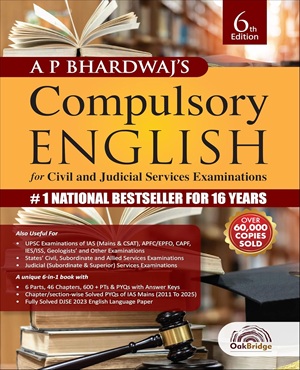
The “Common Errors” section in A.P. Bhardwaj’s Compulsory English includes hundreds of sentences explicitly from past UPSC questions. The Disha 13 Year-wise Solved Papers Guide is also excellent for your practice. By consistently practising with these books, you don’t just learn the question patterns, you will appear in the exam confidently without any worry.
Learn more about the two books from this link → 3 Best Books for IAS Mains Compulsory English