In the CAT Verbal Ability and Reading Comprehension (VARC) section, Reading Comprehension accounts for 16 out of 24 questions (~66% of the sectional score).
Over the past few years, CAT conveners (IIMs) have noticeably shifted away from standard story-driven or direct factual passages. Instead, passages are drawn heavily from abstract, non-fiction publications such as Aeon Essays, The Guardian, Smithsonian Magazine, and The New Yorker.
These passages aren’t difficult because of high-level English vocabulary. They are difficult because they deal with dense philosophy, sociology, evolutionary psychology, and abstract critical theory. Aspirants often read a 600-word paragraph and realise they have no idea what the author is actually trying to prove.
This guide introduces the “Aeon & Editorial Reading Blueprint,” a practical framework that will help you:
- Understand abstract philosophy and editorial passages more effectively.
- Identify the author’s central argument quickly.
- Distinguish the author’s opinion from cited viewpoints.
- Track logical shifts using transition words.
- Improve your accuracy in high-level CAT Reading Comprehension questions.
Whether you’re aiming to improve your RC accuracy or target a 99+ percentile in CAT VARC, this step-by-step strategy will help you read with greater clarity and confidence. We teach this exact strategy to our CAT students in the coaching class.
CAT Tip: Don’t read an RC passage to remember every fact. Read it to understand what the author is trying to prove.
Table of Contents
De-Coding Aeon Essays: How to Read Abstract Philosophy Passages for CAT VARC
Why Aeon-Style Essays Break Most Aspirants
Traditional reading materials (like news summaries or school textbooks) are linear—they present facts in chronological order or state their main point upfront.
Aeon essays and philosophical long-reads are non-linear and dialectical:
The author introduces a popular worldview (Belief A).
They present counter-evidence or a philosophical paradox (Belief B).
They nuance or critique both positions before presenting a qualified, conditional thesis.
If you read an Aeon essay linearly, you will confuse the views criticised by the author with the author’s actual stance—which is the single most common trap in CAT RC options.
Common Trap: In many CAT RC questions, one of the answer choices simply repeats a viewpoint that the author criticises. Because that idea appears prominently in the passage, it often looks correct—even though it is the opposite of the author’s actual position.
Read for the Argument, Not the Information
High scorers in CAT VARC don’t try to memorise every detail. Instead, they focus on understanding the structure of the argument.
As you read, keep asking yourself:
- What problem is the author discussing?
- Which viewpoint is being challenged?
- Where does the author’s opinion begin?
- What conclusion is the author trying to prove?
Once you start reading with these questions in mind, abstract passages become much easier to follow. Instead of feeling overwhelmed by unfamiliar topics, you’ll begin to recognise the logical pattern behind the writing.
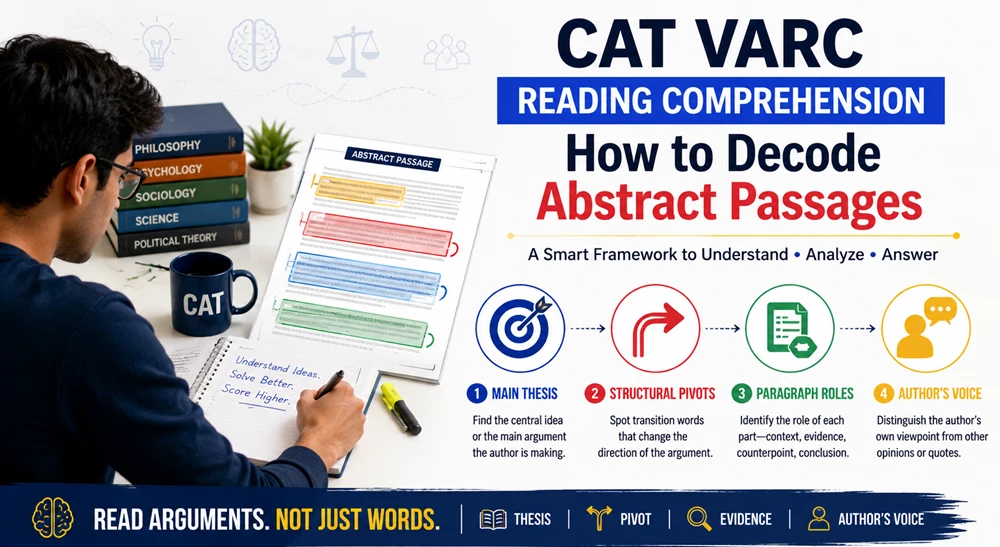
This is exactly what the 4-Step Argument Mapping Framework helps you with in the CAT VARC.
The 4-Step Argument Mapping Method
To master abstract RCs, stop reading for information and start reading for structural function. The following 4-Step Argument Mapping Framework will help you break down even the most complex philosophy, psychology, or sociology passages with confidence.:
                      THE ARGUMENT MAPPING FRAMEWORK

  [ 1. ANCHOR THE MAIN THESIS ] ---> What is the author ultimately defending?
               |
               v
  [ 2. TRACK SHIFTS & PIVOTS ]  ---> Identify tone flips (e.g., "Yet," "Crucially")
               |
               v
  [ 3. LABEL PARAGRAPH ROLES ]  ---> Is this paragraph an Example, Counter, or Claim?
               |
               v
  [ 4. ISOLATE AUTHOR VOICE ]   ---> Is this the author's view or a cited expert's?
Step 1: Anchor the Main Thesis
After reading the first one or two paragraphs, stop and ask: “What problem is the author trying to solve?”
Don’t worry if you don’t understand specific philosophical jargon (e.g., epistemological structuralism). Replace the jargon with a neutral variable like “Concept X.”
CAT Tip: The main thesis is usually about the author’s reasoning, not the difficult vocabulary.
Step 2: Track Structural Shifts (The Pivots)
Abstract essays rely heavily on transition indicators to signal shifts in direction. Circle or highlight words like:
Contrast/Pivot: Yet, however, paradoxically, notwithstanding, nevertheless.
Elaboration: Furthermore, intrinsically, fundamentally, in essence.
Concession: To be sure, granted, admittedly, while it is true that.
These words act like road signs. They tell you when the author’s argument is changing direction.
Common Trap: Many CAT questions are built around what happens after words like however, yet, or nevertheless. If you ignore these pivots, you may misunderstand the author’s actual conclusion.
Step 3: Label Paragraph Roles in Marginal Notes
Don’t write detailed notes—write 1-to-2 word mental labels for each paragraph. Write as:
Para 1: Status Quo / Traditional View
Para 2: Flaw in Traditional View (Pivot)
Para 3: Example (Scientific experiment / Historical case)
Para 4: Author’s Revised Thesis
These simple labels make it easier to remember how the argument progresses without wasting valuable exam time. Remember, you’re not summarising every paragraph—you are identifying its function in the overall discussion.
Step 4: Separate “Author Voice” from “Cited Voice”
This is one of the most important skills in CAT Reading Comprehension.
Abstract passages often discuss the opinions of philosophers, scientists, researchers, or historical thinkers. However, those opinions are not automatically the author’s own views.
When an essay says, “Proponents of utilitarianism argue that happiness is measurable…”, this is NOT the author’s opinion. This is a cited perspective.
Always distinguish between:
What other thinkers believe (Background Data).
What the author believes about those thinkers (Core Perspective).
Master these four habits. Even the most intimidating Aeon-style passages will begin to feel far more structured and manageable.
Key Takeaway: The correct answer usually reflects the author’s final position, not the loudest or longest argument presented in the passage.
Practice Breakdown: Deconstructing an Aeon-Style Passage
Read the following abstract passage excerpt and examine the structural mapping below:
“For centuries, Western political philosophy has treated individual autonomy as the ultimate moral good. From Locke to Mill, the prevailing assumption was that a rational agent, freed from societal coercion, would naturally make decisions that maximize personal well-being. However, recent developments in cognitive neuroscience present a troubling paradox. Neural imaging suggests that human decision-making is heavily governed by implicit social cues and unconscious biases long before the conscious mind formulates a ‘rational’ choice. To insist on radical individualism in light of these findings is not merely anachronistic; it fundamentally misunderstands how human minds operate within shared social ecosystems.”
Structural Analysis Log
Instead of reading this passage from beginning to end without a plan, let’s map each part of the argument.
| Sentence / Block | Structural Function | Author Stance / Key Takeaway |
|---|---|---|
| “For centuries… ultimate moral good.” | Historical Context / Status Quo | Traditional view = Individual autonomy is paramount. |
| “From Locke to Mill… personal well-being.” | Elaboration / Citation | Explains the premise of traditional political philosophy. |
| “However, recent developments… troubling paradox.” | Major Structural Pivot | Signal word “However” shifts the tone from history to modern conflict. |
| “Neural imaging suggests… ‘rational’ choice.” | Scientific Evidence | Neuroscience shows decisions are unconsciously influenced, not purely autonomous. |
| “To insist on radical individualism… social ecosystems.” | Author’s Core Thesis | The author rejects radical individualism as scientifically flawed. |
CAT Tip: Whenever you encounter a word like however, yet, nevertheless, or paradoxically, slow down. These transition words often introduce the author’s real argument.
Why This Analysis Matters
Notice that nearly half of the passage discusses the traditional philosophical viewpoint. Many students mistakenly assume this is the author’s opinion because it appears first and receives significant attention.
In reality, the author uses that viewpoint as background information before presenting new evidence and arriving at a different conclusion. This is one of the most common patterns in abstract CAT Reading Comprehension passages.
Apply the 4-Step Framework discussed above to the passage.
How This Mapping Solves CAT Questions
Sample CAT Question:
What is the author’s primary purpose in the passage above?
(a) To praise the philosophical contributions of Locke and Mill to modern neuroeconomics.
(b) To argue that individual autonomy is an outdated concept in light of neurological evidence.
(c) To prove that human beings are incapable of making moral decisions in a society.
(d) To detail the history of neural imaging techniques in political philosophy.
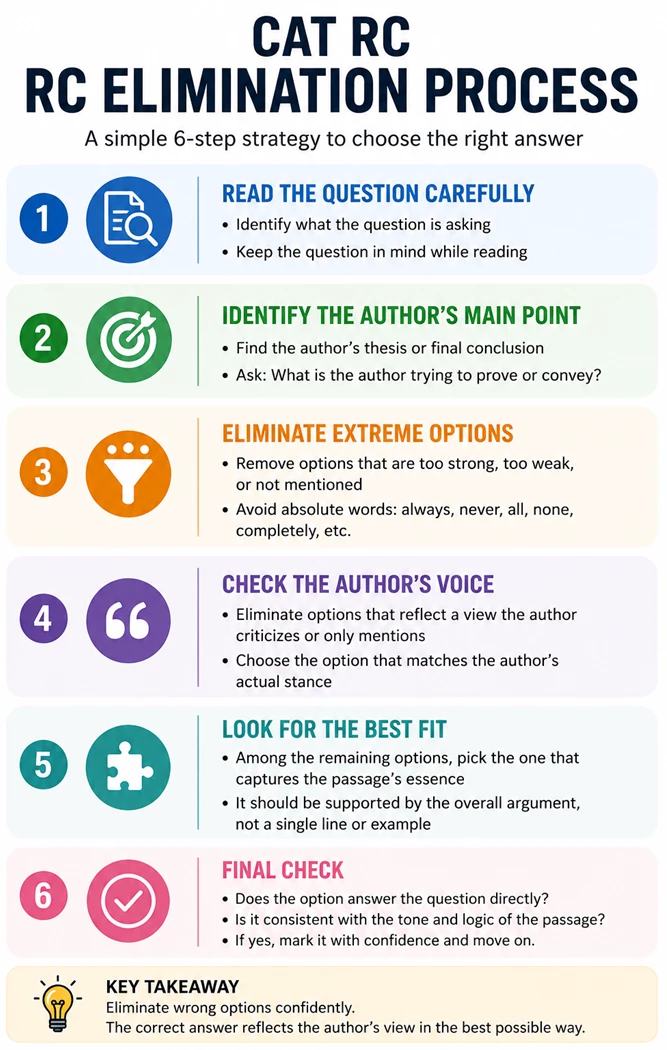
Option Elimination Walkthrough:
Option (a) [Distorted Fact]: The author cites Locke and Mill as examples of traditional philosophy, not to praise their contributions to neuroscience.
Option (b) [CORRECT]: Matches our mapped Author’s Core Thesis (the final sentence rejecting radical individualism due to brain findings).
Option (c) [Extreme Statement]: The passage states that autonomy is flawed, not that humans are incapable of moral decisions.
Option (d) [Out of Scope]: The passage uses neuroscience findings to make a point, not to give a history of neural imaging techniques.
Exam Strategy: In CAT Reading Comprehension, the correct answer usually aligns with the author’s final argument, while incorrect options often focus on background information, isolated facts, or exaggerated interpretations.
The Daily 30-Minute “Aeon Routine” for CAT Aspirants
The routine is designed to help you become comfortable while training your brain to recognise argument structures, logical shifts, and the author’s perspective. To build the skill over the next 3–4 months, follow this daily routine:
Pick One Essay per Day: Visit Aeon.co (or The Guardian Long Reads) and pick an essay under genres like Philosophy, Psychology, Human Nature, or Culture.
Read Without Stopping (Timed 10 Mins): Force yourself to finish a 1,500-word essay in 10 minutes without re-reading sentences. Accept partial ambiguity on first pass.
Write the 3-Sentence Summary (5 Mins): Close the browser tab and write down:
What was the core conflict?
What was the author’s final position?
Identify 2 Catalyst Words (5 Mins): Find the major tone-shift words (however, paradoxically, despite) that signalled the author’s shift from background facts to personal commentary.
Build the Habit, Not Just the Skill
Improving Reading Comprehension isn’t about reading hundreds of passages overnight. It’s about developing the habit of reading analytically every day.
Thirty focused minutes may not seem like much, but over three months, you’ll have analysed nearly 90 high-quality essays. More importantly, you’ll train yourself to recognise arguments, evaluate evidence, and identify the author’s perspective—the exact skills that CAT VARC is designed to test.
Key Takeaway: Read with a purpose. Don’t ask, “What did the passage say?” Ask, “What was the author trying to prove, and how did they build that argument?”
Conclusion
Success in CAT Reading Comprehension isn’t determined by how many difficult words you know—it’s determined by how well you understand how an author builds an argument.
Abstract passages from philosophy, psychology, sociology, or science may appear intimidating at first. However, once you learn to identify the author’s thesis, recognise structural pivots, distinguish background information from the author’s viewpoint, and map the passage’s logical flow, these essays become far more manageable.
Remember the 4-Step Argument Mapping Framework. Pair it with the 30-minute daily reading routine, and you’ll gradually develop the analytical reading skills needed to solve even the toughest CAT VARC passages with greater confidence and accuracy.
With consistent practice, you’ll not only improve your CAT score but also develop critical reading skills that will benefit you throughout your academic and professional journey.
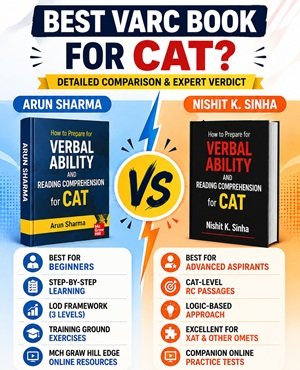
To study CAT VARC completely, we compare the two most popular books for you. Click this link → Nishit Sinha vs. Arun Sharma: Best VARC Book for CAT
Glossary
Abstract Passage: A passage that discusses ideas, theories, or concepts rather than straightforward facts or stories.
Argument: The central reasoning the author uses to support a conclusion.
Author’s Thesis: The main point or position that the author ultimately defends.
Counterargument: An opposing viewpoint presented before being accepted, rejected, or qualified.
Dialectical Writing: A style of writing that explores different viewpoints before arriving at a balanced conclusion.
Inference: A logical conclusion drawn from the information in the passage rather than something stated directly.
Pivot Word: A transition word (such as however, yet, or nevertheless) that signals a change in the direction of the argument.
Structural Mapping: The process of identifying the role each paragraph plays in developing the author’s overall argument.
Disclaimer: This article is intended for educational purposes and is based on analysis of commonly recommended Reading Comprehension practice materials and general CAT preparation strategies. CAT exam patterns may change over time, and no publication mentioned in this guide is an official source of CAT questions. Always refer to the latest official CAT notification and trusted preparation resources for updated information.