In time-restricted competitive exams—such as CAT, Bank PO (SBI/IBPS), GMAT, and SSC CGL — one of the biggest time drains is Reading Comprehension (RC). For many candidates, it isn’t difficult vocabulary. It’s re-reading.
In those exams, most candidates read the given passage top-to-bottom, move to Question 1, forget where the author discussed it, and so re-read the paragraph. By the time they finish a 4-question RC set, they have effectively read the passage two or three times—burning several minutes of precious exam time.
To reduce this time leak and maintain a quick structural overview, one way to reduce unnecessary rereading is Paragraph Shrinking (also known as the 3-Word Annotation Method). This method helps save time to answer questions correctly for long, multi-paragraph passages.
Why this method:
After testing many RC passages from different competitive exams, we found that the Paragraph Shrinking method is effective in saving time. So, read this guide carefully and test it against your own baseline across multiple RC sets. With more practice, I hope it will become easier for you to use the technique.
Table of Contents
Paragraph Shrinking: A 3-Word Annotation Method for Faster RC
What is Paragraph Shrinking?
Paragraph Shrinking is an active reading technique where you compress the core logical function of an entire paragraph into a 3-word structural label on your permitted rough-work area (like paper), where available, or mentally during the exam.
Here, you don’t summarise the paragraph. Instead, you write a 3-word annotation that captures what the paragraph does (function). See how you may write after reading a paragraph:
                      TRADITIONAL SUMMARY vs. PARAGRAPH SHRINKING

  [ TRADITIONAL CONTENT SUMMARY ] ──► "The author talks about how classical economic models
                                     failed during the 2008 housing market crash."
                                     (Too long, bogs you down in facts)

  [ 3-WORD ANNOTATION ]   ──► "P1: Model Failure Ex"
                                     (P1 means the first para and the annotation shows instant structural map for fast reference)
The 3-Word Annotation Rules
Your 3-word label must follow a strict Structure-Role-Target formula. See each word can be with examples:
Word 1: The Structural Role (Claim, Evidence, Pivot, Counter, Ex, Thesis, Resolution)
Word 2: The Core Subject (Inflation, AI, Lockean Theory, Monopolies)
Word 3: The Author’s Tone/Direction (Flaw, Support, Shift, Defense, Critique)
Common 3-Word Examples:
While “P” is the paragraph, the annotation contains three words that you can write or keep in mind:
P1: Status Quo Claim(Presents traditional/accepted view)P2: Neuroscience Counter Pivot(Pivots to modern brain research challenging P1)P3: Clinical Trial Ex(Provides specific study supporting P2)P4: Author Revised Thesis(Delivers the author’s final qualified stance)
Step-by-Step Practice Demonstration
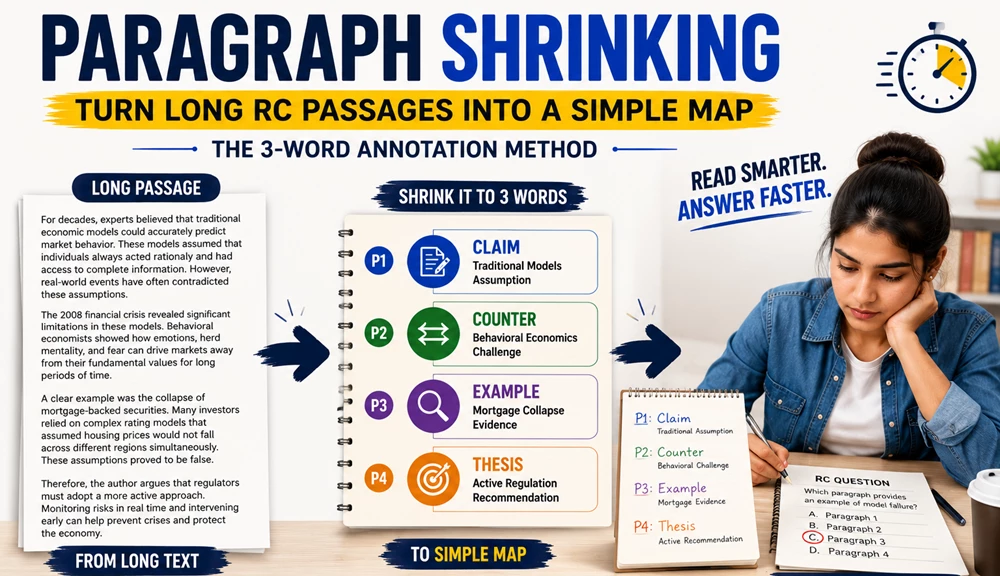
Examine how Paragraph Shrinking transforms a multi-paragraph, dense academic RC passage into a 15-second visual roadmap.
The Raw Passage
[Paragraph 1] For decades, mainstream macroeconomists operated on the efficient-market hypothesis, asserting that financial markets automatically process all available information to reflect true asset values. Under this paradigm, market bubbles were viewed not as structural failures, but as temporary anomalies that self-corrected without intervention.
[Paragraph 2] However, the 2008 global financial crisis revealed profound blind spots in this classical framework. Behavioral economists demonstrated that systemic panic, herd mentality, and asymmetric information frequently drive market prices far away from fundamental economic reality for prolonged periods.
[Paragraph 3] Consider the rapid collapse of mortgage-backed securities during that period. Institutional investors did not evaluate individual loan risks; instead, they relied on flawed mathematical algorithms that assumed housing prices across different regions would never drop simultaneously.
[Paragraph 4] Therefore, central banks must abandon the passive regulatory stance dictated by traditional models. Modern financial oversight requires dynamic, real-time intervention to curb speculative leverage before systemic contagion spreads.
Applying the 3-Word Shrink
                             THE 3-WORD SCRATCHPAD MAP

  +---------------------------------------------------------------------------------+
  |  P1: Efficient Market Thesis   (Traditional assumption presented)               |
  |  P2: Behavioral Science Pivot  (Critique introduced via 2008 crisis)           |
  |  P3: Subprime Case Ex          (Specific example proving algorithmic failure)   |
  |  P4: Active Regulation Call    (Author's final policy recommendation)           |
  +---------------------------------------------------------------------------------+
“The purpose of the annotation is not to remember every paragraph. It is to remember what role each paragraph plays for a question asked.”
How This Map Speeds Up Question Solving
Now, let’s see how you answer the questions asked without re-reading the full passage:
Question 1: Where does the author provide empirical evidence of algorithmic failure in financial institutions?
Without Shrinking: You scroll endlessly through Paragraphs 1, 2, and 3, trying to find mentions of technology or algorithms.
With 3-Word Map: Look at your scratchpad (or remember) →
P3: Subprime Case Ex. You jump directly to Paragraph 3 and answer the question in 10 seconds.
Question 2: What is the primary purpose of the second paragraph?
Without Shrinking: You re-read Paragraph 2 line-by-line under timer anxiety.
With 3-Word Map: Look at your label →
P2: Behavioral Science Pivot. You instantly know that Paragraph 2 serves as a pivot/contrast, introducing counter-arguments to the traditional model.
Does This Method Work for You?
Don’t assume Paragraph Shrinking will reduce your time by a fixed percentage. Its effectiveness depends on the passage, your reading habits, and how quickly you can annotate. Train yourself before the exam.
Try the technique across five practice passages and record as follows:
| Measure | Without Shrinking | With Shrinking |
|---|---|---|
| Passage reading time | _____ | _____ |
| Question-solving time | _____ | _____ |
| Total time | _____ | _____ |
| Correct answers | _____ | _____ |
| Questions requiring rereading | _____ | _____ |
_____
_____
_____
_____
_____
_____
_____
_____
_____
_____
How to use it: Compare at least five RC passages using both approaches. Look for changes in total time, accuracy, and the number of times you need to reread the passage.
After five passages, ask:
Did I spend less total time?
Did I reread less?
Did my accuracy remain the same or improve?
If the annotation is taking too long, simplify it for yourself.
Time Savings Breakdown
| Stage | Traditional Approach | With Paragraph Shrinking |
|---|---|---|
| Initial reading | 2.5 min | 3.0 min |
| Solving the first two questions | 2.0 min | 0.5 min |
| Solving remaining questions | 2.0 min | 0.5 min |
| Total | 6.5 min | 4.0 min |
2.5 min
3.0 min
2.0 min
0.5 min
2.0 min
0.5 min
6.5 min
4.0 min
Note: This is an illustrative comparison, not a guaranteed time-saving result. Your actual results will depend on passage difficulty, reading speed, annotation efficiency, and question type.
The 3-Rule Checklist for Daily Practice
When practicing RC with workbooks like Arun Sharma’s VARC or S.P. Bakshi’s Objective English, follow these rules:
Aim for no more than three words per paragraph: However, if a paragraph genuinely requires a fourth word for clarity, you can use it.
Never Look Back While Writing: During practice, pause briefly after each paragraph and record the label before continuing. Once the habit becomes automatic, aim to create the mental label with minimal interruption to your reading.
Use Standardised Action Verbs: Train your mind using functional words (Asserts, Challenges, Illustrates, Reconciles, Rejects, Proposes) in the annotation.
When Should You Use Paragraph Shrinking?
I don’t always recommend using this paragraph-shrinking method. When the passage is easy to read and follow, it may waste your time instead. Use it especially when:
- The passage has several contrasting viewpoints;
- Paragraphs perform clearly different functions;
- You frequently forget where evidence appeared;
- The passage contains long examples or digressions;
- You tend to reread paragraphs while answering questions.
Learn not to use it for:
- very short passages;
- highly straightforward passages;
- passages where the structure is already obvious.
Common Mistakes to Avoid
1. Writing full summaries: Don’t write too long, as “The author explains why behavioural economists challenged traditional market theory.” for a paragraph. Instead, try a 3-word annotation like “Behavioral Economics — Challenge”.
2. Using vague labels: Don’t write like “Important Point”. The label doesn’t tell you what the paragraph actually does.
3. Recording nouns without function: If you write like “Markets — Investors — Algorithms” as you saw in the paragraph, you may remember the topic but not its role in the argument.
4. Over-annotating: Don’t try to capture every detail, example, statistic, or name. Make it an index—not a second copy of the passage.
5. Making the three-word rule too rigid: Aim for three words, but you can use a fourth word if necessary.
Final Takeaway
Paragraph shrinking is not about remembering everything in an RC passage. It is about remembering the structure of the argument.
Start with written three-word labels during your practice sessions. Over time, the method can become faster and more mental for you.
The goal is simple: Read for meaning. Shrink for structure. Return to the passage with a map—not from scratch — for the question.
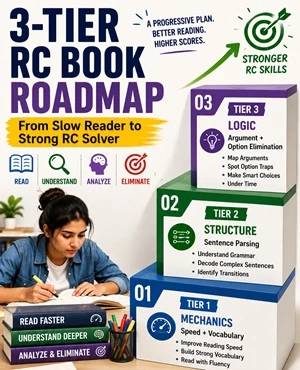
For a broad RC preparation plan for any exam, see our 3-Tier RC Book Roadmap.
If you are preparing especially for the CAT exam, read our book review → Nishit Sinha vs. Arun Sharma