In both SBI PO and IBPS Clerk exams, Double Fillers (two blanks in a single sentence) are among the most challenging yet highly scoring question types in the English Language section. Although each question carries only one mark, many aspirants lose valuable time and accuracy because they rely on guesswork rather than a systematic approach.
Most aspirants tackle these by placing each option pair into the blanks and reading the sentence aloud to see if it “sounds right.” During a time-bound exam, this trial-and-error method quickly becomes confusing. Several options may appear acceptable at first glance, leading to wrong answers and negative marking.
The good news is that Double Fillers are not vocabulary puzzles alone—they follow logical grammatical and contextual patterns. Once you understand these patterns, you can eliminate incorrect options quickly without reading every choice repeatedly.
In this guide, you’ll learn the 2-Way Filter Strategy, a practical method that helps you solve Double Filler questions in under 30 seconds by checking grammar first and context second. You’ll also see a practice set with banking-level questions and discover common mistakes that toppers avoid.
Table of Contents
What Are Double Fillers?
A Double Filler question contains a sentence with two missing words (blanks). Your task is to choose the option containing the correct pair of words that completes the sentence both grammatically and logically.
Unlike Single Fillers, you cannot solve these questions by focusing on only one blank. Both words must work together to create a meaningful and natural sentence.
For example: The manager decided to ________ the proposal because it would ________ the company’s long-term growth.
The answer options:
(a) reject, hinder
(b) approve, damage
(c) postpone, destroy
(d) ignore, improve
The correct answer pair depends not only on the meanings of the words but also on the overall context of the sentence.
Why Are Double Fillers Difficult?
Many candidates believe Double Fillers are simply vocabulary questions. In reality, they test several language skills simultaneously.
You should consider:
- Vocabulary
- Parts of speech
- Sentence structure
- Context clues
- Positive and negative tone
- Logical relationships between ideas
This is why even candidates with a strong vocabulary sometimes choose the wrong answer.
Note: This lesson is useful for general English learners to use the correct words in the right places in a sentence. Besides Bank PO and Clerk Exams, it is also useful for other competitive exams like RBI Assistant, NABARD Grade A, LIC AAO, and insurance examinations.
Why Trial and Error Doesn’t Work
To experience this, imagine a question with five option pairs. You may solve it like this:
- Read the sentence.
- Insert option (A).
- Read again.
- Insert option (B).
- Read again.
- Repeat until all five options are tested.
This process consumes precious time. As several option pairs may sound reasonably correct, it makes difficult to identify the best answer for you.
Instead of repeatedly testing every option, successful candidates first eliminate impossible answers using grammar rules and context. Once only one or two options remain, choosing the correct answer becomes much easier.
This is exactly what the 2-Way Filter Strategy is designed to do. Read the following to learn in more detail about the strategy.
The 2-Way Filter: Mastering Double Fillers in SBI & IBPS Exams
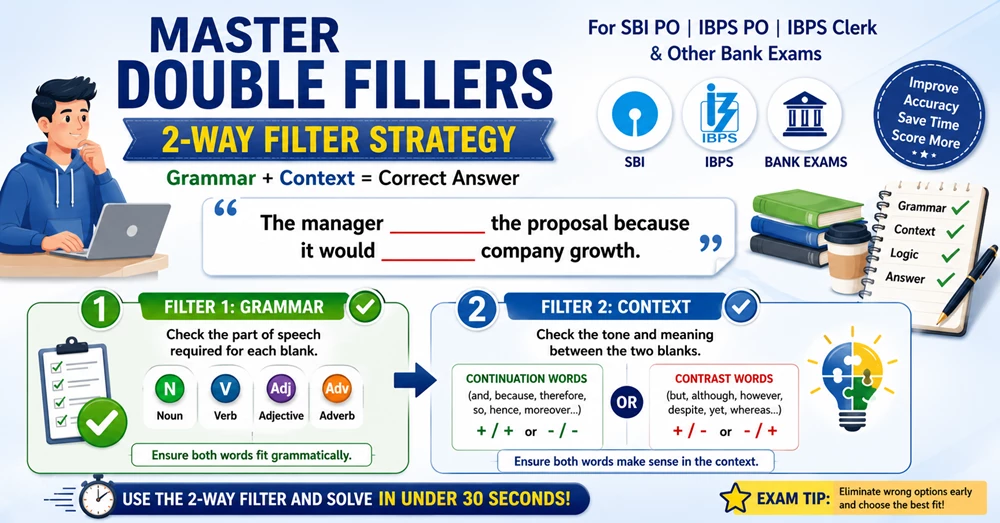
The 2-Way Filter works on a simple principle: Never try to solve both blanks at the same time. Instead, treat them as two independent security checkpoints that an option pair must pass.
Filter 1: The Grammatical Fit (Part of Speech)
Before looking at the meanings of the words, identify the grammatical role required by the blanks.
Is the blank preceded by an article (a, an, the) or a preposition? It probably needs a noun.
Is it modifying a noun? It needs an adjective.
Is it describing an action? It needs an adverb.
For example, look at this sentence: “The company announced a ________.”
The article “a” tells us the blank needs a noun. So, any given option containing an adjective or verb can be eliminated immediately. In this way, without even reading the meanings, you can remove several wrong answers.
Filter 2: The Contextual Tone (Positive vs. Negative)
Analyse the sentence for transition words (but, although, however, despite, because, therefore, furthermore). These words act as signs telling you whether the blanks should have matching or opposing tones.
Coherence Signposts (and, because, therefore, furthermore): The blanks must share a similar tone. Both should be positive (+ / +) or both negative (- / -).
Example: “Due to his excellent performance, he was promoted.” (+ / +)
Contrast Signposts (but, although, despite, however, whereas): The blanks must have opposing tones (+ / -) or (- / +).
Example: “Despite his brilliant strategy, the project failed.” (+ / -)
The 2-Way Filter at a Glance
Before selecting an answer, quickly ask yourself these two questions:
✅ Filter 1: What part of speech does each blank require?
✅ Filter 2: Should the sentence express similar ideas or contrasting ideas?
If an option fails either filter, eliminate it immediately. This systematic approach reduces guesswork, saves valuable time during the exam, and improves your accuracy.
Now that you understand the 2-Way Filter Strategy, let’s apply it to real banking exam-style questions.
Banking-Pattern Practice Set
Directions: Choose the option pair that grammatically and contextually fits the blanks in the given sentences.
1. The central bank’s decision to _________ interest rates was met with criticism, as economists warned it could _________ the already high inflation rate.
(a) reduce, alleviate
(b) hike, exacerbate
(c) slash, accelerate
(d) stabilise, suppress
(e) elevate, mitigate
Filter 1 (Grammar): Both blanks need verbs. Since “to” precedes the first blank, we need a verb in its base form (to reduce, to hike, to slash, to stabilize, to elevate).
Filter 2 (Tone & Logic): The word “as” acts as a cause-and-effect connector here. The second clause warns of a negative outcome (“already high inflation”). Therefore, the second blank must contain a verb that means to make inflation worse or faster.
Alleviate (a), suppress (d), and mitigate (e) mean to reduce or lessen (positive actions), which contradicts the warning. This leaves us with (b) exacerbate (to make worse) and (c) accelerate (to speed up).
Now test the first blank with the remaining choices: cutting/slashing rates historically causes inflation to accelerate, whereas hiking rates is a measure to suppress it. Thus, slashing rates (c) logically matches the warning of accelerating inflation.
Correct Answer: (c) slash, accelerate
2. Although the retail chain reported _________ revenue growth during the festive season, its net profits _________ due to skyrocketing operational costs.
(a) sluggish, plummeted
(b) robust, declined
(c) marginal, stabilised
(d) tremendous, soared
(e) exponential, flourished
Filter 1 (Grammar): The first blank modifies the noun “revenue growth,” so we need an adjective. The second blank serves as the main verb for “net profits,” so we need a verb. All options fit grammatically.
Filter 2 (Tone & Logic): The sentence begins with the contrast connector “Although”. This tells us that the two clauses must have opposing tones. The second clause mentions “skyrocketing operational costs,” which is highly negative and will drag profits down. Therefore, the second blank must be negative (-), meaning the first blank must be positive (+).
Option (a) is (- / -) -> sluggish (negative), plummeted (negative).
Option (b) is (+ / -) -> robust (positive), declined (negative).
Option (c) is (- / neutral) -> marginal (negative), stabilized (neutral).
Option (d) is (+ / +) -> tremendous (positive), soared (positive).
Option (e) is (+ / +) -> exponential (positive), flourished (positive).
Only (b) provides the necessary contrast.
Correct Answer: (b) robust, declined
3. To _________ the growing threat of cyber fraud, SBI has launched a state-of-the-art security platform designed to _________ suspicious transactions in real-time.
(a) encounter, trigger
(b) combat, identify
(c) overlook, monitor
(d) propagate, block
(e) foster, detect
Filter 1 (Grammar): Both blanks require verbs in their base forms.
Filter 2 (Tone & Logic): The sentence deals with “the growing threat of cyber fraud” (negative). To address a threat, a bank must take a defensive, preventive action. Therefore, the first blank must mean to fight, stop, or reduce (- tone towards a threat = positive organizational action). This instantly eliminates overlook (c), propagate (d – to spread), and foster (e – to encourage). We are left with (a) and (b).
Now check the second blank: A security platform is built to catch or stop fraud, not trigger (a) suspicious transactions. It is designed to identify (b) or detect them.
Correct Answer: (b) combat, identify
4. The mergers of public sector banks are expected to create _________ entities that can _________ utilize assets to compete globally.
(a) fragile, poorly
(b) resilient, optimally
(c) vulnerable, effectively
(d) massive, scarcely
(e) dominant, inefficiently
Filter 1 (Grammar): The first blank modifies “entities” (adjective). The second blank modifies the verb “utilize” (adverb).
Filter 2 (Tone & Logic): The overall context of the sentence is positive (“compete globally”). Thus, both blanks should have highly positive, constructive tones (+ / +).
Option (a) has fragile and poorly (- / -).
Option (b) has resilient and optimally (+ / +).
Option (c) has vulnerable and effectively (- / +).
Option (d) has massive and scarcely (+ / -).
Option (e) has dominant and inefficiently (+ / -).
Only (b) maintains a consistently positive, logical tone.
Correct Answer: (b) resilient, optimally
5. Despite the board’s initial _________ towards the digital transition, the IT department successfully implemented the software upgrade without any _________ to daily operations.
(a) skepticism, disruption
(b) enthusiasm, delay
(c) indifference, improvement
(d) reluctance, assistance
(e) eagerness, breakdown
Filter 1 (Grammar): The first blank follows a possessive noun (“board’s”) and an adjective (“initial”), requiring a noun. The second blank follows “without any,” also requiring a noun.
Filter 2 (Tone & Logic): The sentence uses the contrast connector “Despite”. The second clause describes a “successful implementation,” which is positive. This means the board’s initial attitude in the first clause must have been negative (-).
This leaves us with skepticism (a) and reluctance (d) as viable candidates for the first blank.
Now look at the second blank: “successfully implemented… without any [negative event]”. A successful upgrade happens without disruption (a), not without assistance (d).
Correct Answer: (a) skepticism, disruption
Common Mistakes in Double Fillers
Many candidates lose marks not because the questions are difficult, but because they follow ineffective strategies.
You should avoid these common mistakes to help you choose the correct pair fast:
1. Ignoring Grammar: Many aspirants immediately compare word meanings without checking whether the words fit grammatically. Always identify the required part of speech before reading the options.
2. Ignoring Signal Words: Words such as although, however, because, and despite often determine the relationship between the two blanks. Missing these clues usually leads to incorrect answers.
3. Focusing Only on Vocabulary: Knowing the meanings of words is important, but vocabulary alone cannot solve Double Fillers. Grammar and context are equally important.
4. Reading Only the Blanks: Some candidates pay attention only to the missing words and ignore the rest of the sentence. Always read the entire sentence to understand its meaning.
5. Using Trial and Error: Trying every option one by one wastes valuable exam time. Instead, eliminate impossible choices at first using the 2-Way Filter Strategy.
6. Overthinking the Question: Many candidates change their correct answer after reading the options multiple times. If only one option satisfies both grammar and logic, trust your reasoning.
Practice solving several double filler questions using the technique. You’ll get the experience of finding the right option fast.
The Double Filler Checklist
When practising with your bank prep books, keep this checklist next to your rough sheet:
| Checklist | Action |
| What parts of speech do the blanks require? | Eliminate grammatically incorrect options immediately. |
| Is there a transition word (but, because, although)? | Determine whether the tone should match (+/+) or oppose (+/-). Remove options with the wrong tone. |
| Does the vocabulary fit the banking or business context? | Eliminate general synonyms that do not make sense in a corporate or financial setting. |
Quick Memory Trick:
Grammar → Context → Tone → Logic → Answer
Following this sequence every time helps you solve questions quickly without guesswork.
Practice Tips for Faster Improvement
The best way to master Double Fillers is to follow these habits:
- Solve 10–15 Double Filler questions daily.
- Revise common banking and business terms every week.
- Read editorials from newspapers to improve contextual understanding.
- Review every incorrect answer and identify why your choice was wrong.
Regular practice trains your brain to recognise grammatical patterns automatically. This helps you to solve questions easily under exam pressure.
Recommended Books for Bank Exam English
To practice this strategy on high-difficulty questions, use the following workbooks:
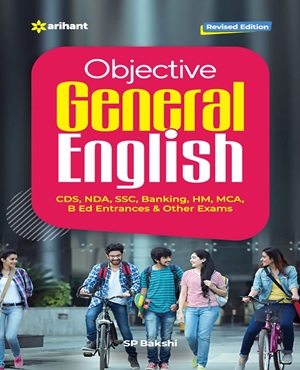
Objective General English by S.P. Bakshi: Excellent for mastering the grammatical part-of-speech rules and more. Its chapters on “Double Fillers” are highly structured.
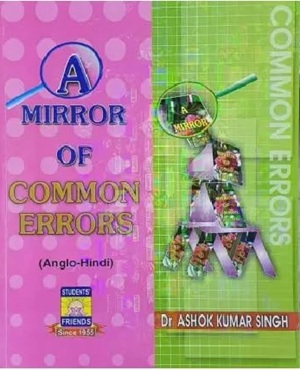
A Mirror of Common Errors by Dr Ashok Kumar Singh: Great for understanding complex sentence structures, helping you easily identify transition clauses and modifiers.
For those who want to appear in any Bank & IBPS PO and Clerk exams, check out these Banking English Books.
Final Thoughts
Double Fillers may appear difficult at first, but they become much easier with the 2-Way Filter Strategy:
- Check the grammar.
- Check the context and tone.
This simple process helps you quickly eliminate incorrect options, improves your accuracy, and saves valuable time during the exam.
Like any other English topic, success comes with regular practice. Solve a few Double Filler questions every day, build your vocabulary, strengthen your grammar, and review your mistakes carefully. Over time, you’ll notice that questions which once seemed confusing become straightforward and predictable.
Whether you’re preparing for SBI PO, SBI Clerk, IBPS PO, IBPS Clerk, or other competitive exams, the recommended books are valuable resources for the English Language section.
Keep practising, trust the process, and let logic—not guesswork—guide your answers.