Writing catchy English captions for Instagram and YouTube is an essential skill for students, content creators, and digital marketers. A well-written caption not only grabs attention but also improves engagement, boosts reach, and helps your content rank better in search results.
Whether you are posting a 60-second YouTube Short or an Instagram Reel, your caption is just as important as your video. It tells the algorithm what your content is about and tells the viewer why they should care.
Drawing from 15+ years of teaching English and extensive experience in digital content writing, here is the 99Learners guide to mastering the art of web captions for social media, blogs and websites.
If you want to improve your English writing skills while growing your social media presence, this step-by-step guide will help you create captions that attract viewers and keep them engaged.
1. The Power of the “Hook”
The first line of your caption is the only thing users see before they have to click “more.” You have about 2 seconds to grab their attention.
The Boring Way: “Here is a video about English grammar.”
The Catchy Way: “Stop making this embarrassing grammar mistake in your emails!”
The Rule: Start with a question, a shocking fact, or a direct benefit to the reader.
2. Use “Power Words” in Captions to Spark Emotion
In the world of SEO and digital marketing, certain words are known to trigger curiosity or action. Use these to make your English sound more dynamic:
Instead of “Good,” use: Essential, Masterclass, Proven, Ultimate.
Instead of “Easy,” use: Effortless, Instant, Simple, Hack.
Instead of “Look,” use: Discover, Uncover, Reveal.
3. The K.I.S.S. Principle (Keep It Simple, Student!)
Web writing is different from academic writing. Online, people “scan” text rather than reading every word.
Break it up: Use short sentences and frequent line breaks.
Use Bullet Points: Like the ones in this article!
Avoid Jargon: Don’t use “linguistic nuances” when you can say “language tips.”
4. Master the “Call to Action” (CTA) for Your Caption
A caption without a CTA is a wasted opportunity. You must tell your audience exactly what to do next.
For Engagement: “Which tip was your favourite? Let me know in the comments!”
For Traffic: “Check out the full guide at the link in my bio!”
For Community: “Join our WhatsApp group for more daily English tips!”
5. The “Visual Grammar” of Emojis
Emojis aren’t just for fun; they act as “visual punctuation.” They help set the tone of your English.
Professional/Educational: Use 📚, ✍️, or 💡.
Exciting/New: Use 🚀, ⚡, or 🔥.
Warning/Mistakes: Use ⚠️ or ❌.
Pro-Tip: Don’t overdo it. One or two emojis per paragraph is usually enough to keep it professional yet modern.
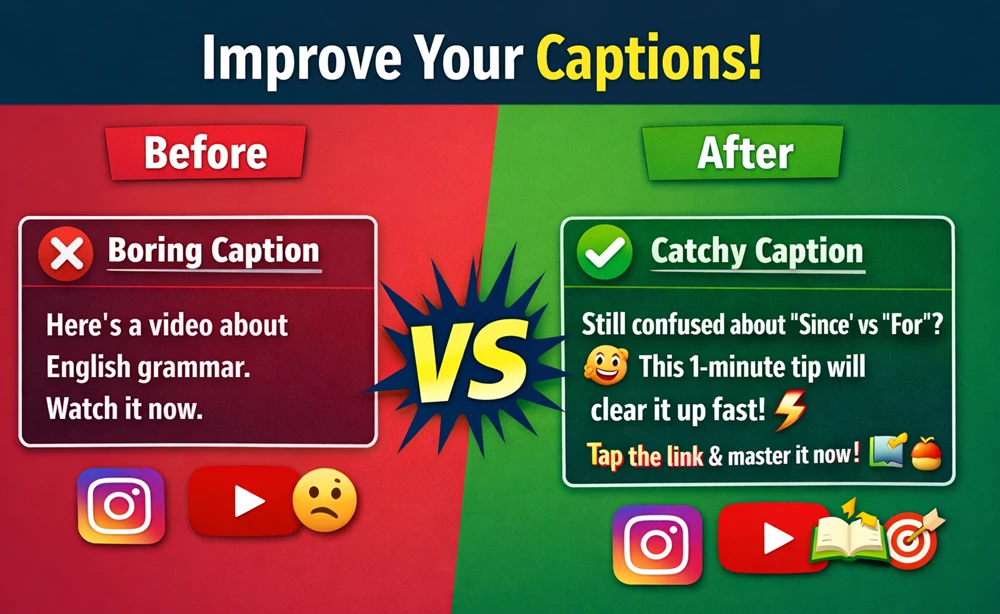
Examples of Catchy English Captions: Before & After
Topic: A video about “Since vs. For”
Before (Boring): “I made a video about since and for. Watch it on my channel, 99Learners. It is very helpful for students.”
After (Catchy): “Still confused about ‘Since’ vs ‘For’? 🧐 You aren’t alone! This 1-minute breakdown clears the confusion forever. ⚡ Click the link in bio to master this IELTS essential! 📚 #99Learners #EnglishGrammar”
Final Thoughts: Don’t Just Post—Write Captions That Convert
Most people focus only on the video—but the real magic is often in the caption.
A strong hook stops the scroll.
Simple words keep people reading.
And a clear CTA drives action.
If you want more views, likes, and engagement, start treating your captions like a powerful tool—not an afterthought.
⚡ Try this today: Rewrite your last caption using these tips—and watch the difference.