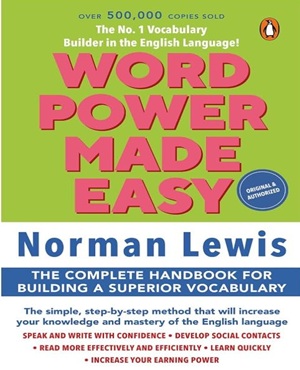
Building a large English vocabulary can be difficult when every unfamiliar word is treated as a separate item to memorise. The key to overcoming this issue lies in etymology—the study of word origins. In his classic work, Word Power Made Easy, Norman Lewis demonstrates that English vocabulary is not a chaotic collection of tens of thousands of random words. Instead, it is built on a structured framework of Latin and Greek roots, prefixes, and suffixes.
Root words, or roots, are the most basic building blocks of a word. They carry the primary meaning, and we add prefixes or suffixes to change their tense, meaning, or part of speech.
For example, dict is a root word meaning “to speak” or “to say”. Add the prefix pre- (before) to it → Predict. Now, it means “to say what will happen before it does”.
Learning common Latin and Greek roots like that can help you recognise patterns shared by many English words. So, instead of memorising every unfamiliar word in isolation, learn roots, prefixes, suffixes, and the surrounding context to make an educated guess about its meaning. This way helps you learn vocabulary easily.
Note: This article explains the root-word learning approach discussed in Norman Lewis’s Word Power Made Easy. It is our own educational guide and is not affiliated with or endorsed by the author or publisher of the book.
How to Learn English Vocabulary with Root Words
1. The Math of Root-Based Learning: Multiplication vs. Addition
Traditional memorisation works on addition like this:
Learn 1 word → Gain 1 word.
Etymological learning works on multiplication:
Learn 1 root → Unlock several related words.
Consider the Greek root ORTHOS (meaning straight, correct, or right):
                                  ┌──► ORTHODONTIST  (orthos + odontos = straight teeth)
                                  │
                                  ├──► ORTHOPEDIST   (orthos + paideia = correction of physical deformities, particularly in children)
     ROOT: "ORTHOS"               │
     (Straight / Correct)  ───────┼──► ORTHOGRAPHY   (orthos + graphein = correct spelling/writing)
                                  │
                                  ├──► ORTHODOX      (orthos + doxa = straight/correct opinion or belief)
                                  │
                                  └──► ORTHOGONAL    (orthos + gonia = straight/right angle)
If you encounter an unseen word like Orthography in an SSC CGL sentence completion question, you do not need to have seen the word before. Recognising ORTHOS (straight/correct) and GRAPH (write) allows you to immediately deduce that it relates to correct writing or spelling.
In this way, you can infer the meanings of several difficult words by learning their roots.
Important: Root Words Are Clues, Not Guarantees
Root-based learning can help you make an educated guess about an unfamiliar word, especially by combining the root with prefixes, suffixes and sentence context. However, remember etymology does not always give the modern meaning directly. When the accurate meaning of a word matters, confirm it with a reliable dictionary.
2. Deep Dive: 5 Root Systems Used in Word Power Made Easy
Now, let’s learn five classic root families highlighted in Word Power Made Easy and see how single roots branch out into many common vocabulary used in daily English and asked in exams:
1. VERT / VERS (Latin: to turn)
Introvert: (intro = inside + vert = to turn) → One whose thoughts are turned inward.
Example: As an introvert, Rahul prefers reading alone rather than attending large parties.
Extrovert: (extro = outside + vert = to turn) → One whose thoughts are turned outward.
Example: Maya is an extrovert who can start a conversation with almost anyone.
Ambivert: (ambi = both + vert = to turn) → One who turns both inward and outward (balanced personality).
Example: An ambivert may enjoy social gatherings but also need plenty of time alone.
Avert: (a- = away + vert = to turn) → To turn away; to prevent a disaster.
Example: The driver managed to avert a serious accident by braking quickly.
Adversity: (ad- = toward + vers = turned against) → Difficulties, misfortune, or unfavourable conditions.
Example: She remained confident even during periods of great adversity.
Inadvertent: (in- = not + ad- = toward + vert = turning) → Not turning attention to; accidental or unintentional.
Example: His inadvertent remark offended several people in the meeting.
2. DIC / DICT (Latin: to say, speak, or assert)
Predict: (pre- = before + dict = to say) → To say or tell beforehand.
Example: Experts predict that demand for electric vehicles will continue to grow.
Contradict: (contra- = against + dict = to say) → To speak against or assert the opposite.
Example: The witness’s second statement appeared to contradict his earlier claim.
Dictator: (dict = to speak/command + -or = person) → A ruler with total power whose word is absolute law.
Example: The dictator suppressed opposition and refused to hold free elections.
Vindictive: (vim = force + dicere = to assert/proclaim) → Having or showing a strong desire for revenge.
Example: She fired him for a petty, vindictive reason.
Jurisdiction: (juris = law/right + dict = to speak/proclaim) → The official power to make legal decisions and judgments.
Example: The case falls under the jurisdiction of the state court.
3. MAL (Latin: bad, evil, or ill)
Malevolent: (mal = evil + vol = to wish) → Wishing evil or harm onto others.
Example: The villain had a malevolent expression that frightened everyone.
Malicious: (mal = bad) → Characterised by malice; intending to do harm.
Example: The company took action against the employee for making malicious accusations.
Malady: (mal = bad) → A disease or ailment.
Example: The doctor searched for a treatment for the mysterious malady.
Malfeasance: (mal = bad + faire = to do) → Wrongdoing or misconduct, especially by a public official.
Example: The investigation uncovered financial malfeasance within the department.
Malignant: (mal = bad + genus = birth/kind) → Infectious, harmful, or cancerous growth.
Example: The biopsy confirmed that the tumour was malignant.
4. CHRONOS (Greek: time)
Chronic: (chronos = time) → Continuing for a long time (e.g., a chronic illness).
Example: The region has been struggling with chronic water shortages.
Chronological: (chronos = time + logos = order/study) → Arranged in the order of time occurrence.
Example: The biography presents the author’s life in chronological order.
Anachronism: (ana- = against/backwards + chronos = time) → Something located in a time period where it does not belong.
Example: The movie contained an obvious anachronism when a modern device appeared in an ancient setting.
Synchronise: (syn- = together/same + chronos = time) → To cause to occur or operate at the exact same time.
Example: Please synchronise your phone with your computer before transferring the files.
5. LOQU / LOCUT (Latin: to speak or talk)
Loquacious: (loqu = talk + -ious = full of) → Extremely talkative; wordy.
Example: The loquacious student continued talking long after the class had ended.
Eloquent: (e- = out + loqu = speak) → Fluent, persuasive, and expressive in speaking or writing.
Example: She gave an eloquent speech about the importance of education.
Grandiloquent: (grandis = grand/large + loqu = speak) → Pompous or extravagant in language style.
Example: His grandiloquent speech impressed some listeners but confused others.
Soliloquy: (solus = alone + loqu = speak) → An act of speaking one’s thoughts aloud when by oneself (especially in drama).
Example: In the final scene, the hero delivers a powerful soliloquy about his lost friend.
Circumlocution: (circum = around + locut = speak) → Talking around a subject; using unnecessary words to express an idea evasively.
Example: Instead of answering the question directly, he used circumlocution to avoid giving a clear response.
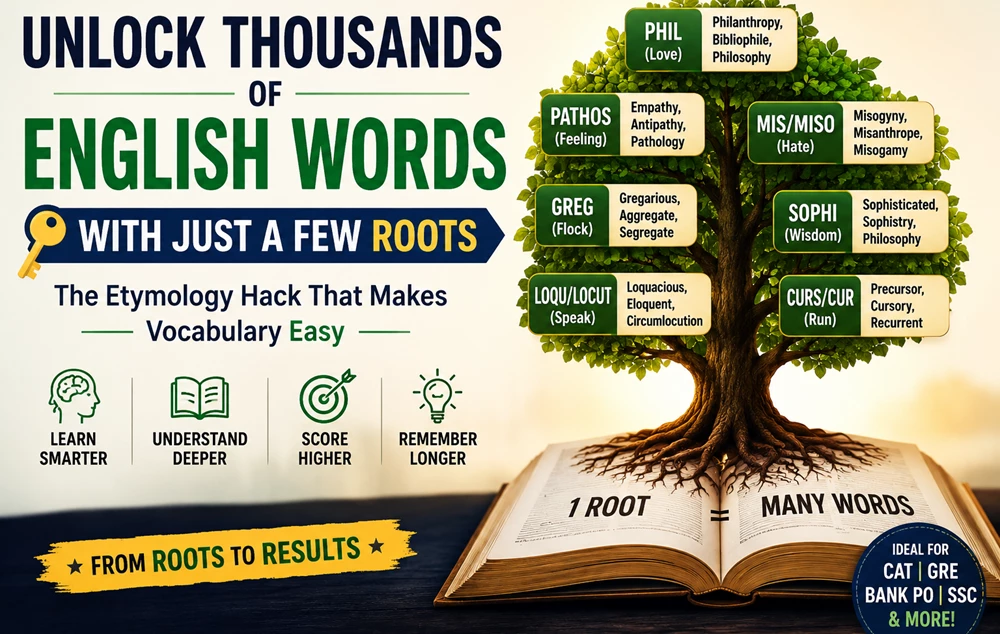
3. High-Yield Root Summary Matrix
Learn more roots used in the most common words asked in competitive exams:
| Root | Language | Core Meaning | Exam Word Examples | Quick Decipher Key |
|---|---|---|---|---|
| PHIL | Greek | Love | Philanthropy, Bibliophile, Philosophy | “Love of…” |
| PATHOS | Greek | Feeling / Suffering | Empathy, Antipathy, Apathy, Pathology | “State of feeling” |
| MIS / MISO | Greek | Hate | Misogyny, Misanthrope, Misogamy | “Hatred toward” |
| GREG | Latin | Herd / Flock | Gregarious, Segregate, Aggregate, Egregious | “Group / Gathering” |
| SOPHI | Greek | Wisdom | Sophisticated, Sophistry, Philosophy | “Wisdom or knowledge” |
| CURS / CUR | Latin | Run | Precursor, Cursory, Incursion, Recurrent | “Running motion” |
Want to learn more? ⇒ 10 Root Words to Decode 100+ SSC Vocab Words
4. How to Apply the Etymology Hack in Mock Tests
When faced with an unseen word in a Reading Comprehension passage, Synonyms/Antonyms question, or Sentence Completion task, follow this 3-step root elimination protocol:
               STEP-BY-STEP ROOT ELIMINATION PROTOCOL

  Step 1: Isolate the Prefix/Suffix ──► Strip "IN-", "CON-", "-OUS", "-ITY"
                                                    │
                                                    ▼
  Step 2: Identify the Base Root    ──► Spot "CIDE" (kill), "SPECT" (look)
                                                    │
                                                    ▼
  Step 3: Apply Contextual Tone     ──► Combine Root Meaning + Sentence Tone (+/-)
Exam-Style Example:
Question: Select the word most SIMILAR in meaning to PERSPICACIOUS.
(a) Gullible (b) Insightful (c) Stubborn (d) Unpredictable
Deconstruct the word:
PER- = through
SPEC / SPIC = to look or see (as in inspect, spectacle, introspect)
-ACIOUS = inclined to / full of
Synthesise the meaning: “Able to see through things clearly.”
Select option: (b) Insightful (having the ability to see deeply into a situation).
Practice Drill: Test Your Root Decoding Skills
Directions: Use your knowledge of root words to answer the following exam-style questions without using a dictionary:
Q1. A person described as a “MISANTHROPE” is someone who:
(a) Collects rare postage stamps
(b) Dislikes and distrusts mankind in general
(c) Loves spending time with domestic animals
(d) Spends money recklessly on luxuries
Q2. The doctor referred the patient to a specialist after diagnosing an “AUTONOMOUS” nervous system response. What does “AUTO” mean in this context?
(a) Automatic
(b) External
(c) Self / Independent
(d) Rapid
Q3. What is the literal etymological meaning of the word “BENEVOLENT”?
(a) Speaking kindly
(b) Wishing well / Wishing good
(c) Doing work quickly
(d) Giving money freely
Q4. A person described as GREGARIOUS is someone who:
(a) Prefers to avoid all social interaction
(b) Enjoys the company of others and tends to form groups
(c) Frequently changes opinions
(d) Has exceptional knowledge of history
Q5. If someone is described as ELOQUENT, which meaning best fits the word?
(a) Able to speak or write fluently and persuasively
(b) Unable to express ideas clearly
(c) Likely to speak without thinking
(d) Extremely unwilling to communicate
Practice Drill Explanations
Q1 Answer: (b) Dislikes and distrusts mankind in general.
Root breakdown: MISO (hate) + ANTHROPOS (mankind/human).
Q2 Answer: (c) Self / Independent.
Root breakdown: AUTO (self) + NOMOS (law/rule). An autonomous system acts independently by its own internal laws.
Q3 Answer: (b) Wishing well / Wishing good.
Root breakdown: BENE (well/good) + VOL (to wish/will). (Contrast with Malevolent = wishing evil).
Q4 Answer: (b) Enjoys the company of others and tends to form groups.
Root breakdown: GREG (flock / herd) → gregarious refers to someone who enjoys being with other people or living in groups.
Q5 Answer: (a) Able to speak or write fluently and persuasively.
Root breakdown: LOQU (to speak) → eloquent describes someone who expresses ideas clearly, fluently, and persuasively.
Word Power Made Easy by Norman Lewis is a popular guide among competitive exam aspirants and students who want to expand their English vocabulary easily. If you have not yet read it, buy a copy of the latest edition for more root-based learning.
This book is suitable for intermediate and advanced students and exam aspirants.
For distraction-free learning, I recommend reading the physical book instead of the Kindle or eBook edition.