
In competitive exams like Bank PO (SBI/IBPS), SSC CGL, NDA/CDS, and OMETs (SNAP/NMAT), grammar and cloze test sections frequently test Phrasal Verbs. When preparing for exams, candidates often memorise the base verb (such as look, break, or pass) but overlook the accompanying preposition (such as in, up, or through).
Changing a single particle completely alters the meaning of a phrasal verb. So, in exam questions, a “Preposition Shift” trap is used to trigger mistakes (that turn into a wrong answer).
Here, “particle” refers to the short word that combines with the main verb and changes its meaning, such as up, down, off, out, or into.
Why do phrasal verbs cause so many mistakes?
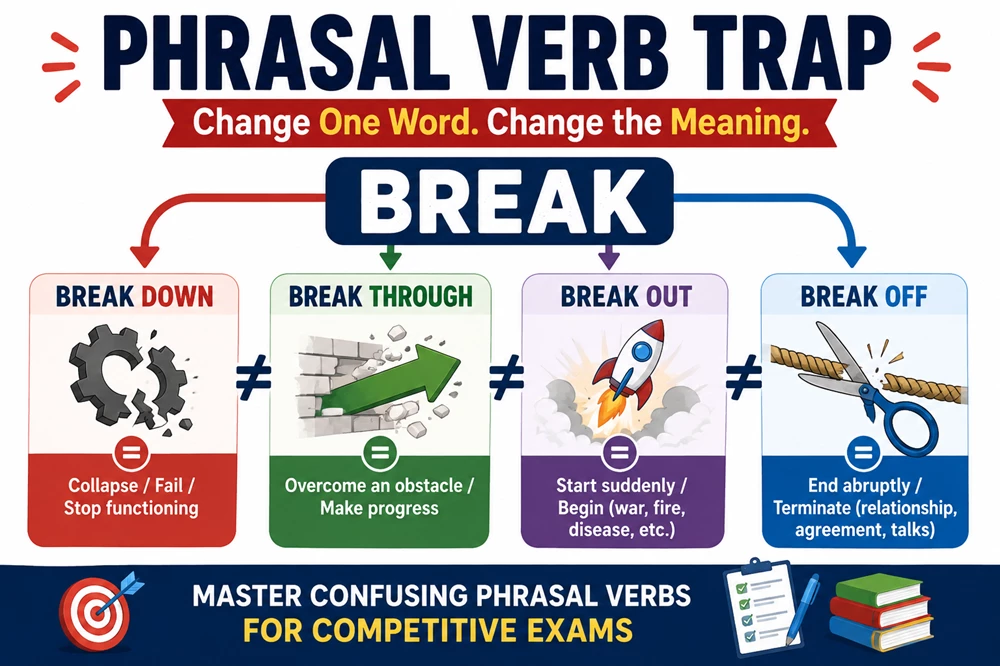
A small change in the particle can completely change the meaning of a phrasal verb. For example, “break down” can mean fail or collapse, while “break through” means overcome an obstacle or achieve a breakthrough. Learning these differences is necessary and especially useful in cloze tests, error-spotting questions, and vocabulary sections of competitive exams.
In this guide, you’ll learn 25+ commonly confused phrasal verbs, with meanings, examples, exam-style questions, and explanations. Although focused on exam preparation, they are useful to learn for day-to-day use for general learners.
Table of Contents
The Preposition Shift: Master Phrasal Verbs in Exams
Understanding the Mechanics of a Preposition Shift
As said before, a phrasal verb consists of a Base Verb + Particle (Preposition/Adverb). While the base verb indicates an action, the preposition after it dictates the directional logic or figurative meaning. See how a preposition change after the verb ‘BREAK’ changes the meaning of the phrasal verb:
THE PREPOSITION SHIFT MATRIX
| Base Verb | Phrasal Verb | Meaning |
|---|---|---|
| BREAK | Break down | Stop functioning or lose emotional control; also, a process such as negotiations can fail or collapse. |
| Break through | Overcome an obstacle or make a major discovery. | |
| Break out | Start suddenly, especially a war, epidemic, fire, or riot. | |
| Break off | Abruptly end a relationship, agreement, or discussion. |
1. High-Frequency Phrasal Verb Clusters
The “BREAK” Cluster
Break down: To stop functioning (mechanically) or to lose emotional control.
Context: “The negotiation broke down due to uncompromising demands from both sides.”
Break through: To overcome an obstacle or make a major discovery.
Context: “Scientists hope to break through in cancer treatment research this year.”
Break out: To start suddenly (used for wars, epidemics, fires, or riots).
Context: “A fire broke out in the warehouse late last night.”
Break off: To abruptly end a relationship, agreement, or discussion.
Context: “The country decided to break off diplomatic ties with its neighbour.”
Quick memory tip: Down = collapse, through = overcome, out = start suddenly, off = end.
The “LOOK” Cluster
Look into: To investigate or examine a matter.
Context: “The committee will look into the allegations of financial fraud.”
Look up to: To admire or respect someone.
Context: “Junior associates always look up to the senior partner for guidance.”
Look down on / upon: To consider someone inferior or treat them with contempt.
Context: “It is wrong to look down on people based on their economic background.”
Look over: To quickly inspect, review, or scan a document.
Context: “Please look over the contract terms before signing the agreement.”
Quick memory tip: Into = investigate, up = admire, down = look with contempt, over = inspect.
The “PASS” Cluster
Pass away: To die (used euphemistically).
Context: “His grandfather passed away peacefully in his sleep.”
Pass out: To lose consciousness / faint; or to distribute items.
Context: “Two marathon runners passed out due to severe dehydration.”
Pass off (as): To falsely represent something or pretend to be someone else.
Context: “The fraudster tried to pass off counterfeit notes as genuine currency.”
Pass up: To decline or forgo an opportunity.
Context: “She could not pass up the chance to study at Oxford on a full scholarship.”
Quick memory tip: Away = die, out = faint/distribute, off = falsely present, up = decline an opportunity.
The “CALL” Cluster
Call off: To cancel an event or planned activity.
Context: “The match was called off due to torrential rain.”
Call on / upon: To formally ask or request someone to do something; or to visit briefly.
Context: “The chairperson called on the treasurer to present the financial audit.”
Call for: To demand, require, or necessitate a specific action.
Context: “The current crisis calls for immediate legislative intervention.”
Call up: To summon for military service, or to recollect/telephone someone.
Context: “The military council called up reservists during the border conflict.”
Quick memory tip: Off = cancel, on = request, for = require, up = summon/contact.
2. Preposition Shift Comparison Matrix
See more phrasal verbs and how their meaning changes when they are followed by different prepositions. Try to use them in your own sentences:
| Base Verb | Phrasal Verb | Exam Meaning |
|---|---|---|
| GIVE | Give in | Yield or surrender under pressure |
| Give up | Abandon hope or cease an attempt | |
| Give away | Reveal a secret or distribute for free | |
| RUN | Run into | Meet unexpectedly or encounter problems |
| Run over | Hit with a vehicle or rehearse quickly | |
| Run out of | Exhaust the supply of a resource | |
| TURN | Turn down | Reject an offer or reduce volume |
| Turn out | Prove to be, produce, or attend an event | |
| Turn over | Transfer control or generate revenue |
3. How You Are Tested with Preposition Shifts in Exams
Case 1: Fillers in Bank PO Cloze Tests
Exam-setters will leave the base verb intact and force you to choose between four prepositions based strictly on paragraph context. See this example question:
“The diplomatic talks between the foreign ministers broke _____ after four hours of intense debate over border security.”
(a) out (b) through (c) down (d) off
Analysis: While “off” implies ending a relationship, the context of an active session failing mid-discussion needs “down” (broke down = collapsed/failed).
Case 2: Error Spotting in SSC CGL / NDA
Exam-setters deliberately pair a correct verb with the wrong preposition, as in the following example question:
“The regulatory body decided to look over (A) / the structural corruption charges (B) / raised by the whistleblowers. (C) / No Error (D)”
Analysis: The error is in Part A. “Look over” means to examine or review something quickly. But the sentence refers to investigating allegations, so “look into” should be used instead.
Question Practice Drill
Q1. Realizing that the evidence was overwhelming, the suspect finally ________ and confessed to the crime.
(a) gave away
(b) gave in
(c) gave out
(d) gave up
Q2. The board of directors decided to ________ the acquisition proposal due to valuation concerns.
(a) turn down
(b) turn out
(c) turn over
(d) turn off
Q3. While reorganizing the attic, she unexpectedly ________ some rare historical manuscripts belonging to her great-grandfather.
(a) ran over
(b) ran into
(c) came across
(d) came through
Q4. Urgent economic reforms are ________ to stabilize the plummeting national currency.
(a) called off
(b) called up
(c) called for
(d) called on
Practice Drill Explanations
Q1 Answer: (b) gave in. Context means surrendering under pressure. Gave away means revealing a secret; gave up means quitting an effort entirely.
Q2 Answer: (a) turn down. Context indicates rejecting a business proposal. Turn out means result/attend; turn over means generate revenue or hand control.
Q3 Answer: (c) came across. Means finding something by chance. Ran into is used for meeting people or encountering obstacles.
Q4 Answer: (c) called for. Context demands or necessitates an action. Called off means cancelled.
Exam Challenge
Directions: In each sentence, one phrasal verb is used incorrectly. Choose the option that correctly replaces the bold phrasal verb according to the context.
Q5. The negotiations had broken through after both sides refused to compromise.
(a) broken down
(b) broken out
(c) broken off
(d) broken up
Q6. The investigating committee promised to look over the allegations against the company.
(a) look up to
(b) look into
(c) look down on
(d) look out
Q7. Although she had worked hard for the promotion, she decided to pass away the opportunity.
(a) pass out
(b) pass off
(c) pass up
(d) pass through
Q8. Because of the sudden storm, the organisers had to call for the outdoor event.
(a) call up
(b) call on
(c) call off
(d) call in
Q9. The company decided to give away after several months of heavy losses.
(a) give in
(b) give up
(c) give out
(d) give over
Q10. The factory ran into fuel after the delivery was delayed for two weeks.
(a) ran over
(b) ran out of
(c) ran through
(d) ran across
Exam Challenge Explanations:
Q5. Answer: (a) broken down. “Break down” means a process (such as negotiations) fails or collapses. Here, the negotiations failed because neither side would compromise.
Q6. Answer: (b) look into. “Look into” means to investigate or examine a matter carefully. The committee is investigating the allegations.
Q7. Answer: (c) pass up. “Pass up” means to decline or forgo an opportunity. Here, she decided not to accept the promotion.
Q8. Answer: (c) call off. “Call off” means to cancel an event or planned activity. The storm caused the organisers to cancel the event.
Q9. Answer: (b) give up. “Give up” means to abandon an attempt or stop trying. Here, the company decided to stop its efforts after continued losses.
Q10. Answer: (b) ran out of. “Run out of” means to exhaust the supply of something. The factory had no fuel left because the delivery was delayed.
Common Exam Trap:
Don’t choose a phrasal verb merely because it sounds familiar. First identify the meaning required by the sentence, then choose the particle.
Quick Revision with Memory Cue
| Phrasal Verb | Quick Meaning | Memory Cue |
|---|---|---|
| Break down | Fail, collapse, or stop functioning | Down = collapse |
| Break through | Overcome an obstacle; make a discovery | Through = get past |
| Break out | Start suddenly | Out = sudden start |
| Break off | End a relationship, agreement, or discussion | Off = end |
| Look into | Investigate or examine | Into = investigate |
| Look up to | Admire or respect | Up = admire |
| Look down on | Treat as inferior | Down = contempt |
| Look over | Quickly inspect or review | Over = scan |
| Pass away | Die | Away = depart |
| Pass out | Faint; distribute | Out = unconscious / distribute |
| Pass off (as) | Falsely present or represent | Off = pretend |
| Pass up | Decline an opportunity | Up = opportunity rejected |
| Call off | Cancel | Off = cancel |
| Call on / upon | Formally ask or request | On = ask |
| Call for | Demand or require | For = require |
| Call up | Summon; telephone; recollect | Up = summon/contact |
| Give in | Yield or surrender under pressure | In = yield |
| Give up | Abandon or stop trying | Up = quit |
| Give away | Reveal or distribute | Away = give/reveal |
| Run into | Meet unexpectedly; encounter a problem | Into = encounter |
| Run over | Hit with a vehicle; rehearse quickly | Over = across |
| Run out of | Exhaust a supply | Out of = none left |
| Turn down | Reject; reduce volume | Down = reduce/reject |
| Turn out | Prove to be; produce; attend | Out = result/appear |
| Turn over | Transfer control; generate revenue | Over = transfer/produce |
Do you want to test your knowledge? → Try this simple Phrasal Verbs Quiz
Contact us if you have any suggestions or improvements.